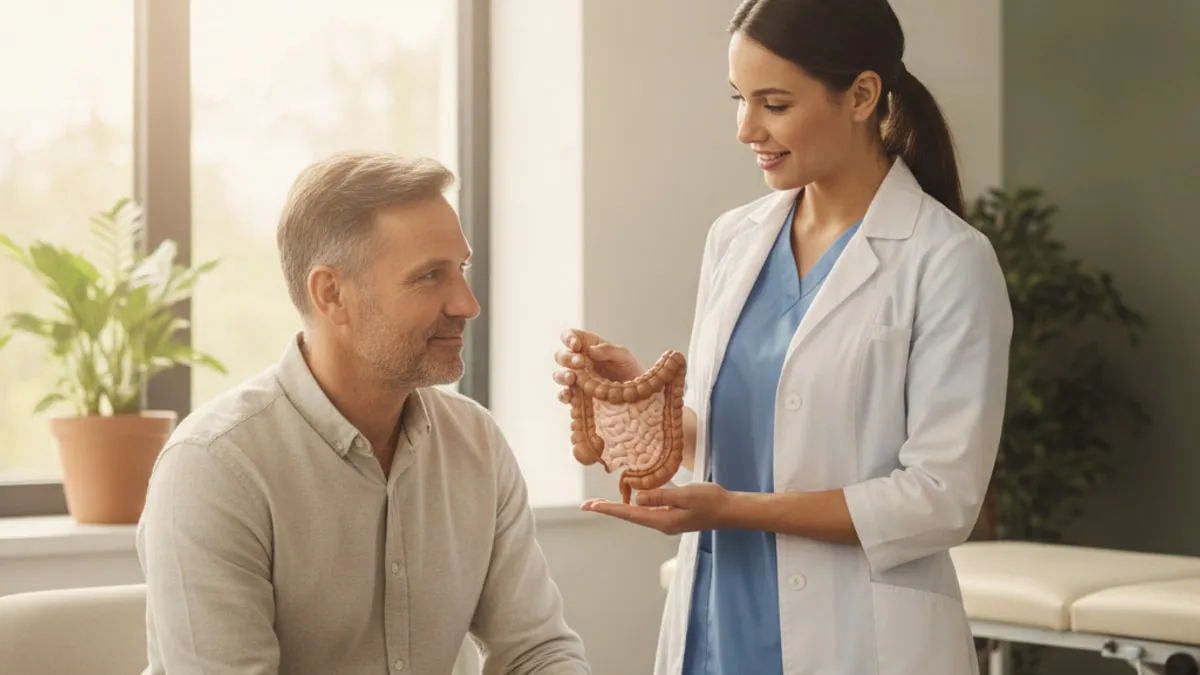
Colonoscopy: Prep, the Procedure and Screening Age
Severe belly pain, fever or heavy bleeding in the hours or days after a colonoscopy needs emergency care. Call 911 or go to the emergency department.
What happens while the scope is inside?
A colonoscopy is a direct visual examination of the lining of the large bowel using a long, flexible tube with a camera and a light at its tip. Once sedation has been given by the care team, the endoscopist passes the scope through the rectum and advances it around the curves of the colon, usually as far as the cecum, where the small bowel joins the large bowel. Gas is used to open the folds of the bowel wall so the surface can be seen, and water is used to rinse away anything left behind.
The part that takes real time is the way back out. Going in is navigation. Coming out is inspection, with the endoscopist flattening folds, re-examining bends and looking behind the valves of the colon, because lesions hide on the far side of a fold rather than in the open.
Anything found can often be handled in the same sitting. A small polyp can be removed, a sample of the lining can be taken, and a site can be marked so it is easy to find again later. Each of those steps adds minutes, which is why two people booked for the same slot length can have very different procedure times.
So when a unit quotes a time, ask what the number covers. Scope in to scope out is one figure. The figure that matters for planning your day includes check in, getting ready and recovery, and it is considerably longer.
Why does the way out set the clock?
Because inspection is measured in minutes spent looking, not in speed. Quality indicator guidance for colonoscopy describes a minimum average withdrawal time of six minutes in an intact colon when nothing has been removed 1. Reaching the cecum and documenting it with images is a separate measure used to judge whether the examination was complete 2.
That has a practical meaning for the person on the table. A fast procedure is not automatically a better one, and the slow, deliberate second look on withdrawal is where polyps are picked up. If your report mentions withdrawal time or cecal intubation, those lines are describing how thorough the look was, not how efficient the appointment felt.
Bowel cleanliness feeds straight into the same clock. When residue is left in the colon, the endoscopist spends procedure time washing and suctioning before the lining can be judged, and some segments still cannot be assessed properly. Consensus recommendations on optimizing bowel preparation quality describe inadequate preparation as a problem that compromises the examination and can lead to it being repeated sooner than planned 3.
In other words, the effort you put into the prep the day before is partly an investment in a shorter, cleaner procedure. A well cleaned colon lets the endoscopist spend the time on looking rather than on clearing the view.
How much of the day should you set aside?
Plan on most of a morning or most of an afternoon, not an hour. The procedure sits inside a longer sequence of registration, preparation, sedation and monitored recovery, and the facility will not discharge you until the care team is satisfied.
| Stage of the day | What is happening | Rough time to allow |
|---|---|---|
| Check in | Registration, consent, confirming the prep went to plan | 15 to 30 minutes |
| Getting ready | Changing, vital signs, an intravenous line, a short conversation with the endoscopist and the person giving sedation | 30 to 60 minutes |
| The procedure | Scope in to scope out, including anything sampled or removed | often 20 to 45 minutes |
| Recovery area | Waking up, monitoring, passing the gas used during the examination | 30 to 60 minutes |
| Discharge | Preliminary findings, written instructions, handover to the person taking you home | 15 to 30 minutes |
These are rough planning figures rather than a timetable. The arrival time on your letter and the endoscopy unit's own estimate are the numbers to plan around, and lists run late for reasons that have nothing to do with you.
Two extra commitments belong in the same plan. You will need an adult to take you home, because sedation rules out driving for the rest of the day. And the evening before is effectively booked by the prep, so the appointment really occupies two parts of two days.
Does the prep take longer than the procedure?
Yes, by a wide margin. The bowel preparation is the long pole in this tent, and it starts before the day of the examination rather than the night before.
European guidance on bowel preparation for colonoscopy describes a low residue way of eating on the day before the examination, a period of clear liquids, and dividing the cleansing preparation between the evening before and the morning of the procedure 4. Consensus recommendations on optimizing preparation quality describe the same divided approach as central to achieving a clean colon 3.
In lived time, that means an evening spent close to a bathroom, interrupted sleep, and an early start to finish the second part of the preparation. It is uncomfortable, it is tedious, and it is the step that determines whether the examination can be read properly.
The cleansing itself works by moving a large volume of fluid through the colon quickly, which is why the instructions insist on drinking the preparation on a schedule and keeping up with clear fluids alongside it. Follow the written instructions your unit gives you. They are specific to the preparation they have chosen and to your appointment time, and they override anything general you read.
What does eating look like in the days before?
For most of the week nothing changes, and then eating narrows in stages: lower residue food, then clear liquids only, then nothing by mouth for a defined window before sedation. The point of the narrowing is simple. Fibre and residue leave material behind on the bowel wall, and material on the bowel wall is exactly what hides the lining.
| Timing | What preparation guidance generally describes | Practical notes |
|---|---|---|
| Two to three days before | Easing off nuts, seeds, popcorn, raw vegetables, skins and whole grains | Some units ask for this only before a repeat or more difficult examination |
| The day before | A low residue way of eating, lighter and much lower in fibre, with a cut off time for solid food | Residue left in the colon is what blocks the view |
| Later the day before and the morning of | Clear liquids only, meaning liquids you can see through | Anything red or purple can be mistaken for blood on the images |
| Around the preparation | The cleansing preparation split between the evening before and the morning of, finishing a set number of hours before the appointment | Use the unit's written instruction, not a general schedule |
The low residue stage and the clear liquid stage are both described in the European bowel preparation guidance as part of getting the colon clean 4. Clear liquids usually include water, clear broth, pulp free juice and plain tea or coffee without milk, though your unit sets its own list.
One item to sort out early rather than on prep day. Some medicines need to be adjusted or paused before a bowel examination, and some need to be kept going. Ask your prescriber about that in advance, and tell the unit what you take.
Does the timing of the last part of the prep matter?
It matters a great deal, and it is one of the few things fully in your control. Research suggests that a shorter interval between finishing the bowel preparation and the start of the colonoscopy is associated with better preparation quality and better examination outcomes 5.
That is the reasoning behind splitting the preparation rather than drinking all of it the evening before. European guidance on bowel preparation recommends the divided approach for that reason 4. If the whole preparation is finished at nine in the evening and the appointment is at two in the afternoon, fluid secreted overnight has had many hours to coat the colon again.
Practically, this means an afternoon appointment does not spare you an early morning. Afternoon lists usually still involve drinking the second part of the preparation hours before arrival. It also means that pushing the second part later because it is unpleasant can quietly undermine the examination you have already given up a day for.
If you are told the preparation was inadequate, that is worth taking seriously rather than filing away. The clinician decides whether a repeat is needed and how soon, and a shorter interval next time is often part of the conversation.
What makes one appointment run longer than another?
Anatomy, cleanliness and findings account for most of the variation. A long or looping colon takes more manoeuvring to navigate. Previous abdominal or pelvic surgery can leave adhesions that make the path less forgiving. Residue in the colon adds washing time. And every polyp removed or sample taken adds minutes.
Sedation plays a part too. Lighter sedation can mean pausing for comfort, while deeper sedation adds monitoring time before and after. The unit's staffing and list order shift your waiting time without changing the procedure itself.
Who holds the scope is also part of the picture. Studies suggest that a higher annual colonoscopy volume by the endoscopist is associated with better quality measures 6. Research suggests that colonoscopy quality measures also differ according to the specialty of the endoscopist 7.
None of that means you should shop for the fastest operator. The useful questions before a booking are about completeness rather than speed: whether the unit audits its own quality measures, and what happens if the preparation turns out to be inadequate on the day. Those answers tell you more about the examination you will get than the minutes printed on the schedule.
How long does the sedation take to wear off?
Sedation is monitored in the recovery area until the care team judges you awake, stable and safe to leave, and the rest of the day is then spent at reduced capacity. The team decides when you are ready to go, not the clock on the wall.
Grogginess, patchy memory of the procedure and a hazy few hours afterwards are common, and that is why someone has to take you home. Most units will not discharge a sedated patient to a taxi alone. Driving, operating machinery, signing anything that matters and drinking alcohol are all off the table for the remainder of the day.
Gas and cramping are also common in the first hours, because air or carbon dioxide was used to open the bowel during the examination. Walking around and passing that gas is part of recovery and staff will expect it. Eating usually restarts according to the instructions you are given, and those instructions change if a polyp was removed.
What is not routine is pain that is severe or getting worse, a rigid or swollen abdomen, fever or chills, heavy bleeding, repeated vomiting, or feeling faint. Those need emergency care. Call 911 or go to the emergency department.
When do results come back, and how soon is the next one due?
What the endoscopist saw is usually discussed on the day, often before you leave, while anything sent to the laboratory takes longer and the wait varies by laboratory and unit. Ask the unit how it returns laboratory reports and who will contact you, then track that rather than a calendar estimate.
The interval to the next examination depends on what was found. European guidance on surveillance after polyp removal sets intervals according to the number, size and microscopic features of the polyps removed 8. That is why two people leaving the same unit on the same morning can be given very different return dates.
For adults at average risk with a clean examination, the American Cancer Society's 2018 guideline update lists colonoscopy every ten years as one of the screening options 9. Your own interval may be shorter for reasons specific to you, including preparation quality, family history or an incomplete examination.
A result outside what the report describes as expected is worth discussing with a clinician, who decides what it reflects and what follows. Do not assume silence means everything was clear. If you have not heard back in the window the unit quoted, chase it.
At what age does screening usually begin?
For adults at average risk, the American Cancer Society's 2018 guideline update recommends starting regular colorectal cancer screening at age 45 9. The same guideline describes continuing regular screening through age 75, with decisions beyond that age individualized to the person 9.
Average risk is the key phrase. A personal or family history of colorectal cancer or certain polyps, some inherited conditions and some long standing bowel conditions all change the starting age and the interval, and that decision belongs to your clinician rather than to a general rule.
Family history is also where screening tends to leak. Research suggests that adherence to colonoscopy among relatives offered cascade screening is incomplete 10. If a first degree relative has had colorectal cancer, that is a conversation to have now rather than at 45.
One distinction worth holding onto. A colonoscopy done because of symptoms is a diagnostic examination, not screening, and its timing is set by the clinician assessing those symptoms. Age thresholds describe when to start looking in people without symptoms. They are not a reason to wait when something has changed.
What can go wrong afterwards, and what signs need urgent attention?
Colonoscopy is a common procedure with a low complication rate, and the main concerns are bleeding and perforation of the bowel wall. Research suggests that bleeding and perforation after colonoscopy are uncommon, and that rates are higher when a polyp has been removed 11.
Knowing the signs matters more than knowing the numbers, because complications can appear hours or days after you get home rather than in the recovery room. Light spotting or a small amount of blood after a polyp has been removed is something the unit will usually have warned you about in writing, and anything beyond what that sheet describes should be reported.
The following need emergency care. Call 911 or go to the emergency department.
- Severe or worsening abdominal pain, or an abdomen that becomes hard, swollen or tender to touch
- Fever or chills in the days after the procedure
- Heavy rectal bleeding, repeated bleeding, or passing large clots
- Persistent vomiting, or an inability to keep fluids down
- Chest pain, breathlessness, fainting or feeling close to fainting
These signs are not something to watch overnight and reassess in the morning. Take the discharge sheet with you so the emergency team can see exactly what was done.
Where does Hemoglobin fit into this?
Hemoglobin is the oxygen carrying protein in red blood cells, measured as part of a standard complete blood count. It enters this conversation because slow blood loss from the bowel can show up in routine bloodwork, which is one reason a clinician may review it when deciding whether a colonoscopy is warranted. The biomarker page covers what the marker measures, how the sample is taken, and what higher or lower results may reflect. FitScript's optimal range for Hemoglobin is 14 to 16 g/dL, and 12 to 15 g/dL for women, while your laboratory's own range appears as printed on your lab report. That optimal range is an optimization target, not a diagnostic cut off, and a value outside the printed range is worth discussing with a clinician, who decides what it reflects.
Which other markers are worth looking at alongside?
When bowel symptoms or an unexpected blood count prompt a referral, clinicians usually look at a cluster of markers rather than one. Iron studies, including ferritin, serum iron and transferrin saturation, describe iron availability and stores. Red cell indices from the complete blood count, such as mean cell volume and mean cell haemoglobin, describe the size and colour of the cells themselves. Platelet count and the white cell differential round out the picture.
General inflammation markers such as C reactive protein are sometimes included, and so are markers of nutrient status such as vitamin B12 and folate when the red cell indices point that way. None of these identifies a cause on its own. They describe a pattern, and the clinician decides what the pattern reflects and which examination, if any, follows.
This is the kind of panel that benefits from being read together and tracked over time rather than glanced at once. FitScript's membership includes 150+ biomarkers tested per year, interpreted by Atlas, the AI health advisor, with any next step decided by a licensed provider.
If a marker sits outside the range printed on your report, bring the report itself to the appointment. Trends across two or three draws are far more informative than a single value in isolation.
How does the time commitment compare with other bowel tests?
Colonoscopy asks for the most time and the most preparation of the common screening approaches, and in exchange it is the only one where a polyp found can be removed in the same sitting. The American Cancer Society's 2018 guideline update describes several acceptable options for average risk adults, including stool based tests and visual examinations of the colon 9.
| Approach | Preparation demand | Time on the day | If the result is abnormal |
|---|---|---|---|
| Colonoscopy | Diet changes and full bowel cleansing | Most of a morning or afternoon, plus a driver and a quiet rest of the day | Polyps can often be removed in the same appointment |
| Stool based testing at home | None | Minutes, at home | A colonoscopy is the follow up examination |
| Imaging based examination of the colon | Bowel cleansing and scan preparations | Shorter than colonoscopy, usually without sedation | A colonoscopy is the follow up examination |
| Flexible sigmoidoscopy | Limited preparation | Shorter, often without deep sedation | A fuller examination may follow |
The honest trade off is this. A shorter test on the day can mean a colonoscopy later anyway if the result is abnormal, and stool based tests have to be repeated on a much shorter cycle to keep working. The best option is the one you will actually complete on schedule, which is a conversation to have with your clinician rather than a calculation to do alone.
When is it worth talking to a clinician?
Book a conversation if you are approaching or past the age at which screening is recommended and have not started, or if you have a family history that might move that date forward. Also raise it promptly for rectal bleeding, a persistent change in bowel habit, unexplained weight loss, ongoing abdominal pain, or a low haemoglobin or ferritin found on bloodwork. A value outside the range printed on your report is worth discussing with a clinician, who decides what it reflects and whether any examination follows.
Bring the practical questions too. Whether an appointment should be morning or afternoon, how to handle the preparation if you struggle with large volumes of fluid, and what to do about medicines beforehand are all things your prescriber and the endoscopy unit can answer in advance.
This article is educational and is not medical advice. Discuss your results, your screening timing and any next step with a clinician or licensed provider, and remember that treatment decisions belong to a licensed provider who has reviewed your full picture.
If the days after a procedure or an illness leave you flat for longer than you expected, how long does fatigue last after illness covers what to watch and when to get it checked.
Key takeaways
- The scope portion is often roughly 20 to 45 minutes, but check in, sedation and monitored recovery make the appointment a half day commitment.
- The way out is where the time goes, and quality guidance sets a minimum average withdrawal time of six minutes in an intact colon with nothing removed 1.
- The preparation, not the procedure, is the long part: low residue eating, clear liquids, and the cleansing preparation divided across two sittings 4.
- A shorter gap between finishing the preparation and the procedure is associated with better preparation quality 5.
- Severe belly pain, fever or heavy bleeding afterwards needs emergency care. Call 911 or go to the emergency department.
References
- Quality indicators for colonoscopy. Gastrointestinal Endoscopy, 2024.
- Colonoscopy quality assurance in Ontario: Systematic review and clinical practice guideline. Canadian Journal of Gastroenterology & Hepatology, 2014.
- Optimizing Bowel Preparation Quality for Colonoscopy: Consensus Recommendations by the US Multi-Society Task Force on Colorectal Cancer. The American Journal of Gastroenterology, 2025.
- Bowel preparation for colonoscopy: European Society of Gastrointestinal Endoscopy (ESGE) Guideline - Update 2019. Endoscopy, 2019.
- Effect of Bowel Preparation to Colonoscopy Interval on Preparation Quality and Colonoscopy Outcomes: A Meta-Analysis. The Turkish Journal of Gastroenterology, 2023.
- Association Between Endoscopist Annual Procedure Volume and Colonoscopy Quality: Systematic Review and Meta-analysis. Clinical Gastroenterology and Hepatology, 2020.
- Association Between Endoscopist Specialty and Colonoscopy Quality: A Systematic Review and Meta-analysis. Clinical Gastroenterology and Hepatology, 2022.
- Post-polypectomy colonoscopy surveillance: European Society of Gastrointestinal Endoscopy (ESGE) Guideline - Update 2020. Endoscopy, 2020.
- Colorectal cancer screening for average-risk adults: 2018 guideline update from the American Cancer Society. CA: A Cancer Journal for Clinicians, 2018.
- Adherence to colonoscopy in cascade screening of colorectal cancer: A systematic review and meta-analysis. Journal of Gastroenterology and Hepatology, 2022.
- Post-Colonoscopy Complications: A Systematic Review, Time Trends, and Meta-Analysis of Population-Based Studies. The American Journal of Gastroenterology, 2016.
Common questions
How long does the colonoscopy procedure itself usually take?
From the scope going in to the scope coming out, the examination is often in the range of 20 to 45 minutes. It runs longer if the colon is long or looping, if the preparation left residue behind, or if polyps are removed or samples taken. Your endoscopy unit can give the estimate it plans around for its own lists.
How long will I be at the facility in total?
Plan on most of a morning or most of an afternoon rather than an hour. Check in, changing, an intravenous line, the procedure, monitored recovery and discharge instructions all sit inside the visit, and lists sometimes run late. Build in the time it takes for the person driving you home to collect you.
How long does the bowel prep take?
The preparation spans more than one day. Eating usually narrows in the days before, clear liquids take over later on the day before, and the cleansing preparation is normally split between the evening before and the morning of the appointment. Expect to stay close to a bathroom for several hours and to have interrupted sleep.
What can I eat the day before?
Most units ask for a low residue way of eating on the day before, which means lighter meals with much less fibre, no nuts, seeds, popcorn, skins or raw vegetables. After the cut off time for solid food, only clear liquids are allowed, meaning drinks you can see through. Anything red or purple is usually excluded because it can be mistaken for blood.
Can I drive myself home or work the same day?
No. Sedation means an adult has to take you home, and driving, operating machinery and signing anything important are off the table for the rest of the day. Plan a light day afterwards and arrange cover at work in advance rather than deciding on the morning.
When will I get my results?
What the endoscopist saw is usually discussed on the day, often before you leave, and you will normally be given a written summary. Anything sent to the laboratory takes longer, and the wait varies by unit and laboratory. Ask who will contact you and by what route, then follow up if you have not heard within the window the unit quoted.
At what age does colorectal cancer screening usually start?
For adults at average risk, screening guidance sets the starting age at 45. A personal or family history of colorectal cancer or certain polyps, some inherited conditions and some long standing bowel conditions can move that date earlier. Your clinician decides what applies to you and which screening option fits.
What symptoms after a colonoscopy need emergency care?
Severe or worsening belly pain, an abdomen that becomes hard or swollen, fever or chills, heavy rectal bleeding or large clots, persistent vomiting, or feeling faint all need emergency care. Call 911 or go to the emergency department, and take your discharge sheet with you so the team can see what was done.