Foods High in Vitamin A (What Your Level Shows)
What is vitamin A, and why does the body need it?
Vitamin A is a fat-soluble nutrient the body uses for vision, immune defence, the integrity of skin and the linings of the gut and airways, and normal growth and reproduction. It is not one molecule. It works as a small family of related compounds, mainly retinol, retinal and retinoic acid, each with a different job 1.
Retinal is the form built into the light-sensitive pigment of the retina, which is why difficulty adapting to dim light is one of the earliest functional changes when intake stays low for a long stretch 1. Retinoic acid works in a completely different way. It binds receptors inside the cell nucleus and changes which genes are switched on, which is how a single nutrient influences tissues as different as immune cells and the epithelium lining the airways and the gut 1.
Storage is the part most people miss. The liver holds the bulk of the body's reserve and releases retinol into the blood bound to a carrier protein, so the circulating level stays fairly steady while the reserve is still adequate 1. That buffering is useful biologically and awkward diagnostically. It means a normal blood level does not prove generous stores, and it means a day of liver or a week of carrots does not move the number much.
The practical takeaway is that vitamin A is a long-game nutrient. What matters is the pattern of what you eat over months, how well your gut absorbs fat, and whether anything is interfering with the way your body handles and releases what it already has.
What is the difference between preformed vitamin A and provitamin A carotenoids?
Preformed vitamin A is retinol and its esters, found in animal foods, and it needs no conversion. Provitamin A carotenoids, mainly beta-carotene and to a lesser extent alpha-carotene and beta-cryptoxanthin, come from plants and have to be cleaved and converted inside the body before they count as vitamin A 1.
That single difference drives almost everything else on this page. Preformed vitamin A from liver, egg yolk, butter and oily fish arrives ready to use, which makes it efficient and also makes it the form behind concerns about excess intake. Carotenoids are converted as the body sees fit, which makes them a slower, self-limiting route. Not every carotenoid counts either. Lycopene and lutein are carotenoids with their own roles, but they are not converted to vitamin A at all.
So a food label or a food table that lists a single vitamin A figure is blending two very different things. For plant foods, the figure is a theoretical ceiling that assumes conversion you may or may not achieve. For animal foods, it is closer to what you actually receive.
Which foods rank highest?
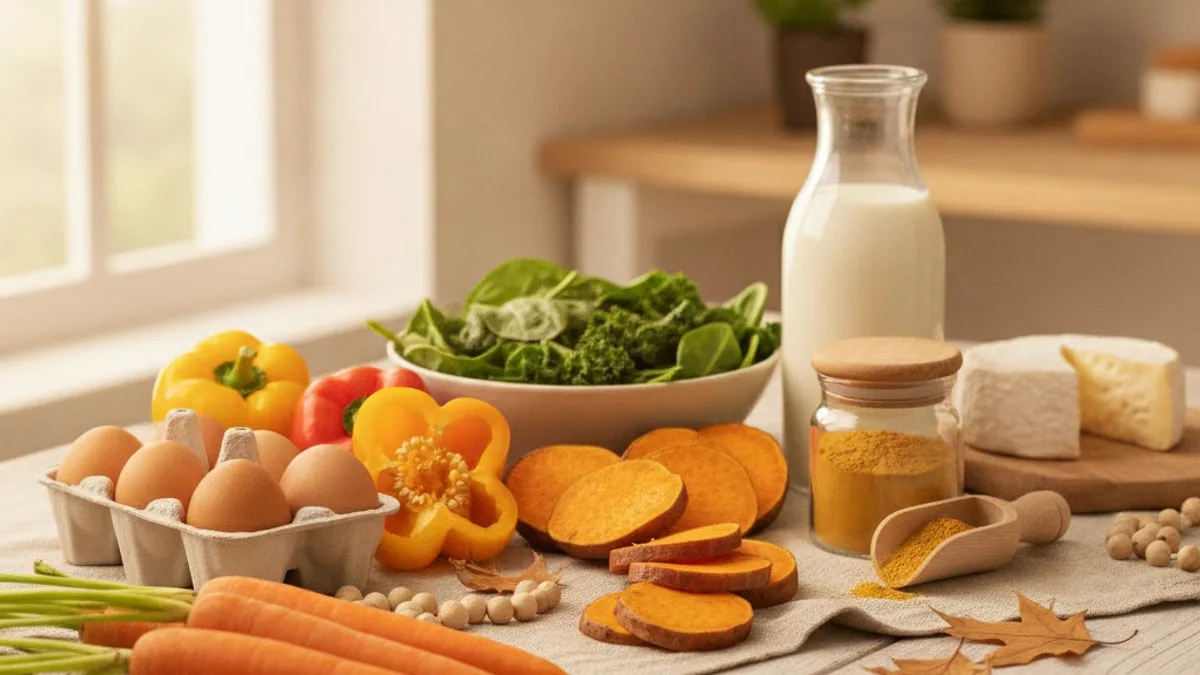
Organ meats sit at the top for preformed retinol, and deeply coloured orange, yellow and dark green plants sit at the top for provitamin A carotenoids. The table below groups common foods by type and shows their relative content rather than amounts, because content varies with variety, ripeness, growing conditions, feed, portion size and preparation.
| Food group | Food | Form supplied | Relative content |
|---|---|---|---|
| Organ meats | Beef liver | Preformed retinol | Very high |
| Organ meats | Chicken or lamb liver | Preformed retinol | Very high |
| Organ meats | Liver pâté, liverwurst | Preformed retinol | High |
| Dairy and eggs | Egg yolk | Preformed retinol | Moderate |
| Dairy and eggs | Butter, ghee | Preformed retinol | Moderate |
| Dairy and eggs | Hard and soft cheeses | Preformed retinol | Moderate |
| Dairy and eggs | Whole milk, cream | Preformed retinol | Moderate |
| Fish | Oily fish such as mackerel, salmon, herring | Preformed retinol | Moderate |
| Fish | Canned tuna | Preformed retinol | Moderate |
| Orange and yellow vegetables | Sweet potato (orange flesh) | Provitamin A carotenoids | Very high |
| Orange and yellow vegetables | Carrot, raw or cooked | Provitamin A carotenoids | Very high |
| Orange and yellow vegetables | Pumpkin, butternut and winter squash | Provitamin A carotenoids | High |
| Orange and yellow vegetables | Red bell pepper | Provitamin A carotenoids | Moderate |
| Dark leafy greens | Spinach | Provitamin A carotenoids | High |
| Dark leafy greens | Kale, collard and turnip greens | Provitamin A carotenoids | High |
| Dark leafy greens | Swiss chard, beet greens | Provitamin A carotenoids | Moderate |
| Dark leafy greens | Romaine and other dark lettuces | Provitamin A carotenoids | Moderate |
| Other vegetables | Broccoli, peas, asparagus | Provitamin A carotenoids | Moderate |
| Other vegetables | Tomato and tomato products | Provitamin A carotenoids | Moderate |
| Fruit | Mango | Provitamin A carotenoids | High |
| Fruit | Cantaloupe and other orange-fleshed melon | Provitamin A carotenoids | High |
| Fruit | Dried apricots | Provitamin A carotenoids | High |
| Fruit | Papaya, persimmon, peach | Provitamin A carotenoids | Moderate |
| Oils, herbs and spices | Red palm oil | Provitamin A carotenoids | Very high |
| Oils, herbs and spices | Paprika, chilli powder, dried herbs | Provitamin A carotenoids | High |
| Fortified foods | Fortified cereals, spreads and milk alternatives | Usually preformed retinol | Varies by product |
Two patterns are worth noticing. First, colour is a decent but imperfect guide on the plant side, because the green of chlorophyll masks the carotenoids in leafy greens. Second, the fat-containing animal foods are the ones carrying preformed retinol, which is consistent with a fat-soluble nutrient that travels with dietary fat.
Why do two people eating the same carrot absorb different amounts?
Because a carotenoid has to be released from the plant cell before anything else can happen, and that release varies enormously. Research suggests that how much provitamin A a plant food actually yields depends on the food matrix, how tightly the pigment is bound inside cell structures, and how the food is processed and eaten 2.
Carotenoids sit inside crystalline structures or bound to proteins within plant cells, and plant cell walls resist digestion. Whatever is not freed passes through. Once released, carotenoids need to be packaged into mixed micelles with fat and bile before intestinal cells can take them up, and they then travel in lipoproteins through the bloodstream 2. Conversion to retinol happens largely in the intestinal cell itself, and the proportion converted is neither fixed nor identical between individuals.
Studies indicate that bioaccessibility and the eventual benefit of carotenoids are shaped by the amount and type of fat in the meal, the presence of other carotenoids competing for the same uptake pathways, fibre, and the person's own digestive capacity 3. That is why a dry salad of raw greens and a tray of roasted squash tossed in oil are not nutritionally equivalent, even if a food table gives them similar numbers.
For anyone with reduced fat digestion, whether from pancreatic or biliary conditions, intestinal disease, or surgery that shortens the absorptive surface, this entire chain is weakened at once. In those situations both preformed retinol and carotenoids are affected, because both depend on fat absorption 1.
Does cooking, chopping or storage change what a food delivers?
Yes, and usually in the direction of making carotenoids more available rather than less. Research suggests that mechanical disruption and heat processing break down cell walls and the structures that hold carotenoids, which increases how much can be released during digestion 3.
That is the opposite of the usual assumption that raw is always better. Chopping, pureeing, gentle cooking and pairing with oil all push in the same direction for a carrot or a sweet potato. The trade-off is that very long or very high-heat cooking, extended light exposure and prolonged storage can degrade carotenoids through oxidation and isomerisation, so the gain is not unlimited 2.
Preformed retinol in animal foods behaves differently. It is already in a usable form and does not need to be freed from a plant matrix, though it is still sensitive to oxidation and to prolonged high heat.
There is one more variable people rarely consider. Carotenoids compete with each other and with other fat-soluble compounds for the same micelles and the same transporters, so a meal very heavy in one carotenoid can modestly reduce the uptake of another 3. In practice this is an argument for variety across the week rather than a reason to engineer individual meals.
Who is most likely to run low?
People with limited access to animal foods or to a varied diet, people with conditions that impair fat absorption, and people under repeated infectious or inflammatory stress. Low vitamin A status is associated with infection and damaged gut lining in a self-reinforcing loop, where poor status weakens the barrier and immune response, and the resulting illness in turn worsens status 4.
Diet pattern matters most in populations where preformed sources are scarce and the realistic intake comes almost entirely from carotenoids. Research suggests that inadequate vitamin A status remains common among women of reproductive age and pregnant women in several lower-income settings, alongside other micronutrient gaps 5.
It is not only a question of poverty or geography. Studies indicate that circulating retinol and beta-carotene levels in healthy adolescents vary considerably between groups and between individuals, with meaningful spread even in well-resourced populations 6.
The groups worth paying attention to, then, include people who avoid all animal foods without replacing the carotenoid-rich plant foods, people with chronic digestive conditions affecting fat absorption, people after certain gastrointestinal surgeries, heavy alcohol users (the liver is both the storage site and the processing site), and anyone with a long run of restricted or monotonous eating. Increased demand matters too, including pregnancy, breastfeeding and growth.
None of this tells you where you personally sit. Diet history is a reasonable way to generate a suspicion and a poor way to settle it.
Can your genes change how well you convert carotenoids?
Yes, and this is one reason identical diets produce different results. Research suggests that common variations in genes involved in carotenoid cleavage, uptake and transport are linked to differences in vitamin A status and in how much vitamin A people derive from provitamin A sources 7.
The key step is enzymatic cleavage of beta-carotene inside the intestinal cell. Variation in that enzyme's activity means some people convert efficiently and others convert comparatively poorly from the same plate of food. Variation in the proteins that handle uptake at the intestinal membrane and transport in the blood adds further spread 7.
What this means in practice is modest but real. A person who converts poorly and relies heavily on plant sources may sit lower than their diet record suggests, while a person with generous preformed intake is less exposed to that variation because retinol bypasses the conversion step entirely.
It also explains a frustration people describe. Someone eats sweet potato, spinach and peppers most days, concludes they must be comfortably covered, and is surprised by a result in the lower part of the range. The food log was accurate. The assumption about conversion was the weak link. This is exactly the kind of individual variation a blood test exists to settle, rather than reasoning backwards from what is on the plate.
What does a blood test for this marker measure?
A serum retinol test measures the retinol circulating in your blood at that moment, which reflects what the liver is releasing more than it reflects total body stores. The Vitamin A (Retinol) biomarker page covers the test, its ranges and how a result is read in full.
FitScript's optimal range is 50 to 80 µg/dL. Optimal ranges are optimization targets, not diagnostic cut-offs, and reference ranges vary by lab, age and sex.
A clinician orders it when a diet pattern, a digestive condition, a symptom or another result raises the question, and they generally read it alongside an inflammation marker rather than on its own. One value is a snapshot, not a verdict.
Why can inflammation make a result read lower than usual?
Because the body pulls retinol out of circulation during an inflammatory response, independently of how much is stored. Evidence suggests that serum retinol concentrations fall during infection and inflammation, which can make status look worse than it is if the result is read in isolation 8.
The mechanism is transport. Retinol travels bound to retinol-binding protein, and the production of that carrier protein drops during the acute phase response while other proteins rise. Less carrier in circulation means less measurable retinol, even with adequate liver reserves 8.
This is why the standard approach pairs a retinol result with an inflammation marker. Research suggests that interpreting serum retinol requires accounting for inflammation, commonly by measuring acute-phase markers alongside it, because unadjusted values overstate the apparent prevalence of poor status 9.
The practical implications are simple. A retinol value drawn during or shortly after an illness, a flare of a chronic inflammatory condition, or a period of significant physical stress carries less information than the same test drawn at a quiet baseline. If an inflammation marker is elevated on the same draw, the retinol number should be read cautiously and the question revisited later. That judgement belongs to a clinician who can see the whole panel and your history, not to a single number on a report.
What might a low result reflect, and what comes next?
A result below the standard range, or in the lower part of it, is an observation rather than a diagnosis. It may reflect genuinely low intake over a long period, poor absorption of dietary fat, high demand, ongoing inflammation suppressing the carrier protein, or a combination, and the same number can arise from different causes 9.
It helps to know what serum retinol cannot show. Because the liver buffers release, the blood level stays relatively stable across a wide span of liver stores and only drops clearly once reserves are substantially depleted 1. That is why a result inside the range does not rule out a marginal reserve, and why clinicians look at trend, context and supporting markers rather than one draw.
For situations where a closer estimate of reserves is needed, other approaches exist. Research suggests that relative dose-response testing reflects liver vitamin A stores and performs usefully as an indicator of status, though it is a clinical assessment rather than a routine panel item 10. Whether that kind of assessment is appropriate is a clinician's call.
The sensible sequence after a low or borderline result is to look at it in context (inflammation markers, recent illness, digestive symptoms, diet pattern), confirm it is not a one-off, and discuss the findings with a clinician or licensed provider who can decide whether anything further is warranted. Repeated infections, persistent digestive symptoms, or a change in night vision are reasons to raise it promptly rather than wait for the next routine panel.
Can you get too much, and does the source matter?
Yes, too much is possible, and the source matters a great deal. Excess preformed vitamin A accumulates in the liver, and research suggests that chronic excessive intake is associated with hepatic injury ranging from stellate cell changes and fibrosis to more advanced liver pathology 11.
The risk sits almost entirely with preformed retinol, and in practice most reported cases involve concentrated supplemental sources rather than ordinary meals, sometimes taken for long periods without monitoring 11. Organ meats are the one food genuinely dense enough to matter if eaten very frequently, which is why liver is traditionally treated as an occasional food rather than a staple. No amounts appear on this page, because how much is appropriate for any individual is a clinical judgement.
Provitamin A carotenoids behave differently. Conversion to retinol is regulated, so very high carotenoid intake does not produce the same accumulation of retinol 1. A very high carotenoid intake can turn the skin a yellow-orange shade, a cosmetic change that resolves when intake falls.
There is one group for whom this question is more than theoretical. In pregnancy, preformed vitamin A intake requires particular care, and the question of what is appropriate belongs with the clinician managing the pregnancy. The same applies to anyone with existing liver disease, where the liver's handling of stored retinol is already under strain 11. If you take anything containing preformed vitamin A, a licensed provider should be the one evaluating whether it is appropriate for you.
Does a diet without animal foods change the picture?
It changes the route, not the requirement. Without animal foods there is no preformed retinol in the diet, so the entire supply depends on converting provitamin A carotenoids, and that conversion is the step with the most individual variability.
That is not an argument against plant-based eating. Plenty of plant foods are rich in provitamin A, and research suggests that factors you can influence, including the fat content of the meal and how the food is processed, meaningfully affect how much is released and taken up 3. It is an argument for not assuming.
The same logic applies to several other eating patterns. Very low-fat diets reduce the uptake of every fat-soluble nutrient, including carotenoids, because micelle formation depends on dietary fat 2. Diets that are varied in calories but narrow in colour, heavy on refined grains and light on deeply pigmented vegetables, can be adequate in energy and thin in carotenoids. Restrictive elimination diets held for months carry the same risk by a different route.
In every one of these cases the honest answer to the question is the same. A diet record tells you the likely input. A blood test, read with an inflammation marker and in the context of your health history, tells you what the body has to work with.
Which other markers are worth running alongside it?
An inflammation marker is the single most useful companion, because without it a low retinol value cannot be separated from a temporary inflammatory dip 9.
Beyond that, several markers add context. Zinc supports production of the retinol-binding protein that carries retinol out of the liver, so zinc status is part of the same system. General protein status markers such as albumin reflect the body's broader capacity to make carrier proteins. A lipid panel is relevant because carotenoids and retinyl esters travel in lipoproteins, so lipid handling influences how fat-soluble nutrients move through the circulation. Liver enzymes are worth seeing because the liver is both the storage depot and the processing site.
The other fat-soluble vitamins are natural companions, since vitamin D, vitamin E and vitamin A share absorption machinery and respond to many of the same disruptions in fat digestion. Panels that look at fat-soluble status as a group tend to be more informative than any one of them read alone.
This is the case for breadth. A single marker invites overinterpretation, while a panel shows whether a value is an isolated finding or part of a pattern, which is a far better basis for a clinical conversation.
When is it worth talking to a clinician?
Whenever a result sits outside the standard range, whenever symptoms suggest a problem regardless of the number, and before changing anything based on what you read here. This article is educational and is not medical advice.
Some situations deserve prompt attention rather than a wait-and-see approach. A noticeable change in night vision or in how your eyes feel, persistent dryness of the eyes, repeated or unusually prolonged infections, and ongoing digestive symptoms that suggest fat is not being absorbed are all reasons to speak with a clinician soon, especially alongside a low result. The same is true of a suboptimal result in pregnancy or while breastfeeding, where demand is higher.
Bring context to the appointment rather than a single figure. Useful information includes recent illness or inflammation around the time of the draw, your usual eating pattern including whether you eat animal foods, any digestive diagnosis or surgery, alcohol intake, and anything you take regularly that contains preformed vitamin A. A clinician can then decide whether the result needs confirming, whether it needs a different kind of assessment, and whether anything further is appropriate.
What is not appropriate is acting on a single value alone, and it is equally inappropriate to ignore an out-of-range result because you feel fine. The point of testing is to produce a conversation with someone qualified to interpret it, not to produce a self-directed intervention. Discuss any result or next step with a clinician or licensed provider who knows your full history.
For related reading on how another fat-soluble vitamin shows up in everyday health questions, FitScript's guides on does vitamin d affect sleep and does vitamin d affect testosterone cover the same observation, context and next-step approach applied to vitamin D.
Key takeaways
- Food supplies vitamin A in two different forms, preformed retinol from animal foods and provitamin A carotenoids from plants, and only the plant form has to be converted.
- Organ meats lead on preformed retinol, while orange and yellow vegetables, dark leafy greens and orange-fleshed fruits lead on carotenoids.
- How much a plant food actually delivers depends on the food matrix, processing and the fat in the meal, so colour on the plate is a guide and not a guarantee.
- Genetic variation in carotenoid conversion means the same diet produces different results in different people.
- Serum retinol falls during inflammation, which is why it is read alongside an inflammation marker rather than on its own.
- Excess preformed vitamin A stresses the liver, and concentrated supplemental sources rather than ordinary meals are where that usually comes from.
- A blood test, interpreted in context by a clinician, is how status is actually known.
References
- Vitamin A Update: Forms, Sources, Kinetics, Detection, Function, Deficiency, Therapeutic Use and Toxicity. Nutrients, 2021.
- Bioavailability of carotenoids. World Review of Nutrition and Dietetics, 2012.
- A review on factors influencing bioaccessibility and bioefficacy of carotenoids. Critical Reviews in Food Science and Nutrition, 2017.
- The vicious cycle of vitamin a deficiency: A review. Critical Reviews in Food Science and Nutrition, 2017.
- Micronutrient Status and Dietary Intake of Iron, Vitamin A, Iodine, Folate and Zinc in Women of Reproductive Age and Pregnant Women: A Systematic Review of Data from 2005 to 2015. Nutrients, 2017.
- Retinol, β-carotene, α-tocopherol and vitamin D status in European adolescents; regional differences an variability: a review. Nutricion Hospitalaria, 2011.
- Genetic Variations Associated with Vitamin A Status and Vitamin A Bioavailability. Nutrients, 2017.
- Inflammation and Vitamin A. Food and Nutrition Bulletin, 2015.
- Biomarkers of Nutrition for Development (BOND)-Vitamin A Review. The Journal of Nutrition, 2016.
- Systematic Review and Meta-Analysis of the Relative Dose-Response Tests to Assess Vitamin A Status. Advances in Nutrition, 2021.
- Vitamin A toxicity and hepatic pathology: A comprehensive review. World Journal of Hepatology, 2025.
Common questions
Can you get enough vitamin A from plant foods alone?
It is possible, but it depends entirely on how well you convert provitamin A carotenoids into retinol, and that varies between individuals. People who eat no animal foods have no preformed retinol in the diet, so every bit of their supply passes through that conversion step. A blood test is the only reliable way to see where your level sits rather than assuming from the plate.
Is liver the best food source?
Liver is the densest common food source of preformed retinol, which is why it is traditionally eaten occasionally rather than daily. Density cuts both ways, since preformed vitamin A accumulates in the liver over time. How often liver fits into an individual diet, especially in pregnancy or in people with liver conditions, is a question for a clinician.
Does cooking vegetables destroy vitamin A?
Gentle cooking usually makes carotenoids more available, not less, because heat and chopping break down the plant cell structures that hold the pigment. Very long or very high-heat cooking, prolonged storage and light exposure can degrade them, so the benefit is not unlimited. Preformed retinol in animal foods does not need this kind of release at all.
Do I need fat in the meal to absorb it?
Vitamin A and carotenoids are fat-soluble, so they are absorbed as part of the fat-digestion process. A meal with essentially no fat reduces how much is taken up from the same vegetables. People with conditions that impair fat digestion are affected across the board, which is one reason digestive history matters when a result comes back low.
Can a blood test tell me whether I eat enough?
Not directly. A serum retinol test shows what is circulating at that moment, which the liver keeps relatively stable while reserves hold up. It is useful for identifying a value that sits outside or low within the range, but it is a snapshot, and a clinician reads it alongside your history and other markers rather than as a verdict on your diet.
Why does my doctor want an inflammation marker on the same draw?
Because the protein that carries retinol in the blood drops during an inflammatory response, which can pull the retinol value down regardless of what is stored. Reading the two together prevents a temporary dip from being mistaken for a long-standing shortfall. If inflammation is present, the retinol number is usually revisited at a quieter baseline.
Can you get too much from food?
From ordinary meals it is uncommon, since the concern centres on preformed retinol and on concentrated sources taken regularly over long periods. Organ meats are the one everyday food dense enough to matter if eaten very frequently. Carotenoids from plants are converted as the body sees fit, so they behave differently, with heavy intake sometimes tinting the skin a harmless yellow-orange.
What should I do if my result comes back low?
Treat it as an observation that needs context rather than a conclusion. Note anything relevant around the time of the draw, such as recent illness, digestive symptoms, alcohol intake or a restricted eating pattern, and bring all of it to a clinician. A licensed provider decides whether the result needs confirming and whether any next step is appropriate for you.