Foods High in Vitamin E (What Your Level Shows)
True deficiency is uncommon in adults who digest and absorb fat normally. It turns up mainly alongside conditions that interfere with fat absorption, which is why intake and status are two separate questions.
What does the blood test for this nutrient show?
A Vitamin E blood test measures alpha-tocopherol in serum, the main circulating and storage form in humans. It reflects intake and absorption over recent weeks rather than what you ate yesterday.
Typical lab reference ranges run from about 5.5 to 17 mg/L, and FitScript's optimal range is 10 to 15 mg/L, an optimization target rather than a diagnostic cut-off. Reference ranges vary by lab, age and sex.
Because the vitamin travels inside lipoproteins, a result is read next to blood lipids rather than in isolation. The biomarker page carries the full detail on what the test measures, how it is run and how a result is read. This guide stays on the food side of the question, on who tends to run low, and on when a blood level is worth having.
Which foods are the richest sources?
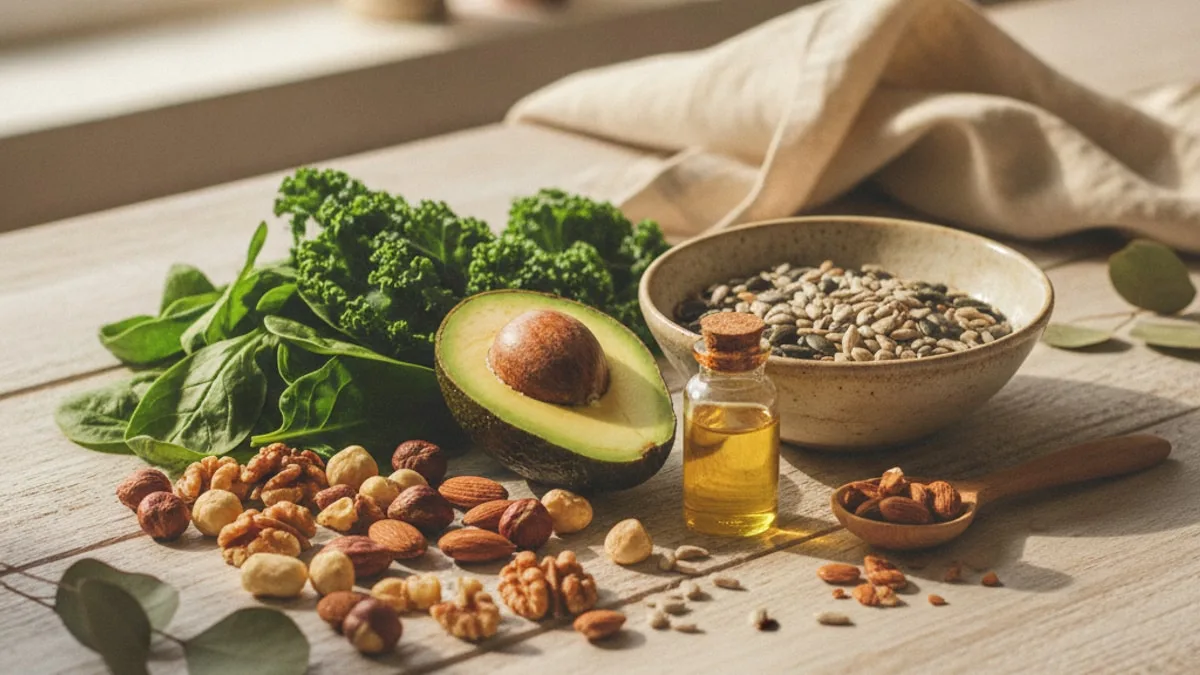
Plant oils, nuts, seeds and wheat germ are the densest sources by a wide margin, with avocado, leafy greens, some fruit, oily fish and eggs filling in the middle of the range. The table below groups common foods by type and shows relative content, not amounts, because what matters for an individual is total pattern across the week rather than a single food.
| Food group | Food | Relative vitamin E content |
|---|---|---|
| Plant oils | Wheat germ oil | High |
| Plant oils | Sunflower oil | High |
| Plant oils | Safflower oil | High |
| Plant oils | Hazelnut oil | High |
| Plant oils | Almond oil | High |
| Plant oils | Olive oil | Moderate |
| Plant oils | Rapeseed (canola) oil | Moderate |
| Plant oils | Soybean oil | Moderate |
| Plant oils | Corn oil | Moderate |
| Nuts and seeds | Sunflower seeds | High |
| Nuts and seeds | Almonds and almond butter | High |
| Nuts and seeds | Hazelnuts | High |
| Nuts and seeds | Pine nuts | Moderate |
| Nuts and seeds | Peanuts and peanut butter | Moderate |
| Nuts and seeds | Brazil nuts | Moderate |
| Nuts and seeds | Pumpkin seeds | Moderate |
| Nuts and seeds | Pistachios | Moderate |
| Grains and cereals | Wheat germ | High |
| Grains and cereals | Fortified breakfast cereals | Varies by product |
| Grains and cereals | Whole grain bread and oats | Moderate |
| Vegetables | Spinach | Moderate |
| Vegetables | Swiss chard | Moderate |
| Vegetables | Beet greens and turnip greens | Moderate |
| Vegetables | Broccoli | Moderate |
| Vegetables | Asparagus | Moderate |
| Vegetables | Red bell pepper | Moderate |
| Vegetables | Butternut squash and sweet potato | Moderate |
| Vegetables | Tomato and tomato products | Moderate |
| Fruit | Avocado | Moderate |
| Fruit | Mango | Moderate |
| Fruit | Kiwi | Moderate |
| Fruit | Blackberries and raspberries | Moderate |
| Fruit | Dried apricots | Moderate |
| Fish and seafood | Rainbow trout | Moderate |
| Fish and seafood | Atlantic salmon | Moderate |
| Fish and seafood | Shrimp and crayfish | Moderate |
| Eggs and dairy | Eggs | Moderate |
| Eggs and dairy | Butter and cream | Moderate |
| Other | Olives | Moderate |
| Other | Fortified spreads and plant milks | Varies by product |
Two patterns stand out. The first is that the fat-rich plant foods cluster at the top, so a diet built on refined starch and lean protein with very little oil, nut or seed content will sit low on vitamin E even when it looks healthy on paper. The second is that leafy greens and vegetables contribute steadily without being spectacular individually, which is why a varied plant intake adds up faster than any single food does.
Fortified products are deliberately listed as varying. The amount added differs between brands and between batches of the same brand, so a label is the only reliable guide to what a specific product contains.
Why do oils, nuts and seeds top the list?
Because plants are the only organisms that make vitamin E, and they concentrate it where their own fats are most vulnerable. Vitamin E is synthesised by photosynthetic organisms, which is why vegetable oils, seeds, nuts and green leaves are the dominant dietary sources 1.
The logic is the same inside a seed as it is inside a human cell membrane. A seed stores polyunsaturated oil as fuel for germination, and that oil oxidises easily when exposed to oxygen and light. Tocopherols sit in the oil and interrupt the chain reaction that would otherwise degrade it. Green leaves hold their own supply in the chloroplast membranes, where photosynthesis generates reactive oxygen continuously.
This explains an otherwise confusing pattern on nutrient tables. Animal foods are not vitamin E factories. A trout or an egg contains what the animal accumulated from its own diet, which is why fish and eggs land in the moderate band rather than the high one, and why a grass-finished animal product can differ from a grain-finished one. It also explains why the oil pressed from a seed carries more than the whole food gram for gram, since pressing concentrates the fat fraction where the vitamin lives.
What is alpha-tocopherol, and why does the form matter?
Food contains eight related compounds, four tocopherols and four tocotrienols, but the body holds on to only one of them. Studies indicate that alpha-tocopherol is the form that meets the human requirement, so the other tocopherols and tocotrienols present in food do not substitute for it 2.
The reason is a liver protein that selectively picks alpha-tocopherol out of the pool arriving from the gut and loads it into lipoproteins for delivery to tissues. The other forms are largely metabolised and excreted instead of being recirculated.
This has a practical consequence for food choices. Sunflower, safflower and wheat germ oils are rich in alpha-tocopherol specifically, while soybean and corn oils carry a larger share of gamma-tocopherol. On a nutrient database that reports total vitamin E activity, two oils can look closer than they are in terms of what the body retains. Almonds, hazelnuts and sunflower seeds are reliable because the dominant form in them is the one the liver keeps.
It also means a blood test does not measure everything in your food. The standard measurement targets serum alpha-tocopherol, which is the fraction that reflects what the body has actually taken up and held.
What does vitamin E actually do in the body?
It is the main fat-soluble antioxidant in cell membranes, where it stops the chain reaction that damages polyunsaturated fats. Research suggests that the core function of vitamin E is protecting polyunsaturated fatty acids in membranes and lipoproteins from oxidation 3.
Picture a cell membrane as a sheet of fat molecules packed side by side. When one polyunsaturated fat is attacked by a reactive molecule, it becomes reactive itself and attacks its neighbour, and the damage propagates across the sheet. Alpha-tocopherol sits within that sheet and absorbs the reactive species, ending the chain. That is why the nutrient is concentrated in membranes and in circulating lipoproteins rather than floating free in plasma.
Tissues with high membrane turnover and high polyunsaturated content are the ones that feel a shortfall first. Nerve tissue and red blood cells sit near the top of that list, which is why prolonged, severe deficiency shows up as neurological and haematological problems rather than as a vague tiredness.
Research suggests that the intake associated with optimal function may be higher than the intake needed simply to avoid clinical deficiency 4. That distinction is the reason an optimization-minded reader cares about a measured level rather than assuming that the absence of symptoms means the absence of a gap.
Does a diet high in polyunsaturated fat change how much you need?
Yes, the requirement moves with polyunsaturated fat intake rather than sitting at one fixed number. Research suggests that vitamin E requirement rises in relation to polyunsaturated fatty acid intake, because those fats are the molecules it protects 3.
This is one of the more useful ideas in the whole topic. Somebody eating a lot of oily fish, seed oils, walnuts and flaxseed is carrying more oxidisable fat in their membranes than somebody eating mostly saturated and monounsaturated fat. The protective demand scales with the exposure.
It also explains why the richest food sources tend to arrive pre-packaged with their own protection. Sunflower seeds carry polyunsaturated oil and a generous tocopherol load in the same food. Problems are likelier when the two come apart, for example when polyunsaturated fat intake climbs through refined or heavily processed sources while nuts, seeds, whole oils and green vegetables stay low.
There is no need to calculate anything here. The practical reading is that a high polyunsaturated diet raises the value of keeping whole, vitamin E rich plant fats in the rotation, and raises the value of an actual measurement over an assumption.
Does cooking, refining or storage change the amount in food?
Yes, and the losses are real, which is why two servings of the same food can differ. Vitamin E is sensitive to heat, light, oxygen and prolonged storage, since the chemistry that makes it protective also makes it consumable.
Deep frying is the harshest case. Repeated heating of an oil at high temperature degrades its tocopherol content as the vitamin is used up protecting the oil itself. Oil held in a clear bottle near a window or a hob loses more than oil kept sealed in a cool dark cupboard. The same applies to nuts and seeds, where rancidity is the visible endpoint of a process that has already consumed some of the protective content.
Refining strips a portion as well. Unrefined and cold-pressed oils generally retain more than heavily refined versions of the same oil, and wheat germ loses content once milled and left exposed.
Practical handling matters more than precision here. Buy nuts and seeds in quantities you will finish, keep them cool and sealed, store oils away from light and heat, and use gentler cooking methods for the oils you are relying on as a source. None of this is a reason to avoid cooked food, since cooked greens and roasted vegetables still contribute meaningfully.
Why does the fat in a meal matter for absorption?
Because vitamin E is fat-soluble and cannot cross the gut wall on its own. It needs dietary fat to trigger bile release, bile salts to form micelles, and intestinal cells to package it into chylomicrons before the liver sorts it and sends it out in lipoproteins.
Every stage of that chain is a point where absorption can fall short. A spinach salad eaten with no fat at all delivers less than the same salad dressed with olive oil. Reduced bile flow, pancreatic insufficiency or inflamed small intestine all reduce uptake independently of what is on the plate.
The lipoprotein stage matters just as much as the gut stage. In people with abetalipoproteinemia and familial hypobetalipoproteinemia, the lipoproteins that would normally carry vitamin E to tissues are absent or scarce, and vitamin E status is severely affected with evidence of oxidative stress 5.
This is also why a serum level is interpreted next to blood lipids. Vitamin E rides in the same particles that carry cholesterol and triglycerides, so a person with very high lipids can show a serum value that overstates tissue status, and a person with very low lipids can show one that understates it. Labs often express the result relative to total cholesterol and triglycerides for this reason.
Who is most likely to run low?
People who do not absorb fat normally, far more often than people who simply eat badly. Vitamin E deficiency is associated with disorders of fat absorption and fat transport rather than with ordinary dietary shortfall in otherwise healthy adults 2.
The groups worth flagging include the following.
- People with chronic fat malabsorption from pancreatic, biliary or small intestinal conditions, where fat-soluble vitamins fall together rather than one at a time.
- People who have had bariatric or other gastrointestinal surgery. Research suggests that vitamin E status warrants monitoring after bariatric surgery, where low status has been reported among patients 6.
- People with inherited disorders of lipoprotein production, where the transport system itself is the limiting step 5.
- People with cholestatic liver conditions, where reduced bile flow blunts absorption of all fat-soluble nutrients.
- Premature infants, who are born with small stores, a separate clinical situation managed by a specialist team.
There is a dietary tail as well. Very low fat eating patterns, long term restrictive diets and diets with almost no nuts, seeds, oils or green vegetables sit lower on intake. That is a reason for a measured level rather than a reason to assume a problem. Intake and absorbed status are different questions, and only one of them shows up in blood.
What might a lower than typical result reflect?
A result below the typical reference range means circulating alpha-tocopherol is lower than most people's, and the usual first question is whether the cause is intake, absorption or lipid transport. It is an observation, not a diagnosis.
A clinician looks at the result in context. Low intake is the simplest explanation in someone with a diet that contains few of the foods in the table above. Impaired absorption moves up the list when other fat-soluble nutrients are low too, when there is a history of gastrointestinal surgery, or when digestive symptoms are present. Very low blood lipids can also pull the number down without tissue stores being as low as the figure suggests, which is why the lipid-adjusted interpretation exists.
A mildly suboptimal value in a well person with no symptoms is usually a prompt to look at the diet pattern and to recheck, not an emergency. A clearly low value, a value accompanied by neurological symptoms such as unsteadiness, numbness or muscle weakness, or a value in someone with a known absorption problem is worth discussing with a clinician promptly.
The sequence that keeps this safe is simple. The value shows what is circulating, the pattern around it suggests what might be driving it, and a licensed provider decides what, if anything, should change.
What might a higher than typical result reflect?
Most often it reflects supplemental intake, high blood lipids carrying more of the vitamin, or both, since food alone rarely pushes a serum level above the reference range. The vitamin travels in lipoproteins, so a person with elevated cholesterol or triglycerides can show a high serum value that says more about lipid concentration than about vitamin status.
Higher is not automatically better. Studies indicate that dietary vitamin E intake is associated with favourable findings for some health outcomes while findings across other outcomes are less consistent 7. That is a reason to be measured rather than enthusiastic about pushing a number upward.
If a result comes back above the typical range, the useful information for a clinician is the full picture. What supplements are in use, including multivitamins and fish oil blends that often contain added tocopherol, what the lipid panel shows, and whether anything has changed recently. This guide does not recommend taking, starting, stopping or adjusting any supplement, and no amount or schedule is given here, because that decision belongs to a licensed provider who has reviewed the person in front of them.
The same rule applies as at the low end. Never ignore a result that sits outside the standard range, and never act on one in isolation.
Which other markers are worth testing alongside?
The markers that help most are the ones that explain transport and absorption, since a vitamin E level read on its own can mislead in either direction.
| Marker | Why it helps interpret a vitamin E result |
|---|---|
| Total cholesterol | Vitamin E circulates in lipoproteins, so the serum value is read relative to lipid concentration |
| Triglycerides | High or low triglycerides shift the serum value without matching a change in tissue stores |
| Vitamin A | Another fat-soluble vitamin absorbed by the same bile and micelle route, often low together |
| Vitamin D | Fat-soluble status, and a common second gap in restricted or very low fat diets |
| Liver enzymes and bilirubin | Bile flow and liver function sit upstream of fat-soluble vitamin absorption |
| Full blood count | Red blood cell membranes are rich in polyunsaturated fat, so haematology adds context |
| Ferritin and B12 | Broader absorption picture after gastrointestinal surgery or in malabsorption |
Reading these together is what turns a single number into something useful. One low fat-soluble vitamin invites a diet question. Several low fat-soluble vitamins alongside abnormal liver or digestive markers points toward an absorption question instead, and that is a conversation for a clinician rather than a supermarket decision.
How is the sample taken, and when would a clinician order it?
It is a standard venous blood draw, with the serum protected from light because alpha-tocopherol degrades on exposure. Some labs ask for a fasting sample, mainly because recent fat intake shifts triglycerides and the result is read against blood lipids. Follow whatever instruction the testing lab gives, since the handling requirement varies.
A clinician typically orders it when there is a reason to suspect reduced absorption or low status rather than as a routine screen in a healthy adult. Common situations include known or suspected fat malabsorption, chronic pancreatic or biliary conditions, a history of bariatric or bowel surgery, cystic fibrosis, unexplained neurological symptoms such as unsteady gait or peripheral numbness, and monitoring in people already under supervision for a fat-soluble vitamin issue.
It also appears inside broader nutrient panels ordered for optimization rather than for symptoms. FitScript's membership includes 150+ biomarkers tested per year, and Atlas, the AI health advisor, writes the interpretation that a member reads alongside their other markers.
What a test cannot do is tell you which food to eat or how much. It tells you where your circulating level sits today, which is the one thing that guessing from a diet diary cannot give you.
When is it worth talking to a clinician?
Whenever a result sits outside the typical range, whenever symptoms suggest an absorption problem, and before making any change based on a number you do not fully understand.
Bring it up promptly in these situations. Neurological symptoms such as unsteadiness, loss of coordination, numbness, tingling or progressive muscle weakness. Persistent digestive symptoms such as pale, greasy or floating stools, unexplained weight loss or chronic diarrhoea. A known malabsorption condition, chronic liver or pancreatic disease, or a history of bariatric or small bowel surgery, where fat-soluble nutrient status is part of routine follow-up. Pregnancy or breastfeeding, where any nutrient decision is made with a clinician.
For a healthy adult with a mildly suboptimal result and no symptoms, the conversation is usually calmer. It covers the diet pattern, the lipid panel, the other fat-soluble vitamins, and a plan for rechecking. Food is the first lever in that conversation, and it is the lever this page is about.
This article is educational and is not medical advice. Discuss your results and any change in how you eat or supplement with a clinician or licensed provider, who is the one to decide what is appropriate for you.
Key takeaways
- Plant oils, nuts, seeds and wheat germ are the densest sources, with avocado, leafy greens, oily fish and eggs contributing steadily in the middle of the range.
- Only plants make vitamin E, which is why animal foods sit lower and why a diet thin on oils, nuts, seeds and greens sits low on intake 1.
- Alpha-tocopherol is the form the body retains, so oils rich in other tocopherols do not count the same way 2.
- Absorption needs dietary fat, bile and working lipoproteins, so status is not the same thing as intake.
- True deficiency is uncommon and is mostly seen alongside fat malabsorption, gastrointestinal surgery and inherited lipoprotein disorders.
- A serum alpha-tocopherol level read alongside blood lipids is how status is actually known, and what to do about any result is a clinician's decision.
Related reading, does vitamin d affect sleep and does vitamin d affect testosterone, covers two other fat-soluble vitamin questions that tend to come up in the same conversation.
References
- Vitamin E - Occurrence, Biosynthesis by Plants and Functions in Human Nutrition. Mini Reviews in Medicinal Chemistry, 2017.
- Human Vitamin E deficiency, and what is and is not Vitamin E?. Free Radical Biology & Medicine, 2024.
- Vitamin E function and requirements in relation to PUFA. The British Journal of Nutrition, 2015.
- Optimal nutrition: vitamin E. The Proceedings of the Nutrition Society, 1999.
- Vitamin E and oxidative stress in abetalipoproteinemia and familial hypobetalipoproteinemia. Free Radical Biology & Medicine, 2015.
- Vitamin E status among bariatric surgery patients: a systematic review. Surgery for Obesity and Related Diseases, 2021.
- Vitamin E intake and multiple health outcomes: an umbrella review. Frontiers in Public Health, 2023.
Common questions
Which food has the most vitamin E?
Wheat germ oil is the densest common source, followed by sunflower oil, safflower oil, sunflower seeds, almonds and hazelnuts. Wheat germ itself is high. Avocado, spinach, chard, broccoli, red pepper, trout, salmon and eggs contribute moderate amounts across a varied week of eating.
Can you get enough vitamin E from food alone?
For most adults who digest and absorb fat normally, yes. A diet that regularly includes plant oils, nuts, seeds, avocado and leafy greens covers the need without any supplement. The people who struggle are usually those with an absorption problem rather than those with a poor shopping list.
Do you need to eat fat with these foods?
Yes, since vitamin E is fat-soluble and needs dietary fat and bile to be absorbed. Most rich sources already contain fat, so this mainly matters for vegetables. Dressing a salad with olive oil or adding nuts or avocado helps you take up more of what the greens contain.
Does cooking destroy vitamin E?
Some of it. Heat, light, oxygen and long storage all reduce content, and repeated high temperature frying is the harshest case. Keep oils sealed away from light and heat, store nuts and seeds cool and use them before they go rancid. Cooked greens and vegetables still contribute.
Is a blood test the only way to know my vitamin E level?
Yes. A diet diary estimates intake, not status, and absorption is the part that varies most between people. A serum alpha-tocopherol measurement, read alongside your blood lipids because the vitamin travels in lipoproteins, is the only way to know where your actual level sits.
Why would a clinician order a vitamin E test?
Usually when there is a reason to suspect reduced fat absorption or low status, such as a known digestive or liver condition, a history of bariatric or bowel surgery, or unexplained neurological symptoms. It also appears inside broader fat-soluble nutrient panels run for general optimization.
Do I need to fast before the test?
Sometimes. Recent fat intake shifts triglycerides, and the result is interpreted against blood lipids, so some labs ask for a fasting sample. Follow the instruction your testing lab gives, and tell them about any supplements you take, since many multivitamins and oil blends contain added tocopherol.
Is a higher vitamin E level better?
Not automatically. A level above the typical range usually reflects supplemental intake or high blood lipids rather than better health, and more is not a goal in itself. If your result sits outside the standard range in either direction, bring it to a clinician rather than adjusting anything yourself.
Are fortified cereals a reliable source?
They can contribute, but the amount added varies between brands and products, so the label is the only guide to what a specific box contains. Whole food sources such as nuts, seeds, plant oils, avocado and greens are more consistent and bring other nutrients along with them.