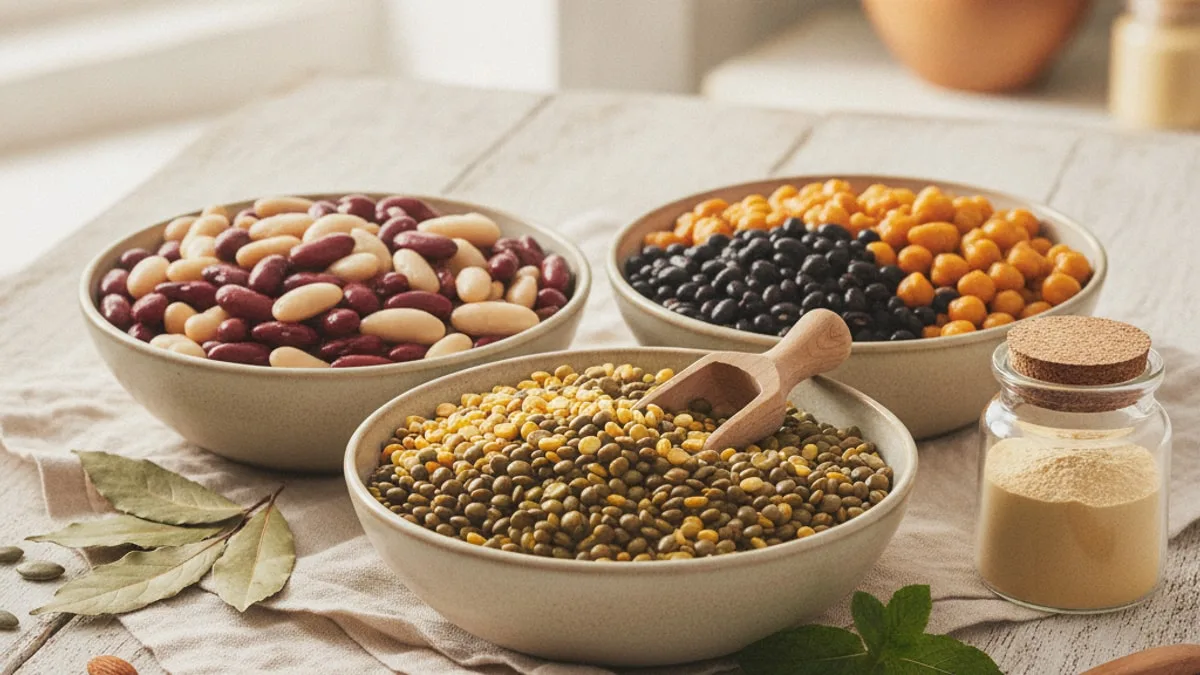
High-Fiber Foods for Cholesterol and Blood Sugar
Below, the highest fiber foods are grouped by type, with what each group does inside the body and which lab markers tend to shift when eating patterns change.
Which legumes carry the most fiber?
The most fiber-dense legumes are the small dried beans and pulses, including navy beans, small white beans, black beans, pinto beans, kidney beans, lima beans, split peas, lentils of every colour and chickpeas. Legumes are seeds built for storage, so their cell walls are thick and their starch is packed tightly inside those walls. Both of those structural features survive soaking and cooking, which is why a bowl of beans delivers more fiber than almost anything else on an ordinary plate.
Within the group there is a clear gradient. Navy beans, split peas and lentils sit at the top. Chickpeas, black beans, pinto beans and kidney beans sit just behind them. Green peas, edamame and peanuts (botanically legumes, even though most people file them with nuts) land in the moderate band. Soy foods vary widely by processing, because straining and pressing remove much of the plant structure, so whole soybeans and edamame hold more fiber than the smoother soy products made from them.
Preparation changes less than people expect. Canned beans keep their fiber, and rinsing them lowers the sodium in the packing liquid rather than the fiber. Cooking softens cell walls enough to make beans digestible, but it does not dissolve fiber away. Cooling cooked beans, grains or potatoes raises their resistant starch, a form of starch that escapes digestion in the small intestine and is fermented further down, behaving in the gut much like fiber. Hummus, bean flours, dals and pureed bean soups keep the fiber as well, since nothing is strained out of them.
What makes legume fiber different from the fiber in fruit or grains?
Legumes supply several fiber types at once, while most other plant foods lean in one direction. Oats and barley are rich in viscous soluble fiber. Wheat bran and vegetable skins are mostly insoluble. Legumes carry both, plus resistant starch and a family of fermentable sugars called oligosaccharides. For the full breakdown of the two main categories and what each one does, the guide to soluble vs insoluble fiber covers the distinction in detail.
Soluble fiber dissolves into a gel. That gel thickens the contents of the small intestine, slows the rate at which sugars and fats reach the bloodstream, and traps bile acids as they pass through. Insoluble fiber does not dissolve. It adds bulk, holds water and shortens transit time through the colon. Resistant starch and oligosaccharides arrive in the colon largely intact, where resident bacteria ferment them into short chain fatty acids such as butyrate, acetate and propionate. Research suggests that these fermentable fractions reshape the gut microbiome in ways that influence glucose handling 1.
The practical consequence is that legumes cover more jobs per serving than a single fruit or refined grain does. A plate built only on raw salad leaves produces volume and water with modest fiber. A plate with beans or lentils on it produces gel formation, bulk and fermentation at the same time. That is also why beans are the food most often blamed for gas, since fermentation is the point rather than a flaw.
Which fruits are high in fiber?
The fruits highest in fiber are the ones with edible seeds or an edible skin. Raspberries and blackberries lead the group, because each tiny drupelet carries a seed. Guava, passion fruit, pomegranate arils, avocado, pears eaten with the skin, apples eaten with the skin, figs and prunes follow closely. Kiwi, oranges eaten in segments rather than juiced, bananas, strawberries, blueberries and mango sit in the moderate band.
Two details change the answer more than variety does. The first is the peel. Peeling an apple or a pear removes a meaningful share of its insoluble fiber along with some of its polyphenols. The second is processing. Juicing strips out nearly all of the fiber and leaves the sugars behind, so a glass of juice and a whole piece of fruit behave very differently in the gut. Blending keeps the fiber in place, though the gel structure is partly broken up, so a smoothie empties from the stomach faster than the same fruit eaten whole.
Dried fruit concentrates everything, fiber and sugar together, which is why prunes and dried figs appear so often in conversations about sluggish bowels. Fruits high in fiber for constipation tend to be the ones that combine insoluble fiber with sorbitol, a sugar alcohol that draws water into the colon, and prunes, pears and kiwi are the classic examples.
Which vegetables are high in fiber?
The vegetables highest in fiber are dense, starchy or seed-bearing rather than leafy. Artichoke hearts, green peas, Brussels sprouts, broccoli, okra, parsnip, winter squash, beets and sweet potato eaten with the skin all sit in the high band. Carrots, cauliflower, cabbage, green beans, asparagus, bell peppers and courgette fall into the moderate band. Spinach, lettuce, rocket and other leafy greens contribute real fiber, but they are mostly water by weight, so a plate of them delivers less than a smaller portion of beans or sprouts.
Structure explains the pattern again. Fiber lives in cell walls, stalks, skins and seeds. Stems and florets are richer than soft leaves. Skins are richer than flesh. A potato with its jacket on is a different food from a peeled one, and the same is true of cucumbers, aubergine and sweet potato.
Cooking does not destroy fiber. Boiling softens cell walls and some soluble fiber leaches into the cooking water, which is one argument for using that water in soups and stews. Roasting and steaming leave the fiber essentially intact. For a high fiber vegetables list that doubles as a low starch list, the cruciferous family and the stalky vegetables do most of the work, which matters for anyone watching carbohydrate alongside fiber.
Where do whole grains fit alongside legumes?
Whole grains sit just below legumes for fiber density, and they bring something legumes do not. Oats and barley are the standouts because of beta-glucan, a viscous soluble fiber that forms a thick gel. Rye, bulgur, farro, freekeh, whole wheat, air-popped popcorn, brown rice, buckwheat and quinoa round out the group, with milling and refining determining how much of the bran and germ survives into the finished product.
Not every whole grain behaves the same way. Studies indicate that the physical structure of grain fiber and the phytochemicals bound to it both contribute to how whole grains affect health, so intact kernels and finely milled flours are not interchangeable 2. Fiber in whole grains also travels with polyphenols attached to the bran, and research suggests that this combination of fiber and polyphenols is what shapes the gut response to whole grain foods rather than fiber alone 3. The composition of that fiber and phenolic package varies by grain, and studies suggest it is relevant to markers of inflammation 4.
In practice this means a chewy, visibly intact grain tends to behave differently from a soft bread made from flour that happens to be labelled whole grain. Reading the ingredient list for an intact or coarsely milled whole grain as the first item is more informative than the claim on the front of the pack.
What does a grouped high-fiber food list look like?
This table groups the main high fiber diet foods by type and ranks them relative to each other rather than by any amount. Fiber content varies with variety, ripeness, portion size, peel and preparation, so treat the bands as a map, not a measurement.
| Food group | Examples | Relative fiber content |
|---|---|---|
| Legumes | Navy beans, small white beans, split peas, lentils, black beans, pinto beans, kidney beans, lima beans, chickpeas | High |
| Legumes | Green peas, edamame, whole soybeans, peanuts | Moderate |
| Fruit | Raspberries, blackberries, guava, passion fruit, avocado, pears with skin, figs, prunes, pomegranate arils | High |
| Fruit | Apples with skin, kiwi, oranges, blueberries, strawberries, bananas, mango, dates | Moderate |
| Vegetables | Artichoke, green peas, Brussels sprouts, broccoli, okra, parsnip, winter squash, sweet potato with skin | High |
| Vegetables | Carrots, cauliflower, cabbage, green beans, asparagus, beets, peppers, leafy greens | Moderate |
| Whole grains | Barley, oats, bulgur, rye, freekeh, whole wheat, air-popped popcorn | High |
| Whole grains | Brown rice, quinoa, buckwheat, whole-grain pasta, whole-grain bread | Moderate |
| Nuts and seeds | Chia seeds, flaxseed, almonds, pistachios | High |
| Nuts and seeds | Walnuts, sunflower seeds, pumpkin seeds, cashews | Moderate |
The pattern worth noticing is that the high band of every group shares a structural feature, an intact skin, a seed, a thick cell wall or a bran layer. Foods lose their place in the band when that structure is removed by peeling, juicing, straining or fine milling.
Why does fiber matter for cholesterol?
Viscous soluble fiber interacts directly with the way the body recycles cholesterol. Bile acids are made in the liver from cholesterol, released into the small intestine to help absorb fat, and then mostly reabsorbed further down and sent back to the liver. Soluble fiber forms a gel that binds some of those bile acids so they leave in stool instead of returning. The liver then draws on circulating cholesterol to make replacements, and that ongoing demand is the mechanism behind the link between fiber-rich eating patterns and lipid markers.
Fermentation adds a second route. Short chain fatty acids produced when bacteria break down resistant starch and oligosaccharides are absorbed and reach the liver, where they participate in fat and cholesterol metabolism. A large umbrella review of fiber and health outcomes found that higher dietary fiber intake is associated with favourable cardiometabolic outcomes across a wide range of populations 5. Research also suggests that higher dietary fiber intake is associated with lower all-cause and cardiovascular mortality in prospective cohort studies 6.
For a reader looking at a lipid panel, the useful framing is observation, meaning and next step. The observation is the number on the report. The possible meaning is that diet, body composition, genetics, thyroid function, kidney function and family history all feed into it. The next step is a conversation with a clinician who can see the whole panel and your history rather than one line of it.
How does fiber affect blood sugar?
Fiber slows and smooths the arrival of glucose into the bloodstream rather than removing carbohydrate from the meal. A gel-forming fiber increases the viscosity of stomach and intestinal contents, so the stomach empties more slowly and digestive enzymes reach starch molecules less easily. Legumes add a second brake, because much of their starch sits inside cell walls that resist digestion, so a share of it passes through to the colon untouched.
What happens in the colon matters too. Fermentation of resistant starch and oligosaccharides produces short chain fatty acids and shifts the bacterial population, and research suggests that fiber-driven changes in the gut microbiome influence glucose homeostasis 1. A review of fiber and metabolic health reported that dietary fiber intake is associated with better metabolic markers and with measures of body weight regulation 7.
There is also a straightforward satiety effect. High fiber foods take longer to chew, occupy more space in the stomach and leave the stomach more slowly, which tends to change how much is eaten at the next meal without any conscious effort. That is part of why beans and lentils show up so often in eating patterns built around steadier energy.
Where does LDL cholesterol fit into this?
LDL Cholesterol is the lipid marker most often watched when eating patterns change, and the full picture of what it measures, how it is tested and how to read a result lives on the LDL Cholesterol guide. In brief, typical lab reference ranges run from 40 to 130 mg/dL, while FitScript's optimal range is 50 to 100 mg/dL. Optimal ranges are optimization targets rather than diagnostic cut-offs, and standard reference ranges vary by lab, age and sex. One value on one day is a single data point, not a verdict, and a result outside the range you expected is worth discussing with a clinician rather than acting on alone.
What does fiber have to do with inflammation?
Fiber reaches the immune system indirectly, through the gut. The colon houses a large share of immune tissue, and the bacteria living there respond to what arrives undigested. Short chain fatty acids produced during fermentation are the main fuel for the cells lining the colon, and a well-fed gut lining maintains a tighter barrier against bacterial products crossing into circulation.
A review of fiber and human inflammation reported that dietary fiber intake is associated with differences in circulating inflammatory markers 8. The composition of whole grain fiber and the phenolic compounds bound to it has also been examined in relation to markers of inflammation 4.
For someone tracking labs, this is where high-sensitivity CRP becomes interesting. It is a general marker, raised by infection, injury, recent illness, body composition and plenty of other inputs, so it is read alongside the rest of a panel rather than on its own. An unexpected result is a prompt to look at context and repeat the measurement with a clinician's input, not a conclusion about diet.
Which high-fiber foods are lower in carbohydrate?
The lowest carbohydrate high fiber foods are non-starchy vegetables, berries, avocado, and nuts and seeds. Broccoli, cauliflower, Brussels sprouts, asparagus, courgette, cabbage and leafy greens deliver fiber with very little digestible starch. Raspberries, blackberries and avocado do the same among fruit. Chia seeds, flaxseed and almonds pack fiber into a small volume. For a fuller breakdown of this group, the guide to high fiber low carb foods works through the options by category.
Legumes occupy an interesting middle position. They are genuinely high in fiber and also genuinely starchy, so people managing carbohydrate closely often favour lentils, black soybeans and edamame, which sit at the lower starch end of the group. The fiber in a legume is not absorbed as glucose, which is why many people subtract it when they think about the carbohydrate load of a meal, though labelling conventions for that calculation differ between countries.
The trade-off is worth naming honestly. Eating only the low carbohydrate high fiber vegetables narrows the fiber types reaching the colon, because non-starchy vegetables supply less resistant starch and fewer oligosaccharides than beans do. Variety across the groups generally produces a broader fermentation profile than any single category.
Can high-fiber foods help with constipation?
Fiber influences stool in two different ways, and knowing which one is in play changes the food choice. Insoluble fiber from wheat bran, vegetable skins, nuts and seeds adds bulk and holds water, which stretches the colon wall and stimulates movement. Soluble, gel-forming fiber softens stool and makes it easier to pass. Legumes contribute both, which is why beans appear on nearly every high fiber list aimed at bowel regularity.
Fluid is part of the same system, since fiber needs water to form a gel or to stay bulky, and the two work together rather than separately. Sorbitol-containing fruits such as prunes, pears and apples act by a related route, pulling water into the colon osmotically.
Fiber is not the answer to every bowel complaint. In people with slow transit constipation, pelvic floor dysfunction or an obstructive problem, adding bulk can make symptoms worse rather than better, and the right approach depends on the cause. Some medicines also change bowel habit, so ask your prescriber rather than assuming food is the only variable. Persistent constipation, especially when it is new, is worth discussing with a clinician.
What gets in the way of eating more fiber?
Tolerance is the most common obstacle, and it is physiological rather than a failure of willpower. Oligosaccharides in beans, lentils and some vegetables are fermented rapidly, producing gas. People differ substantially in how much of that they notice, partly because their gut bacterial populations differ. Soaking dried beans and discarding the soaking water, rinsing canned beans, and choosing lentils or split peas over larger beans all reduce the oligosaccharide load somewhat.
Underlying conditions matter too. In people with irritable bowel syndrome, inflammatory bowel disease, diverticular disease or a history of bowel surgery, the usual advice about fiber may need modifying, and a clinician or registered dietitian is the right person to work that through. In people with swallowing or chewing difficulties, texture becomes the limiting factor, and pureed bean soups and dals keep the fiber while removing the chewing.
Practical friction is real as well. Dried beans need planning, which is why canned and frozen options matter. Cost is usually a point in favour of legumes rather than against them, since dried pulses are among the least expensive protein and fiber sources available. And some medicines affect appetite, digestion or bowel habit, so ask your prescriber if something changed around the time a prescription started.
Which lab markers are worth watching alongside a higher-fiber diet?
The markers that tend to move with a sustained change in eating pattern are the lipid and glucose panels, with an inflammation marker alongside them. On the lipid side, LDL cholesterol, apolipoprotein B, non-HDL cholesterol, HDL cholesterol and triglycerides each describe a different piece of the picture, and reading them together is more informative than tracking one line. On the glucose side, fasting glucose, HbA1c and fasting insulin describe current state, three-month average and the effort the pancreas is making to hold that state. High-sensitivity CRP adds the inflammatory context.
Timing is its own variable. HbA1c reflects a period of weeks to months, so it responds slowly. Triglycerides are sensitive to the most recent meals and to alcohol. Lipid panels have specific preparation instructions that differ between labs and clinicians, so follow the instructions that came with the requisition. When results are compared over time, the comparison is cleaner when the conditions match.
A membership like FitScript's covers 150+ biomarkers tested per year, with interpretation by Atlas, its AI health advisor, and any treatment decision that follows belongs to a licensed provider who has reviewed the member. The value of repeat testing is in the trend. One panel shows where things sit. A second panel, taken under similar conditions after a real change in eating, shows direction.
When is it worth talking to a clinician?
Talk to a clinician when a result sits outside the standard range, when a trend is moving the wrong way across repeated panels, or when symptoms accompany the numbers. Some situations deserve prompt attention rather than a wait-and-see approach, including blood in the stool, unexplained weight loss, a persistent change in bowel habit, severe or worsening abdominal pain, or vomiting with constipation. Those are worth discussing with a clinician promptly, regardless of what any food list says.
It is also worth a conversation before making a large dietary change in specific circumstances, including in people with an inflammatory bowel condition, a history of bowel obstruction or surgery, chronic kidney disease, or a diagnosed swallowing disorder. A clinician or registered dietitian can adapt the general principles to the individual situation, and treatment decisions belong to a licensed provider.
This article is educational and is not medical advice. Discuss your own lab results and any change to your diet or treatment with a clinician or licensed provider who knows your history.
Key takeaways
- Legumes are the most fiber-dense common food group, with navy beans, split peas, lentils, black beans and chickpeas at the top and green peas, edamame and peanuts in the moderate band.
- Legumes are unusual because they supply soluble fiber, insoluble fiber, resistant starch and fermentable oligosaccharides at the same time, while most other foods lean one way.
- Structure predicts fiber content across every group, so skins, seeds, stalks, bran layers and intact kernels mark the high band in fruit, vegetables and whole grains.
- Soluble fiber binds bile acids and slows glucose absorption, while fermentable fiber feeds gut bacteria that produce short chain fatty acids.
- Lipid markers, glucose markers and an inflammation marker read together tell you more about a dietary change than any single value does.
- An unexpected or out-of-range result is a reason to talk to a clinician, not a reason to self-diagnose or to ignore the number.
References
- Dietary fibre and the gut microbiome: implications for glucose homeostasis. Current Opinion in Clinical Nutrition and Metabolic Care, 2025.
- Whole grains are not equal: the role of fiber structure and phytochemicals in health. Food & Function, 2025.
- Dietary fiber and polyphenols from whole grains: effects on the gut and health improvements. Food & Function, 2024.
- Composition of Whole Grain Dietary Fiber and Phenolics and Their Impact on Markers of Inflammation. Nutrients, 2024.
- The impact of dietary fiber consumption on human health: An umbrella review of evidence from 17,155,277 individuals. Clinical Nutrition (Edinburgh, Scotland), 2025.
- Dietary fiber intake and all-cause and cause-specific mortality: An updated systematic review and meta-analysis of prospective cohort studies. Clinical Nutrition (Edinburgh, Scotland), 2024.
- Effects of dietary fibre on metabolic health and obesity. Nature Reviews. Gastroenterology & Hepatology, 2024.
- Impact of Dietary Fiber on Inflammation in Humans. International Journal of Molecular Sciences, 2025.
Common questions
Which legume has the most fiber?
Navy beans, small white beans, split peas and lentils sit at the top of the legume group, with chickpeas, black beans and kidney beans close behind. Green peas, edamame and peanuts carry less, though they still contribute more than most vegetables. Exact content varies with variety, cooking method and portion size.
Do canned beans have as much fiber as dried beans?
Yes, canned beans keep their fiber. Rinsing them reduces the sodium in the packing liquid rather than the fiber, so rinsing is worth doing if sodium is a concern. Canned and frozen legumes are a practical option when soaking and simmering dried beans is not realistic.
Does cooking destroy the fiber in legumes and vegetables?
No. Cooking softens cell walls so food becomes digestible, but it does not remove fiber. Boiling can leach a little soluble fiber into the cooking water, which is one reason to use that liquid in soups and stews. Roasting and steaming leave fiber essentially intact.
Are peanuts legumes, and do they count toward fiber intake?
Peanuts are botanically legumes, since they grow in pods underground, even though most people treat them as nuts in the kitchen. They contribute fiber in the moderate band, less than beans and lentils but more than many snack foods. They also carry a lot of fat and calories in a small volume.
Why do beans cause gas, and does that ever settle?
Beans contain oligosaccharides, a type of carbohydrate that human enzymes cannot break down, so gut bacteria ferment them and produce gas. Sensitivity varies a lot between people. Soaking dried beans and discarding the water, rinsing canned beans, and choosing lentils or split peas can reduce the effect. Persistent bloating or pain is worth raising with a clinician.
Do juices and smoothies count as high-fiber foods?
Juice does not, because the process removes nearly all of the fiber and leaves the sugars behind. Smoothies keep the fiber since nothing is strained out, though blending breaks up the structure, so a smoothie leaves the stomach faster than the same fruit eaten whole. Whole fruit remains the most fiber-dense form.
Can someone get enough fiber without eating legumes?
Yes, though it takes more variety. Berries, pears and apples with the skin, cruciferous and stalky vegetables, whole grains such as oats and barley, and nuts and seeds can all contribute. What legumes offer that is harder to replace is resistant starch and fermentable oligosaccharides in one food.
Which blood tests show whether a higher-fiber diet is doing anything?
A lipid panel including LDL cholesterol, non-HDL cholesterol and triglycerides, along with fasting glucose, HbA1c and high-sensitivity CRP, gives the most relevant picture. These markers change on different timescales, so comparing panels taken under similar conditions is more useful than reading one result. A clinician decides what to test and what any change means for you.