Home Sleep Apnea Test: How It Works and Its Limits
Falling asleep while driving is an emergency, not a scheduling problem. Stop driving, arrange another way home, and call 911 for anyone who is unresponsive, gasping and not waking, or blue around the lips. Do not wait for a test result.
What exactly is a home sleep apnea test?
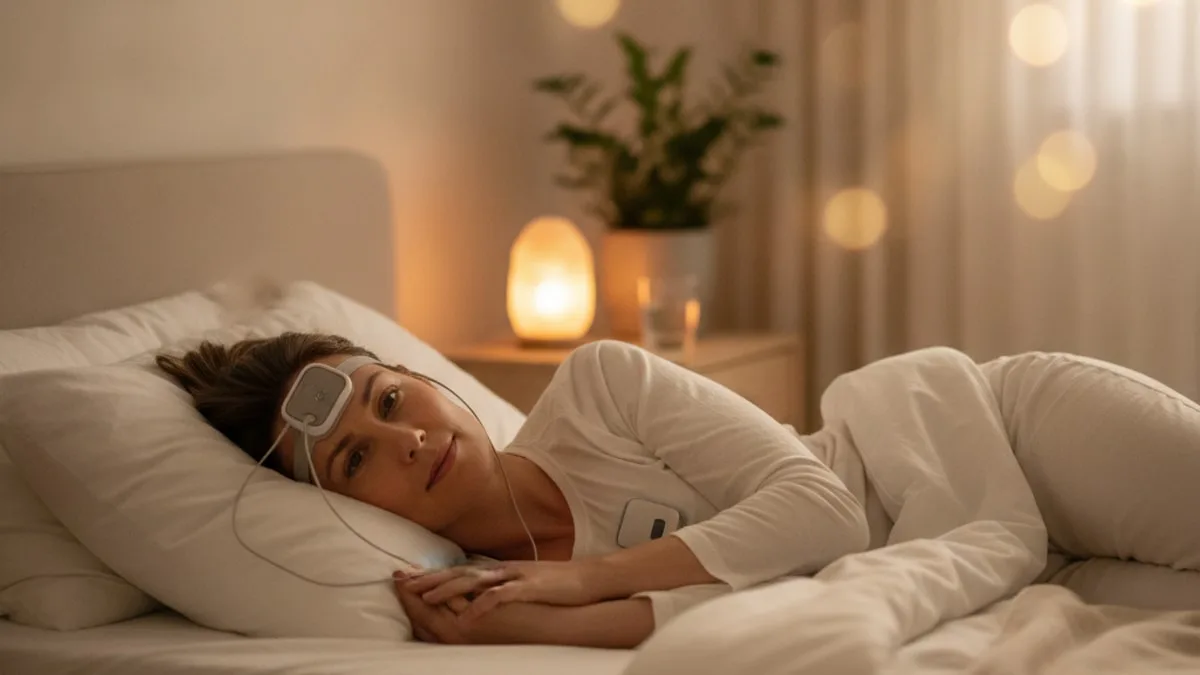
A home sleep apnea test is a portable recording device worn for a single night in your own bed that measures breathing during sleep rather than sleep itself. Three signals do most of the work, airflow at the nose and mouth, the effort the chest and abdomen make to pull air in, and the oxygen saturation of the blood read at a fingertip. Software, usually reviewed by a trained scorer, then counts how often airflow stops or shrinks across the night and reports an average number of those events per hour.
Portable monitors sit on a spread. At one end is a full attended laboratory recording with brain-wave sensors, at the other a single oxygen channel, and home apnea kits generally occupy the middle ground, recording several respiratory channels without electrodes on the scalp 1. That design is a deliberate trade. Removing the scalp and eye sensors makes the kit something an adult can apply alone at bedtime, at the cost of knowing exactly when sleep began and ended.
The purpose is narrow, and it is worth stating plainly. These devices are used to assess breathing in adults where obstructive sleep apnea is already suspected from symptoms and examination 3. A home kit is not a general screen for tiredness, and it is not designed to sort out every reason a night of sleep feels unrefreshing. It answers one question, how often breathing was interrupted, and it answers it under real-world conditions rather than in a laboratory bedroom.
What does the kit actually record overnight?
Most home kits record four to six channels, each tied to one part of the breathing cycle. The combination is what allows an interrupted breath to be identified and classified rather than simply noticed.
| Sensor | What it records | What it cannot show |
|---|---|---|
| Thin tube at the nostrils | Airflow and pressure changes at the nose and mouth | Whether you were asleep or lying awake |
| Elastic belt at the chest or abdomen | Breathing effort, which separates an obstructed breath from an absent one | How much air actually moved |
| Fingertip oximeter | Oxygen saturation and pulse rate | Why a drop in saturation happened |
| Position sensor | Whether you were on your back, side or front | Sleep depth or stage |
| Small microphone | Snoring sound | Severity on its own |
Not every device uses the same hardware. Some families of home monitors replace belts and a nasal tube with signals taken from the finger, combining pulse characteristics with movement sensing to infer breathing disturbance. Device categories differ in how many channels they capture and in how they handle a sensor that slips loose at two in the morning 9. This matters more than it sounds. If the nasal tube comes out, a kit with a belt and an oximeter still has something to work with, while a thinner setup may lose the night entirely.
How does a home test differ from an overnight test in a sleep lab?
The laboratory version, polysomnography, adds brain, eye and muscle recording plus a technologist in attendance, which means it measures sleep itself and not only breathing 4.
| Feature | Home apnea test | Overnight test in a sleep lab |
|---|---|---|
| Where it happens | Your own bed, usual routine | Lab bedroom, sensors applied for you |
| Channels recorded | Airflow, effort, oxygen, position, snore | All of those plus brain, eye, chin and leg signals and heart tracing |
| Sleep staging | Not measured | Measured through the night |
| Index denominator | Hours the device was recording | Hours of measured sleep |
| Sensor failure | Night may be lost or repeated | Staff can replace a sensor mid-night |
| Other sleep conditions | Not assessed | Can be assessed |
| Same-night therapy setup | Not possible | Possible under some protocols |
The denominator difference drives much of the rest. In a lab, events are divided by measured sleep time. At home, there is no sleep signal, so events are divided by recording time, which includes the stretch spent reading, turning over and waiting to drift off. That dilutes the index, and the dilution is one of the recognised limitations of home testing 5. The reverse is also true, and home testing has real advantages, lower cost per night, no waiting list for a lab bed, and a recording taken in the sleeping environment a person actually uses 9.
How is the result scored, and what does AHI mean?
AHI stands for apnea-hypopnea index, the average number of apneas and hypopneas recorded per hour. An apnea is a near-total stop in airflow lasting at least ten seconds; a hypopnea is a partial reduction accompanied by a fall in oxygen saturation or an arousal from sleep. The definitions and measurement techniques for these events were set out by an American Academy of Sleep Medicine task force report 6.
The American Academy of Sleep Medicine task force report sets the severity bands at mild for 5 to under 15 events an hour, moderate for 15 to under 30, and severe for 30 or more 6.
Home reports often use a different label. Because recording time replaces sleep time, many devices report a respiratory event index or respiratory disturbance index rather than a true AHI, and the two are not interchangeable 5. Reading a home report next to a laboratory report without noticing which index is printed is a common source of confusion.
The bands are also a convention rather than a biological boundary. Where the line between normal and abnormal should be drawn has been questioned directly 7. A number just under a band edge in someone with heavy daytime sleepiness and witnessed pauses means something different from the same number in someone with no symptoms, which is why the clinician reading the report weighs the history alongside the index.
Who is a good candidate, and who is usually sent to the lab?
Home testing is built for uncomplicated adults in whom moderate to severe obstructive sleep apnea is already likely. Research suggests that, in adults with a high pre-test likelihood of obstructive sleep apnea and no major competing condition, portable monitoring can support the diagnosis without a laboratory night 2. Guidance on how portable monitoring is used in adults describes the same selection logic, pairing the device with a clinical assessment rather than sending it out blind 8.
The exclusions are where most people get sorted toward the lab. Home testing is generally considered unsuitable in people with significant heart failure, significant lung disease, neuromuscular disease, or a suspicion of a sleep disorder other than obstructive apnea 5. The reasoning is practical. In those situations the breathing pattern may be mixed, the oxygen signal harder to interpret, or the real question may be something a respiratory-only recording never looks at.
Dexterity and living situation count too. The sensors have to be applied correctly at bedtime and stay on, which is harder for someone with limited hand function or cognitive difficulty and no one at home to help. In those cases an attended night is both easier and more informative. None of this is a judgement on anyone. It is a matching problem, and the person ordering the test is matching the question to the tool.
Can a result in the normal range miss sleep apnea?
Yes, and this is the single most important limit to understand. Research suggests that home recordings can underestimate the frequency of breathing events, so a result within the normal range does not rule out obstructive sleep apnea in a symptomatic adult 5.
There are three mechanisms behind that. First, the denominator, as above, includes wakeful time. Second, home kits do not record brain activity, so an event that ends in a brief arousal without a measurable oxygen dip may not be counted at all. Third, sensors fail unattended, and a nasal tube that works loose in the small hours leaves a gap no technologist can fix 9.
The practical consequence is a rule of thumb used in sleep medicine. A positive home test in a person with matching symptoms is usually taken at face value. A negative home test in a person with strong symptoms is usually followed by a laboratory night rather than treated as the end of the enquiry 8. Milder apnea is the category most likely to slip through, which matters because mild disease still produces daytime consequences in some people.
If symptoms persist after a report comes back clear, that is information, not a contradiction. It is worth bringing back to the clinician who ordered the test rather than filing away.
What happens on the night itself?
The night is deliberately ordinary, because the point of testing at home is to record a typical night rather than a staged one. The kit arrives by post or is collected in person, with written and usually video instructions for placing each sensor.
You apply the sensors shortly before your normal bedtime, switch the recorder on, and go to sleep as you otherwise would. Most kits ask that the recording run for a minimum number of hours, so starting earlier rather than later gives a margin if sleep onset takes a while. Follow the instructions supplied with the specific device about skin preparation, nail polish on the oximeter finger, and what to do if a sensor falls off during the night, because these differ between devices. If you take anything regularly in the evening, ask your prescriber before changing anything, since some medicines affect breathing or sleep and the decision is not one to make alone.
In the morning you remove the sensors and return the kit. The raw recording is downloaded, reviewed and scored, and a report goes to the clinician who ordered it, not usually direct to you with an interpretation attached. If too much data was lost, a repeat night is sometimes requested, which is routine rather than a sign that anything went wrong. Some protocols record two or three nights, because night-to-night variation in breathing events is real and a single recording is a sample rather than a census.
How do people get one, and what does it cost?
A home apnea test is ordered after a clinical assessment, not bought as a standalone answer. The assessment usually covers symptoms, sleep timing, witnessed pauses, blood pressure, neck and airway examination and other conditions, because the device is chosen to answer a question that has already been framed. That consultation may happen in person or by telehealth depending on the service.
Costs vary widely by clinic, region and whether the test is delivered through a sleep service, a primary care referral or a direct-to-consumer provider. Coverage rules also differ by payer and plan, and some plans require documented symptoms or a specific referral pathway before a home test is authorised, so it is worth confirming the requirements before the kit is ordered rather than afterwards. Any figure quoted in a general article would be out of date or wrong for your situation, so ask the provider for a written price and ask your insurer what applies.
One thing to clarify up front is who reads the result. A kit that produces a number with no clinician attached leaves you with an index and no interpretation. The useful package is the recording plus a qualified reading plus a conversation about what, if anything, follows. That is also the model portable monitoring was built around, a device used inside a clinical pathway rather than as a consumer gadget 2.
What usually happens after an abnormal result?
An abnormal report starts a conversation, it does not pick a therapy by itself. The clinician reads the index alongside the oxygen tracing, body position data, symptoms, body composition, blood pressure and anything else in the record, then discusses options.
Obstructive sleep apnea is associated with excessive daytime sleepiness, and a CADTH report reviewed continuous positive airway pressure as a management option for adults with the condition 10. Other avenues exist in sleep medicine, including positional approaches, dental appliances made by a dentist with sleep training, airway assessment by a surgeon, and attention to contributing factors. Which of these is appropriate, in what order, and whether any of them is right for one person is a clinical judgement. Treatment decisions belong to a licensed provider who has reviewed the whole picture.
Follow-up is part of the pathway rather than an optional extra. If a therapy is started, the clinician usually wants to know whether symptoms changed, whether the device is tolerated, and whether objective measures improved. If nothing is started, the plan is normally to review symptoms over time, because sleep-disordered breathing can change with weight, nasal patency, alcohol intake and age.
The report itself is not a verdict on your health. It is one measurement from one night, and it is most useful when it is read in context by someone who knows the rest of your history.
Why does heavy daytime sleepiness deserve its own look?
Because sleepiness is the symptom that sends most people toward a sleep test, and it has more than one explanation. Breathing interruptions are one route to unrefreshing sleep. Insufficient time in bed, shift schedules, circadian misalignment, mood, thyroid and iron status, chronic pain and some medicines all reach the same destination, and a breathing-only recording was never designed to tell them apart.
That is why long sleep hours and persistent sleepiness are worth characterising before and after a test. How many hours are spent in bed, how fragmented the night feels, whether sleepiness is worst in the morning or after lunch, whether naps help or leave you groggy, and whether a partner has seen pauses or gasping, all of this shapes what a report means. Someone sleeping ten hours and still exhausted is describing something different from someone sleeping six and nodding off at a desk.
Sleepiness that affects driving or operating machinery changes the urgency of everything else. That is not a wait-and-see symptom, and it is the one situation where the conversation with a clinician should happen now rather than after the next available appointment. Until it is sorted out, arranging alternative transport is the safe default rather than an overcautious one.
Keeping a simple two-week log of bedtime, wake time, naps and how you felt gives the clinician far more to work with than a single recalled estimate.
What can this test not tell you?
It cannot tell you how you slept, only how you breathed. Without brain, eye and muscle channels there is no sleep staging, no measure of how long it took to fall asleep, and no count of arousals, all of which a laboratory recording captures 4.
Several conditions sit outside its reach entirely. Insomnia, periodic limb movements, parasomnias, narcolepsy and nocturnal seizure activity are assessed with channels a home respiratory kit does not carry 5. If one of those is the leading suspicion, a home apnea kit will not confirm or exclude it, and a normal breathing report can be falsely reassuring in that situation.
It also cannot explain why the airway collapses in a particular person. Anatomy, muscle tone, nasal resistance, fluid shift when lying flat and arousal threshold all contribute, and sorting out which dominates takes clinical assessment rather than an index number. Nor does the report say how a person functions during the day, which is why symptom questionnaires and history still carry weight.
Finally, it is a sample. Breathing events vary from night to night with sleep position, alcohol, nasal congestion and sleep deprivation, so one recording describes one night. A result close to a band edge is often interpreted cautiously for exactly this reason, and a repeat recording is sometimes the sensible next step rather than a sign of failure.
How do consumer sleep wearables compare?
A wrist or finger wearable estimates sleep from movement and an optical pulse signal, which is a different kind of measurement from what a medical home kit records. Home apnea devices capture airflow, respiratory effort and oxygen saturation, and it is those channels that allow a breathing event to be identified and classified 1.
That said, wearables are useful for the thing they do well, which is showing patterns over weeks. Bedtime drift, short time in bed, weekend catch-up sleep and heavy variability all show up clearly, and those patterns are genuinely worth bringing to a consultation. Some devices also flag oxygen dips overnight. A flag of that sort is a prompt to ask a clinician a question, not a result, and it is not scored against the event definitions used in sleep medicine.
The practical stance is to treat wearable output as a diary rather than a diagnostic. If it keeps showing fragmented nights, low oxygen flags or a mismatch between hours in bed and how you feel, that is a good reason to seek an assessment. It is not a reason to decide either that you have a condition or that you do not. The person ordering a formal recording is the one who can settle the question.
Where does hemoglobin fit into the picture?
A fingertip oximeter reports the percentage of oxygen-carrying capacity that is saturated, not how much capacity exists, so blood work and an overnight recording answer different questions. Hemoglobin is measured on a standard blood count, and that page covers what it is, how it is measured and how to read a result.
FitScript's optimal range for hemoglobin is 14 to 16 g/dL, and 12 to 15 g/dL for women. The laboratory's own reference range appears as printed on your lab report. Optimal ranges are optimization targets rather than diagnostic cut-offs, and reference ranges vary by lab, age and sex. A value outside the range in either direction is worth discussing with a clinician promptly rather than read alone next to an overnight breathing report.
Which other markers are often reviewed around a sleep question?
Blood work does not diagnose sleep-disordered breathing, but clinicians frequently review a metabolic and nutritional picture alongside sleep complaints because several routine markers bear on energy, breathing and recovery. Which panel makes sense depends on the person and is decided by the clinician ordering it.
Commonly reviewed areas include fasting glucose and HbA1c for glucose handling, a lipid panel, iron markers such as ferritin and transferrin saturation, thyroid markers, vitamin D status, kidney and liver markers, and an inflammation marker such as CRP, reported in words on most panels rather than as a target you set yourself. Blood pressure, measured properly and repeatedly, belongs in the same conversation even though it is not a blood test.
The reason to run these around a sleep question is practical rather than diagnostic. If daytime fatigue persists after breathing has been assessed, a broader data set gives the clinician somewhere else to look, and it establishes a baseline to compare against later. A membership like the one FitScript runs includes 150+ biomarkers tested per year with interpretation by Atlas, its AI health advisor, and any treatment that follows is decided on by a licensed provider after reviewing the person.
One caution worth repeating. A single marker outside a range is an observation, not a conclusion. It may reflect timing, hydration, recent illness, training load or something that deserves follow-up, and the next step is a conversation rather than a self-directed change.
When is it worth talking to a clinician?
Soon, if sleepiness is affecting driving, work safety or daily function, and promptly if a partner reports witnessed pauses in breathing, choking or gasping at night. Those symptoms are the reason home apnea testing exists, and they warrant assessment rather than a watch-and-wait approach.
Other prompts worth raising at a routine appointment include loud habitual snoring, waking unrefreshed despite adequate time in bed, morning headaches, frequent night-time waking to urinate, blood pressure that is hard to control, and difficulty concentrating that does not match workload. Bring the two-week sleep log and any wearable summary, because a pattern is more persuasive than a recollection.
If a home test has already been done, two situations deserve a return visit. One is a report that is outside the normal range, which should be read and explained rather than filed. The other is a report in the normal range in someone whose symptoms have not changed, since home recordings can underestimate milder disease 5.
This page is educational and is not medical advice. Discuss your results, and any treatment option under consideration, with a clinician or licensed provider who can see the whole picture.
Key takeaways
- A home apnea test records breathing, effort and oxygen for one night in your own bed, and it does not measure sleep itself 1.
- Home reports divide events by recording time rather than sleep time, so the index can read lower than a laboratory equivalent 5.
- The American Academy of Sleep Medicine task force report sets severity at mild for 5 to under 15 events an hour, moderate for 15 to under 30, and severe for 30 or more 6.
- A result in the normal range in a person with strong symptoms usually leads to an attended laboratory night, not to a closed file 8.
- Home testing is aimed at uncomplicated adults with a high pre-test likelihood, and other conditions push the assessment toward the lab 5.
- Consumer wearables show patterns worth discussing, not scored respiratory events.
- Sleepiness at the wheel is an emergency, and it is handled first.
Related reading, long sleep hours have their own set of explanations in sleeping too much causes, the question of whether night-time breathing problems move the scale is covered in can sleep apnea cause weight gain, nutrient status and sleep quality are discussed in does vitamin d affect sleep, and if a clinician wants metabolic data alongside a sleep question, how to test blood sugar at home explains the practical side.
References
- Portable monitoring in the diagnosis of the obstructive sleep apnea syndrome. Seminars in Respiratory and Critical Care Medicine, 2005.
- Utility of portable monitoring in the diagnosis of obstructive sleep apnea. Journal of Postgraduate Medicine, 2015.
- Portable monitoring for the diagnosis of obstructive sleep apnea. Current Opinion in Pulmonary Medicine, 2008.
- A Concise Review of Polysomnography and Obstructive Sleep Apnea for the Neurophysiologist. Journal of Clinical Neurophysiology, 2023.
- Home sleep testing for the diagnosis of obstructive sleep apnea-indications and limitations. Seminars in Respiratory and Critical Care Medicine, 2014.
- Sleep-related breathing disorders in adults: recommendations for syndrome definition and measurement techniques in clinical research. The Report of an American Academy of Sleep Medicine Task Force. Sleep, 1999.
- Polysomnography in the diagnosis of the obstructive sleep apnea-hypopnea syndrome: where do we draw the line? Chest, 2000.
- The use of portable monitoring for sleep apnea diagnosis in adults. Expert Review of Respiratory Medicine, 2014.
- Portable monitoring devices in the diagnosis of obstructive sleep apnea: current status, advantages, and limitations. Jornal Brasileiro de Pneumologia, 2010.
- CPAP Treatment for Adults with Obstructive Sleep Apnea: Review of the Clinical and Cost-Effectiveness and Guidelines. CADTH Rapid Response Reports, 2013.
Common questions
How long does a home sleep apnea test take from start to finish?
The recording itself is a single night, and most kits ask for a minimum number of hours of usable data. Before that there is a clinical assessment to decide whether the test fits the question, and afterwards the recording has to be downloaded, scored and reported back to the ordering clinician. Timelines differ by service, so ask the provider what to expect at each stage.
Is a home test as good as an overnight test in a sleep lab?
It records fewer signals and does not measure sleep itself, so the two are not interchangeable. A home kit is designed for uncomplicated adults in whom obstructive sleep apnea is already strongly suspected, while a lab night can assess sleep stages and other sleep conditions. The clinician ordering the test decides which one answers your question.
Can a home test be ruined by not sleeping well?
Poor sleep does not usually ruin a recording, but it can dilute the result, because a home device divides events by the time it was switched on rather than by measured sleep time. If very little sleep happened, or sensors came loose, the service may ask for a repeat night. That request is routine, not a sign that something went wrong.
Does a home test pick up insomnia or restless legs?
No. A home apnea kit records breathing, effort and oxygen, so it does not assess insomnia, limb movements, parasomnias or other sleep conditions. If one of those is the main suspicion, a different assessment is needed, and a clear breathing report would not rule it out. Raise the specific symptoms with the clinician so the right test is chosen.
What should I do differently on the night of the test?
As little as possible, since the point is to record a typical night. Follow the written instructions that come with the device about sensor placement, skin preparation and what to do if something falls off. If you take anything in the evening, ask your prescriber before changing it, because some medicines affect sleep and breathing and that decision is not one to make alone.
My result came back normal but I am still exhausted. What now?
Take that back to the clinician who ordered the test rather than treating the report as the end of the matter. Home recordings can read lower than a laboratory equivalent, and milder breathing disturbance is the category most likely to be missed. Persistent fatigue also has explanations outside breathing, which is why the next step is usually a wider assessment.
Can a smartwatch or ring replace a home sleep apnea test?
No. A wearable estimates sleep from movement and an optical pulse signal, and it does not record airflow or breathing effort. It is still useful as a diary of bedtimes, sleep duration and night-to-night variability, and those patterns are worth bringing to an appointment. An oxygen flag from a wearable is a reason to ask a clinician a question, not a result.
Should I get blood work done around a sleep question?
Often it is useful, and the clinician decides which markers apply. Routine areas reviewed alongside fatigue and sleep complaints include glucose handling, iron and thyroid markers, vitamin D status and basic metabolic panels, plus properly measured blood pressure. Results outside a range are observations to discuss, not conclusions on their own.