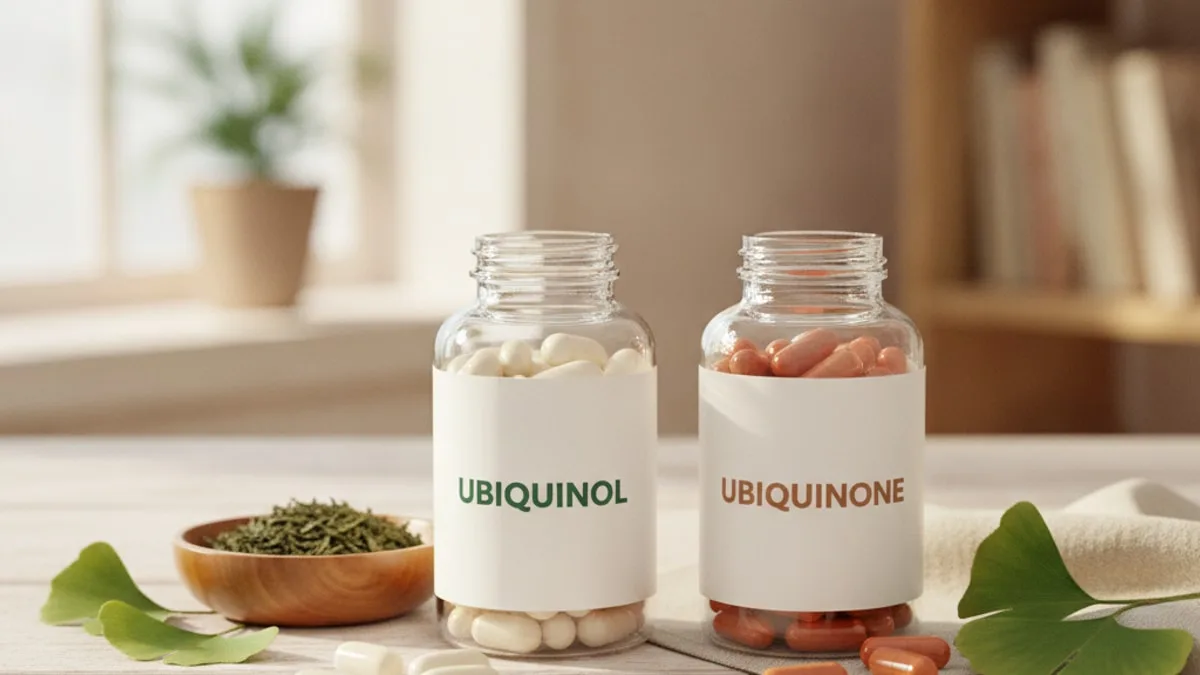
Ubiquinol vs Ubiquinone (How the CoQ10 Forms Differ)
This page explains the chemistry in plain terms, what absorption work has found, why the formulation wrapped around the powder often matters as much as the form printed on the front of the bottle, how to read a label, and what a plasma coenzyme Q10 measurement can and cannot tell you. It is educational content and not medical advice.
What exactly is ubiquinone, and what is ubiquinol?
Ubiquinone is the oxidized form of coenzyme Q10, and ubiquinol is the reduced form, which is the same molecule carrying two extra electrons and two extra protons.
Coenzyme Q10 has two parts. One is a benzoquinone ring, the working end of the molecule, where electrons are accepted and released. The other is a long, fat-loving tail built from ten repeating isoprene units, which is where the 10 in CoQ10 comes from. The tail anchors the molecule inside membranes. The ring does the chemistry.
In the oxidized state, the ring carries two carbonyl groups, and the molecule is called ubiquinone. Add one electron and it becomes a short-lived halfway state known as semiquinone. Add a second electron, with the protons that come along with it, and the ring now carries two hydroxyl groups instead. That molecule is ubiquinol.
That back and forth is the entire job. Inside the inner mitochondrial membrane, coenzyme Q10 accepts electrons from one set of respiratory complexes and passes them to the next, flipping between the oxidized and reduced states over and over as cells generate energy. Outside the mitochondria, in cell membranes and in the lipoproteins circulating in blood, the reduced form behaves as a fat-soluble antioxidant, giving up electrons to neutralise reactive species before they damage nearby fats.
Research suggests that coenzyme Q10 in blood travels mainly with lipoproteins and sits predominantly in its reduced ubiquinol state in healthy people 1. That single detail explains most of the confusion around the two labels. They name a redox state, not two separate nutrients.
Are these two different supplements, or one molecule in two states?
They are one molecule in two states, and the body moves it between those states constantly using its own enzymes.
This matters for how you read a supplement shelf. A bottle labelled ubiquinone and a bottle labelled ubiquinol contain the same compound at different points in its redox cycle. Cells carry enzyme systems that reduce ubiquinone to ubiquinol, and the respiratory chain oxidises ubiquinol back again as part of normal energy production. Nothing about swallowing one form locks the molecule into that form afterwards.
Absorption studies suggest that ingested ubiquinone appears in circulation largely in the reduced ubiquinol state, because reduction happens during and after uptake from the gut 2. The same work notes that plasma coenzyme Q10 is overwhelmingly reduced regardless of which form was swallowed 2, which is consistent with the predominance of the reduced form reported in healthy people 1.
So the common marketing frame, one form being active and the other inactive, does not hold up. Both forms are biologically usable, and the conversion machinery is part of ordinary metabolism rather than something a supplement has to work around.
What genuinely differs between the two is chemical stability. Ubiquinol is the electron-rich state, which makes it more prone to oxidising back to ubiquinone when exposed to air, light or heat. Manufacturers handle that with stabilised ingredient forms, sealed softgels and opaque packaging. Ubiquinone is the more stable powder to work with, which is why it dominated the market for decades before stabilised ubiquinol became commercially practical.
Has one form been compared directly against the other in people?
Both forms have been studied in people, but the head to head comparisons that exist look mainly at how much coenzyme Q10 shows up in blood, not at long-term health outcomes.
A 2023 review that set the two forms side by side in a cardiovascular context noted that much of the longer-running clinical work has used ubiquinone, while ubiquinol has been examined more for how it raises circulating levels, and that direct comparisons between the forms for hard outcomes remain limited 3. That is the honest shape of the picture. People often assume a clear winner exists because the packaging implies one.
Studies indicate that oral supplementation raises measured coenzyme Q10 in both plasma and red blood cells in healthy volunteers 5, which tells you the molecule reaches circulation, not that one form outperforms the other for a particular goal.
Where comparisons do get interesting is in how the product is built. Research suggests that a food-grade coenzyme Q10 formulation improved bioavailability in single-dose and repeated-dose pharmacokinetic work in healthy volunteers 4. Two products naming the same form on the front can therefore behave quite differently in a blood sample, depending on how the powder was dissolved, emulsified or carried.
The practical reading is that the ubiquinol versus ubiquinone question is narrower than it looks. It is one variable among several, sitting alongside the delivery system, the fat content of the meal around it, and the individual absorbing it.
Which form absorbs better?
Ubiquinol is frequently described as the better absorbed form, and some formulations support that, but absorption work points to the delivery system as the dominant factor rather than the redox state alone.
Coenzyme Q10 is a large, strongly fat-loving molecule that is absorbed slowly and incompletely from the gut, and research suggests that uptake improves when it is taken alongside lipids 2. Plasma concentrations rise gradually rather than sharply after oral intake, with peak levels appearing several hours later 2. This is not a nutrient that floods the bloodstream.
A 2020 review identified poor water solubility as the central obstacle to coenzyme Q10 absorption and the reason so much manufacturing effort goes into formulation 6. Crystalline coenzyme Q10 in a dry capsule has to dissolve before it can be absorbed at all, and crystals do not dissolve readily in the gut.
There is a second reason raw absorption comparisons mislead. Because swallowed ubiquinone is largely reduced on its way into circulation 2, a blood test taken afterwards will show mostly ubiquinol either way. The form you ingested is not the form you measure.
Individual variation adds more noise. Research suggests that plasma coenzyme Q10 concentrations are closely tied to circulating lipids and other personal determinants 1, so two people taking an identical product can land in different places. That is precisely the situation where measuring beats guessing.
Does the formulation matter as much as the form?
In absorption terms, the formulation often matters at least as much as whether the label says ubiquinol or ubiquinone.
The core problem is physical. Coenzyme Q10 does not dissolve in water, and poor solubility is described as the main formulation challenge for the ingredient 6. Everything manufacturers do is an attempt to present the molecule to the gut in a form it can take up.
That produces several common approaches on the shelf.
- Oil suspensions in a softgel, where the powder is dispersed in a carrier oil such as a medium-chain triglyceride or rice bran oil.
- Solubilised and self-emulsifying systems, which use emulsifiers to form fine droplets in the gut. Research suggests that a food-grade formulation of this general type improved bioavailability in healthy volunteers across single and repeated use 4.
- Terpene-assisted products, where an ingredient such as d-limonene is included with the intention of keeping the coenzyme Q10 in solution rather than letting it recrystallise.
None of that makes any particular product the right one for a given person. It does mean that comparing a solubilised ubiquinone against a plain powdered ubiquinol, or the reverse, is not really a comparison of the two forms at all. It is a comparison of two delivery systems that happen to carry different redox states of the same compound.
How well tolerated are the two forms?
Both forms are generally well tolerated, and reported effects in supplementation work have tended to be mild.
A 2020 review of coenzyme Q10 supplementation described it as having a favourable safety profile, with adverse reports mostly mild and gastrointestinal in nature 6. Because ubiquinol and ubiquinone are the same molecule, differences in how a product sits with someone usually trace back to the rest of the capsule rather than the redox state, meaning the carrier oil, the emulsifiers, the softgel shell and any added ingredients.
A few practical points come up often. Softgels contain fats, and some people find any oil-based capsule sits heavily. Gelatin shells are animal derived, which matters for vegetarian and vegan readers, and plant-based softgels exist as an alternative. Products that bundle coenzyme Q10 with other actives introduce more ingredients to react to, which makes it harder to work out what caused what.
Anyone taking prescription medicines, anyone pregnant or breastfeeding, and anyone living with an ongoing medical condition should have a licensed provider or pharmacist review a new supplement before starting it, because supplements interact with care that is already in place.
Which goals has each form been looked at for?
A 2020 review surveyed coenzyme Q10 supplementation across a range of health contexts and alongside its safety and formulation challenges 6. The cardiovascular setting is where the two forms have most often been discussed together, and the 2023 comparison noted that longer clinical experience in that area has largely involved ubiquinone 3.
Antioxidant status in blood compartments is another area that has been examined. Studies indicate that oral supplementation raised coenzyme Q10 concentrations in plasma and in erythrocytes among healthy volunteers 5, which is a measurement outcome rather than a clinical one.
Blood pressure is probably the single most common question people bring to this molecule, and it is covered separately on the page about CoQ10 and blood pressure rather than squeezed in here.
Two cautions belong with all of this. First, none of the work above means a supplement addresses a disease, and no supplement should take the place of care a clinician provides. Second, individual response varies, partly because research suggests circulating coenzyme Q10 tracks closely with lipid levels and other personal determinants 1. Where a goal is specific and ongoing, measuring your own level is more informative than extrapolating from group averages.
How do the two forms compare side by side?
The table below summarises the practical differences. It contains no amounts, because the amount on a label and a clinician's guidance determine that, not an article.
| Form | What it is | What research has looked at | Practical notes |
|---|---|---|---|
| Ubiquinone (oxidized CoQ10) | The quinone state of coenzyme Q10, a stable crystalline powder that does not dissolve in water, which is the central formulation obstacle 6 | Slow, partial absorption improved by lipids 2, and the form behind much of the longer clinical experience summarised in a 2023 comparison of the two 3 | Labelled as coenzyme Q10, CoQ10 or ubiquinone. Stable in storage. Found in dry capsules, oil softgels and solubilised formats, and these behave quite differently from one another. |
| Ubiquinol (reduced CoQ10) | The electron-rich state of the same molecule, and the state in which coenzyme Q10 mostly circulates in healthy people 1 | Plasma coenzyme Q10 response, including the comparison with the oxidized form in a 2023 review 3, and rises in plasma and erythrocyte levels after oral supplementation 5 | Named explicitly as ubiquinol on the label. More prone to oxidising on exposure to air, light and heat, so it comes in sealed softgels with protective packaging. Usually the pricier of the two. |
| Either form, as formulated | The same compound presented in a delivery system designed to get it into solution | A food-grade formulation improved bioavailability in single and repeated pharmacokinetic work in healthy volunteers 4 | Delivery system, carrier oil and meal context all influence what reaches the blood. Two products naming the same form are not interchangeable. |
How do you read a CoQ10 label?
Start with the form, then look at everything the front of the bottle is not telling you.
- Find the form by name. The supplement facts panel should say ubiquinol or ubiquinone outright. Where it only says coenzyme Q10 or CoQ10, it is conventionally the oxidized ubiquinone form, but the panel is the place to confirm it rather than the marketing copy.
- Check the amount per serving and the serving size. Amount per capsule and amount per serving are different numbers when a serving is two or three capsules. The label and a clinician set what is appropriate, so the job here is simply knowing what is actually in the bottle.
- Look at the delivery system. Softgel or hard capsule, oil-based or dry, solubilised or plain.
- Be wary of proprietary blends. When several ingredients sit under one blend total, the individual amounts are hidden. You cannot tell how much coenzyme Q10 is in there, and a blend is an easy place for an expensive ingredient to be present in token quantities.
- Look for third-party testing. Independent verification that the contents match the label is the single most useful quality signal on a supplement. The certifier should be named on the packaging, with a lot number or certificate you can look up.
- Check packaging and expiry. Ubiquinol in particular benefits from opaque, sealed, moisture-resistant packaging because of its sensitivity to oxidation. A loose, clear bottle is a poor sign for the reduced form.
- Read the other ingredients. Carrier oils, gelatin or plant-based shells, soy derivatives and colourings all matter for allergies, dietary preferences and tolerability.
- Discount absorption superlatives. Claims that a product is the most absorbable, or many times better than others, are marketing. Formulation genuinely matters 4, but the honest version of that point is specific and modest rather than a slogan on the front panel.
Who should check with a clinician before starting either form?
Anyone whose health is already being managed by a professional should check first, because supplements do not sit in isolation from the rest of your care.
That includes people taking prescription medicines of any kind, people who are pregnant, trying to conceive or breastfeeding, people with liver or kidney conditions, people with a bleeding or clotting disorder, anyone with surgery scheduled, and anyone giving a supplement to a child. It also includes people who are already taking several supplements, where overlap and interaction become harder to track.
Timing matters for one more group. People who are about to have blood drawn for a coenzyme Q10 measurement should tell the ordering clinician what they are already taking and when they last took it, because circulating levels reflect recent intake.
None of this is a reason to avoid asking. It is a reason to ask someone who can see your full picture. Discuss your results, your supplements and any treatment with a clinician or licensed provider before changing anything, and where a prescription therapy is under consideration, a licensed provider evaluates whether it is appropriate for you.
Can a blood test show your CoQ10 status?
Yes. Coenzyme Q10 can be measured in blood, and laboratories can report the total as well as the reduced and oxidized fractions.
Research suggests that plasma reduced, oxidized and total coenzyme Q10 can be measured reliably in humans when samples are handled appropriately, since the ratio between the fractions is sensitive to how the sample is collected and stored 7. Most routine panels report total coenzyme Q10, which is the number people usually see.
Two interpretation points come with it. Circulating coenzyme Q10 is carried on lipoproteins and tracks with lipid levels 1, so results read better alongside a lipid panel than on their own. And supplementation raises measured levels in plasma and erythrocytes 5, so a result reflects recent intake as well as baseline status.
| Measure | Typical lab reference range | FitScript optimal range |
|---|---|---|
| Coenzyme Q10, plasma or serum | 0.5 to 2.5 µg/mL | 1 to 2 µg/mL |
Typical lab reference ranges vary by laboratory, assay, age and sex, so read your own report against the range printed on it. FitScript's optimal range is an optimization target, not a diagnostic cut-off, and a value outside it is not a diagnosis of anything.
Here is how to think about a result. The observation is a number for total coenzyme Q10 in your blood, measured on one day. What it may reflect is a combination of intake, absorption, lipid status and individual variation, all of which influence where the number lands 1. The next step for a result that sits low in the range, or that does not move after months of supplementation, is a conversation with a clinician about absorption, formulation and whether coenzyme Q10 is the right thing to be focusing on at all. A result that is markedly outside the laboratory's stated range is worth discussing with a clinician promptly rather than filing away.
This biomarker is explained in more depth on the Coenzyme Q10 page, including what influences the number over time. FitScript's membership covers 150+ biomarkers tested per year, and Atlas, the AI health advisor, reads each result in the context of the rest of your bloodwork rather than in isolation.
Which foods contain CoQ10?
Food contributes a modest amount of coenzyme Q10, while the body synthesises most of its own supply in its tissues.
The richer dietary sources are concentrated in foods with high mitochondrial density or high fat content. Organ meats such as heart, liver and kidney sit at the top. Oily fish including sardines, mackerel, herring and trout follow, then beef, pork and poultry. Among plant foods, soybean, canola and sesame oils contribute, along with peanuts, pistachios, sesame seeds, and vegetables such as spinach, broccoli and cauliflower in smaller quantities.
Two practical details are worth knowing. Dietary coenzyme Q10 occurs in both the oxidized and reduced states depending on the food and how it has been handled, which is another reminder that the two forms are not exotic alternatives but states of an ordinary nutrient. And because coenzyme Q10 is fat soluble, it is absorbed along with dietary fat 2, so the fat content of a meal matters for what gets taken up.
Which CoQ10 forms does FitScript stock?
FitScript's supplement catalogue carries both forms, so the choice does not depend on which form happens to be available.
On the ubiquinol side, the catalogue lists Designs for Health CoQnol CoQ10 (Ubiquinol), a reduced-form coenzyme Q10 product, and Pure Encapsulations Ubiquinol VESIsorb, which is also a reduced-form product built around a specific delivery system.
On the ubiquinone side, it lists Life Extension CoQ10 (Ubiquinone) with d-Limonene, an oxidized-form product that includes d-limonene, and Pure Encapsulations CoQ10, a straightforward oxidized-form product.
Those descriptions are deliberately limited to form and brand. No product here is ranked above another, and which one suits a given person depends on their bloodwork, what they are already taking, how they tolerate oil-based capsules, and what a clinician advises after reviewing them. The amount on the label and a clinician's guidance determine how any of them is used.
How do people usually decide between the two?
Most people decide on a mix of three practical considerations rather than on chemistry.
The first is what they have already tried.
The second is cost and consistency. Ubiquinol products generally cost more, and a form you take consistently is more useful than a form you buy once. People often choose the option they can sustain.
The third is what their clinician says in the context of everything else they are taking. That conversation is the one that should carry the most weight, and it is also where any question about amounts belongs.
If you want a tiebreaker that is actually informative, it is the blood test. Measure before, take one product consistently as labelled, and measure again. That tells you something specific about your own absorption, which no comparison of the two forms in the abstract can.
Key takeaways
- Ubiquinone and ubiquinol are the oxidized and reduced states of the same molecule, coenzyme Q10, and the body cycles between them as part of normal energy production.
- Coenzyme Q10 circulates mainly on lipoproteins and predominantly in its reduced state in healthy people 1, and swallowed ubiquinone appears in blood largely as ubiquinol 2.
- Absorption is slow and incomplete, improves with dietary fat 2, and is limited above all by poor water solubility 6.
- The delivery system can change how much reaches the blood 4, so comparing two products is rarely a clean comparison of the two forms.
- On a label, confirm the form by name, check the serving size, avoid proprietary blends, and look for third-party testing.
- Plasma coenzyme Q10 can be measured, including its reduced and oxidized fractions 7, and reads best alongside a lipid panel.
- No supplement replaces clinical care, and a licensed provider is the right person to decide what fits alongside your existing treatment.
References
- Coenzyme Q10: absorption, antioxidative properties, determinants, and plasma levels. Free Radical Research, 2002.
- Coenzyme Q10: absorption, tissue uptake, metabolism and pharmacokinetics. Free Radical Research, 2006.
- Comparison of Coenzyme Q10 (Ubiquinone) and Reduced Coenzyme Q10 (Ubiquinol) as Supplement to Prevent Cardiovascular Disease and Reduce Cardiovascular Mortality. Current Cardiology Reports, 2023.
- A New Food-grade Coenzyme Q10 Formulation Improves Bioavailability: Single and Repeated Pharmacokinetic Studies in Healthy Volunteers. Current Drug Delivery, 2019.
- Coenzyme Q10 in plasma and erythrocytes: comparison of antioxidant levels in healthy probands after oral supplementation and in patients suffering from sickle cell anemia. Clinica Chimica Acta, 2002.
- Coenzyme Q10 supplementation: Efficacy, safety, and formulation challenges. Comprehensive Reviews in Food Science and Food Safety, 2020.
- Measurement and stability of plasma reduced, oxidized and total coenzyme Q10 in humans. Scandinavian Journal of Clinical and Laboratory Investigation, 1999.
Common questions
Is ubiquinol better than ubiquinone?
Neither form is better for everyone. They are the same molecule, coenzyme Q10, in two different redox states, and the body converts between them continuously. The delivery system a product uses, and how consistently someone takes it, usually matter more than which of the two words appears on the front of the bottle.
Does the body convert ubiquinone into ubiquinol?
Yes. Cells carry enzyme systems that reduce ubiquinone to ubiquinol, and the respiratory chain oxidises ubiquinol back to ubiquinone as part of normal energy production. In blood, coenzyme Q10 sits mostly in the reduced ubiquinol state in healthy people, whichever form was swallowed.
How much CoQ10 should I take?
This page does not give amounts. The amount per serving is set by the product label, and whether that amount is appropriate for you is a decision for a clinician or licensed provider who can see your full health picture and everything else you are taking.
Can I take ubiquinol and ubiquinone at the same time?
Since both products contain the same molecule, taking them together mainly means taking more coenzyme Q10 overall. Ask a clinician or pharmacist before stacking supplements, and read both labels so you know the total amount you are actually taking.
Does a blood test show my CoQ10 level?
Yes. Coenzyme Q10 can be measured in plasma or serum, and some laboratories report the reduced and oxidized fractions as well as the total. The result reflects recent intake as well as your baseline, so tell the ordering clinician what you are taking and when you last took it.
What is FitScript's optimal range for coenzyme Q10?
FitScript's optimal range for coenzyme Q10 is 1 to 2 µg/mL, against a typical lab reference range of 0.5 to 2.5 µg/mL. The optimal range is an optimization target rather than a diagnostic cut-off, and reference ranges themselves vary by laboratory, assay, age and sex.
Should CoQ10 be taken with food?
Coenzyme Q10 is fat soluble, which is why many labels direct that it be taken with a meal containing fat. Follow the directions printed on the product you are using, and raise any timing question with the clinician or pharmacist guiding your supplements.
Can I get enough coenzyme Q10 from food alone?
The body makes most of its own coenzyme Q10, and food contributes a modest amount on top, with organ meats, oily fish, certain oils, nuts and seeds among the richer sources. Food will not shift a blood level the way a supplement does, so a test is the way to see where you actually sit.
Does ubiquinol go off faster than ubiquinone?
Ubiquinol is the electron-rich state and is more sensitive to air, light and heat, which is why it is usually sold in sealed softgels and opaque packaging. Check the expiry date, store the product as the label instructs, and avoid leaving either form in a warm or sunny spot.