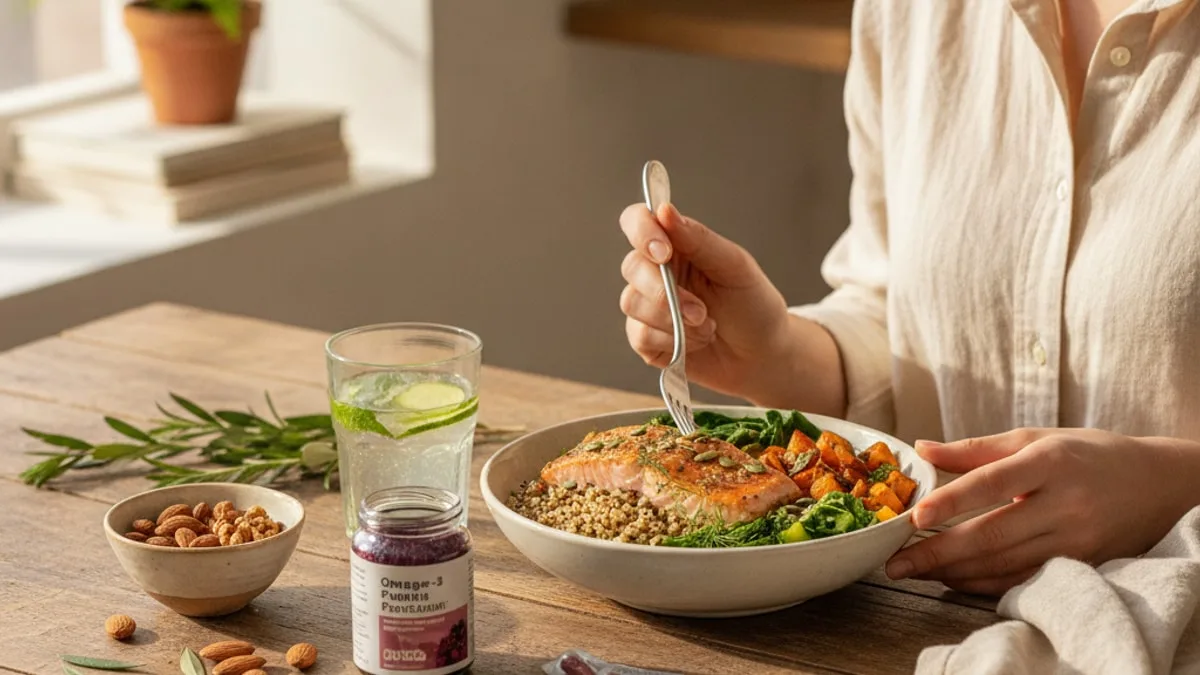
What to Eat on GLP-1 Weight-Loss Treatment
Why does food feel so different once this treatment starts?
Food feels different because the treatment acts on the same signalling your gut uses after a meal, slowing how quickly the stomach empties and quieting appetite. People search for a GLP-1 diet as though it were a fixed menu with set foods and forbidden ones. It is more useful to think of it as a short list of priorities applied to a much smaller volume of food.
GLP-1 is a hormone released from cells in the small intestine when food arrives. It prompts the pancreas to release insulin in response to that meal, slows the movement of food out of the stomach, and acts on appetite centres in the brain so fullness arrives earlier and lingers. A GLP-1 weight-loss treatment keeps that signal switched on for far longer than the natural hormone would.
Three practical consequences follow. First, portion size drops, often sharply, and a plate that once felt normal can feel overwhelming. Second, hunger stops prompting you to eat, so meals have to be planned rather than triggered. Third, eating quickly, eating a large volume at once, or eating a very rich meal tends to produce discomfort, nausea or reflux rather than satisfaction.
None of that tells you what to eat on its own. It simply means every mouthful has to carry more nutrition than it used to, because there are fewer of them. Whether this kind of treatment is appropriate for any individual is a decision a licensed provider makes after an evaluation.
Why does protein come first when appetite drops?
Protein comes first because fast weight loss draws on lean tissue as well as fat, and protein at each eating occasion is the strongest dietary lever against that. Research suggests that structured nutritional management, with protein intake a central element, belongs alongside GLP-1 treatment rather than as an afterthought 1.
In practice that means putting the protein portion on the plate first and eating it first, before the parts of the meal that are easy to finish. When fullness arrives after a few bites, you want those bites to have been the ones that matter. It also means spreading protein across the day rather than loading it into one evening meal, because a stomach that empties slowly handles small amounts better than one large serving.
Dense, easily eaten sources help when volume is limited. Eggs, fish, poultry, lean meat, plain yoghurt, cottage cheese, milk, tofu, tempeh and legumes all pack protein into a small space. On days when solid food is unappealing, protein-rich liquids and soft foods often go down when a plated meal will not.
This guide gives no gram targets, and that is deliberate. The right amount of protein depends on body size, age, kidney function, activity level and how quickly weight is coming off. That is a conversation to have with a clinician who can see your labs, not a number to copy from an article.
Why does muscle loss matter during rapid weight loss?
Muscle matters because weight loss is never purely fat loss, and the lean tissue you give up is not easy to win back. Studies indicate that weight reduction achieved with obesity pharmacotherapy includes a fall in lean mass alongside the fall in fat mass 2. A meta-analysis of randomised controlled trials of GLP-1 treatments at doses used for obesity management reported reductions in measures of muscle mass, with less certainty about what happens to muscle strength and function 3.
Why care? Skeletal muscle is the body's largest site for disposing of glucose after a meal, it carries a meaningful share of daily energy expenditure, and it is what lets you carry shopping, climb stairs and recover from illness. Losing fat while keeping muscle is a different outcome from losing the same number on the scale with a chunk of it coming from lean tissue, even though the scale cannot tell the two apart.
The concern is sharpest in older adults. Low muscle mass combined with reduced strength is associated with frailty, falls and loss of independence, which is why muscle is worth watching during any period of fast weight loss rather than only at the end of it.
The response is not to lose weight more slowly out of fear. It is to pair the reduced intake with enough protein and with resistance training, so the body has both the raw material and the signal to hold on to the tissue you want to keep.
How should meals be structured when the stomach empties slowly?
Meals should be smaller, more frequent and slower, because a stomach that empties gradually tolerates a steady trickle far better than a single large load. Most people land naturally on three modest meals with one or two small protein-containing snacks, though the exact pattern is personal and worth adjusting rather than forcing.
A few structural habits do most of the work:
- Eat slowly and chew thoroughly. Fullness signals arrive late and then arrive all at once, so pace is the main protection against overshooting.
- Stop at the first sign of comfortable fullness rather than at an empty plate. The gap between satisfied and uncomfortable is narrow.
- Keep any single meal moderate in fat. Fat slows gastric emptying further, so a very rich meal stacks a slow process on top of an already slow one.
- Put the biggest, most protein-dense meal at the time of day when appetite is best, which for many people is earlier rather than late evening.
- Stay upright for a while after eating. Lying down soon after a meal makes reflux more likely when the stomach is still full.
It also helps to detach eating from hunger for a while. If appetite is the only cue, meals get skipped, and skipped meals are how protein and micronutrient intake quietly collapse. Setting rough eating times, even when you do not feel like eating, keeps intake from drifting down to a level that is hard to recover from.
Which foods tend to go down easily, and which tend to cause trouble?
Soft, moist, protein-rich foods are usually the easiest, while large, fried, very fatty or fizzy items are the most common sources of trouble. Tolerance is individual and changes over time, so treat the table below as a starting pattern rather than a rulebook.
| Usually easier to tolerate | Often harder to tolerate |
|---|---|
| Poached or baked fish, chicken, eggs, plain yoghurt, cottage cheese | Large fried meals, heavy cream sauces, very rich pastries |
| Soups and stews with protein blended or cooked in | Big portions of doughy bread eaten in one sitting |
| Cooked or roasted vegetables, peeled soft fruit | Large volumes of raw salad or raw vegetables early on |
| Small portions of oats, rice or well-cooked grains | Dense, dry meats eaten quickly without fluid alongside |
| Water and unsweetened drinks sipped between meals | Fizzy drinks, alcohol, very sugary drinks |
Two patterns are worth noticing in yourself. Many people find that food preferences shift on their own, with rich and sweet foods losing some of their pull. That is useful, but it can also drag total intake of real food down to the point where nutrition suffers. The other pattern is the reverse trap, where the only things that still appeal are soft, sweet and low in protein. Both situations are worth raising with a clinician, because the fix is usually a change to what is on the plate rather than a change to anything else.
How much fluid is enough, and why is it so easy to miss?
Fluid needs do not fall just because food intake does, and thirst is easy to overlook when appetite signalling is quieter. Research suggests that inadequate fluid intake sits among the nutritional problems described during obesity pharmacotherapy, alongside low protein and low micronutrient intake 5.
The practical difficulty is competition for space. Drinking a large glass with a meal fills a stomach that is already slow to empty, which crowds out food that is carrying protein and micronutrients. The usual solution is to sip steadily between meals and keep drinks at meals modest, so fluid and nutrition are not fighting for the same volume.
Under-drinking shows up in recognisable ways: headaches, constipation that will not shift, fatigue out of proportion to activity, dark urine, and lightheadedness when standing up quickly. Those symptoms get blamed on the treatment when the cause is often simpler. If they persist despite steady fluids, or if lightheadedness is pronounced, that is worth discussing with a clinician promptly rather than waiting.
Plain water does most of the job. Milk and unsweetened dairy alternatives count and bring protein with them. Broths and soups count twice over, since they deliver fluid, salt and, if made well, protein. Alcohol does not count, and heavy reliance on caffeine can aggravate reflux in people who already have it.
What role does fibre play, and how should it be added?
Fibre matters mainly because slowed gut transit makes constipation common, and it works best when it is increased gradually alongside fluid. Adding a large amount of fibre quickly to a stomach that empties slowly tends to produce bloating and discomfort rather than relief.
A gentler approach works better. Build from cooked vegetables, soft fruit, oats, well-cooked legumes and whole grains in small portions, increase over weeks rather than days, and pair every increase with more fluid. Fibre without fluid can make constipation worse, which is the opposite of the intended effect.
Fibre also feeds the gut microbiome and slows glucose absorption from a meal, both of which are reasons to keep some plant matter in the diet even when total volume is small. The challenge is that fibre is filling, and filling is exactly what you do not need more of when protein is already hard to fit in. That tension is why protein goes on the plate first and fibre fills the space that is left.
Studies indicate that a nutrition-focused approach, including attention to fibre, fluid and protein, may help limit the unintended nutritional consequences of obesity pharmacotherapy 5. If constipation persists despite food and fluid changes, a clinician can look at whether something else is contributing and decide what else is appropriate.
What nutrient gaps show up when total food volume falls?
The gaps that show up are the predictable consequence of eating less of everything: fewer calories means fewer micronutrients unless the food gets denser. A narrative review describes micronutrient and nutritional deficiencies associated with GLP-1 treatment, including shortfalls in protein and in micronutrients such as iron, vitamin B12 and vitamin D 6.
Several factors compound each other. Portion sizes shrink. Meals get skipped when hunger never arrives. Nausea narrows food choices toward bland, low-nutrient options. Whole food groups sometimes drop out because they no longer appeal. Each step is reasonable on its own; stacked together they produce a diet that is adequate in volume comfort and inadequate in nutrition.
The signs are non-specific, which is why they are easy to attribute to weight loss itself: tiredness, hair shedding, brittle nails, poor exercise recovery, feeling cold, low mood, shortness of breath on exertion. None of those identifies a specific deficiency, and none of them is a diagnosis. They are reasons to look rather than reasons to guess.
This article gives no supplement amounts, and that is not an oversight. Whether supplementation is appropriate, and in what form, depends on what your labs show and on everything else going on in your health, which is why that decision belongs to a licensed provider rather than to a search result.
Which lab tests can show those gaps?
The tests that help most are the ones covering protein status, iron, B vitamins, vitamin D, electrolytes and metabolic markers, because those are where the shortfalls of a much smaller diet tend to land first. A single value never diagnoses anything; the pattern across markers, and the direction of travel between tests, is what carries meaning.
| Marker | What it reflects | Why it is worth watching during fast weight loss |
|---|---|---|
| Total Protein and albumin | The total of protein fractions circulating in blood | A falling trend can prompt a closer look at whether intake is keeping pace with loss |
| Ferritin with iron studies | Stored and circulating iron | Red meat, fortified foods and overall volume often drop together |
| Vitamin B12 and folate | Availability of two vitamins needed for red cell production | Intake and absorption both change when the diet narrows |
| Complete blood count, including MCV | Red cell number, size and haemoglobin | Red cell size shifts can point toward iron, B12 or folate issues before symptoms are obvious |
| Vitamin D | Circulating vitamin D status | Commonly suboptimal already, and easy to miss while attention is on the scale |
| Sodium, potassium and kidney markers | Fluid and electrolyte balance, kidney function | Reduced intake, vomiting or poor fluid intake can move these |
| HbA1c, fasting glucose and insulin | Glucose handling over time and at the moment of testing | Shows how metabolic health is responding as body composition changes |
| Lipid panel | Circulating cholesterol and triglycerides | Changes alongside weight and diet composition |
Typical lab reference ranges vary by lab, age and sex, and a result outside a range is an observation to interpret rather than a verdict. FitScript is built around repeat testing, with 150+ biomarkers tested per year and interpretation from Atlas, its AI health advisor, while any treatment decision stays with a licensed provider.
Does resistance training change what you should be eating?
Resistance training does not change the food list much, but it changes what the protein is for, because muscle responds to load and protein is the raw material it uses. Protein without a training stimulus gives the body material with no particular reason to build; training without protein gives a reason with no material.
Two or three sessions a week covering the major movement patterns is the usual shape of it, with walking or other easy activity on other days. Progressive load matters more than exercise variety, and consistency matters more than intensity, particularly when total intake is low and recovery is slower than usual.
Research suggests that these therapies are intended as adjuncts to lifestyle intervention, with nutritional support and activity forming part of the recommended management rather than optional extras 1. That framing matters, because the alternative is losing weight passively and discovering later that a share of what went was tissue you wanted.
Practical timing is simple: eat protein across the day rather than concentrating it, and get some protein in reasonably close to a training session, especially if appetite is poor afterwards. If energy for training is consistently absent, that is usually a sign total intake has drifted too low, which is worth raising at a review rather than pushing through.
How should eating adapt when nausea, reflux or constipation appear?
When gut symptoms appear, change the texture, temperature, size and pace of meals before changing anything else, since most discomfort comes from volume and richness rather than from specific foods. Nausea often eases with smaller, cooler, blander, lower-fat meals and slower eating. Reflux often eases with smaller evening meals, staying upright afterwards and avoiding late eating. Constipation usually responds to the combination of fluid, gradually increasing fibre and daily movement.
What should not happen is protein disappearing from the diet during a rough patch. If solid protein is unappealing, soft and liquid sources often remain tolerable, which keeps intake going until things settle.
Some symptoms are not food problems and should not be managed with food. Persistent vomiting, an inability to keep fluids down, severe or ongoing abdominal pain, signs of dehydration, or symptoms that keep worsening rather than settling are worth contacting a clinician about promptly. Never adjust, pause or stop a prescription therapy on your own judgement; that decision belongs to the licensed provider who evaluated you and who can see the whole picture.
It is also worth keeping a short record of what you ate, how much and how you felt afterwards for a week or two. Patterns that are invisible day to day become obvious on paper, and that record makes a clinical review far more productive than trying to recall it from memory.
What about alcohol, coffee and heavily processed foods?
All three deserve a second look, because when total food volume is small, anything that takes up space without contributing nutrition costs more than it used to. Alcohol brings calories with essentially no protein, vitamins or minerals, contributes to dehydration, and can worsen nausea and reflux on a slow-emptying stomach. Many people also find their desire for it drops on its own.
Coffee is usually fine in moderation and is not a problem for most people, though it can aggravate reflux in people with existing symptoms and does little for hydration if it replaces water. Tea, water and milk-based drinks do that job better.
Heavily processed convenience foods are not banned, and demanding perfection here tends to backfire. The honest issue is density. When you can only eat a small amount, a soft, sweet, low-protein item occupies the slot that could have carried protein, iron and fibre. The simple test is to ask what each item is contributing other than calories and comfort, then build most meals from the ones with a good answer.
Food should still be enjoyable. A diet that is nutritionally perfect and impossible to live with does not survive the months that matter, and the eating habits built during this period are the ones you will rely on afterwards.
What happens to eating if treatment changes or stops?
If treatment changes or stops, appetite usually returns before habits do, which is why the eating pattern built during weight loss matters more than the loss itself. The goal through the whole process is to come out the other side with your muscle largely intact and a way of eating you can maintain without the appetite suppression doing the work for you.
That is why protein-first meals, regular eating times, resistance training and adequate fluid are described here as durable habits rather than temporary measures. They remain sensible when appetite is loud again. A pattern built entirely around tiny portions and limited food variety, by contrast, has nothing to fall back on once hunger returns.
Studies indicate that lean mass changes accompany fat loss during obesity pharmacotherapy 2, which makes the composition of any later weight change worth paying attention to as well. Retesting the same markers at intervals, rather than once at the start, is what makes that trend visible.
Any change to a prescription therapy, including stopping it, is a decision for the licensed provider who evaluated you, made in the context of your results, your symptoms and your goals.
When is it worth talking to a clinician?
It is worth talking to a clinician whenever symptoms persist, intake has dropped to a level you cannot sustain, or results move in a direction you do not understand. Specific prompts include ongoing vomiting or an inability to keep fluids down, dizziness on standing, severe abdominal pain, noticeable hair shedding, fatigue or muscle weakness that is not improving, and markers that have moved into suboptimal territory across repeat tests.
Bring information rather than impressions. A short food and symptom record, your recent lab results, your current activity, and an honest account of how much you are actually eating give a clinician far more to work with than a general sense that something feels off. Bring questions too, about protein, about whether any supplementation is appropriate for you, and about what your results suggest.
This article is educational and not medical advice. Discuss your results, your symptoms and any treatment with a clinician or licensed provider who can evaluate your full history, and never ignore a result that falls outside the standard range.
Key takeaways
- Protein at every eating occasion is the first priority, because fast weight loss draws on lean tissue as well as fat.
- Muscle is worth protecting deliberately with protein plus resistance training, not left to chance.
- Smaller, slower, less fatty meals suit a stomach that empties gradually; eat the protein portion first.
- Fluid needs do not fall with appetite, and sipping between meals avoids crowding out food.
- Add fibre gradually and always alongside fluid, or it can make constipation worse.
- Smaller food volume means fewer micronutrients, so testing beats guessing about gaps.
- Protein status, iron, B12, folate, vitamin D, electrolytes and metabolic markers are the labs that tend to show the problem first.
- Any decision to start, change or stop a prescription therapy belongs to a licensed provider after an evaluation.
If you want to see how structured weight-loss support is organised around this kind of eating pattern, the hub pages for medical weight loss for men and medical weight loss for women set out how the process works, and the guide to what is mcv on a blood test explains one of the red cell markers listed above in more detail.
References
- Dietary Strategies and Nutritional Management in Patients Receiving GLP-1 and Dual GIP/GLP-1 Receptor Agonists as Adjuncts to Lifestyle Interventions: A Systematic Review of Randomised Clinical Trials. Diabetes, Obesity & Metabolism, 2026.
- The effect of obesity pharmacotherapy on body composition, including muscle mass. International Journal of Obesity, 2025.
- Effect of GLP-1 receptor agonists at doses for obesity management on muscle health: systematic review and meta-analysis of randomized controlled trials (RCTs). International Journal of Obesity, 2026.
- Unintended Consequences of Obesity Pharmacotherapy: A Nutritional Approach to Ensuring Better Patient Outcomes. Nutrients, 2025.
- Micronutrient and Nutritional Deficiencies Associated With GLP-1 Receptor Agonist Therapy: A Narrative Review. Clinical Obesity, 2026.
Common questions
What should eating look like day to day on GLP-1 weight-loss treatment?
Smaller meals eaten slowly, with a protein source on the plate first, fluids sipped between meals rather than with them, and fibre increased gradually. Most people settle into three modest meals plus one or two small protein-containing snacks, adjusted to when appetite is best.
Why is protein emphasised so much?
Because weight that comes off quickly includes lean tissue as well as fat, and protein is the main dietary lever for limiting that. The right amount depends on your size, age, kidney function and activity, so ask a clinician who can see your results rather than copying a number.
Can I drink water with meals?
Yes, but keep it modest. A stomach that empties slowly has limited space, and filling it with liquid at mealtimes can crowd out food that is carrying protein and micronutrients. Sipping steadily between meals usually works better for both hydration and nutrition.
Will I lose muscle while losing weight?
Some lean tissue typically goes along with fat during any rapid weight loss, which is why protein at every meal and two or three resistance sessions a week are worth building in from the start rather than adding later.
Which blood tests are worth asking about while losing weight quickly?
Protein status, iron and ferritin, vitamin B12 and folate, a complete blood count, vitamin D, electrolytes and kidney markers, plus glucose and lipid markers. Repeat testing matters more than a single snapshot, because the direction of travel is what tells you something.
What helps with constipation?
Steady fluid intake, fibre increased slowly over weeks rather than days, and daily movement. Adding fibre without extra fluid can make things worse. If it persists despite those changes, raise it with a clinician instead of continuing to adjust on your own.
Do I need supplements?
That is not something to decide from an article. Whether supplementation is appropriate, and in what form, depends on what your labs show and on the rest of your health history, which is why a licensed provider makes that call after reviewing your results.
Should I keep eating this way if the treatment stops?
The habits are worth keeping. Protein-first meals, regular eating times, adequate fluid and resistance training all still make sense once appetite returns. Any decision to pause, change or stop a prescription therapy belongs to the licensed provider who evaluated you.
When should I contact a clinician promptly?
If you cannot keep fluids down, have ongoing vomiting or severe abdominal pain, feel dizzy on standing, or notice fatigue and weakness that keep worsening. Results that fall outside the standard range should also be discussed rather than ignored.