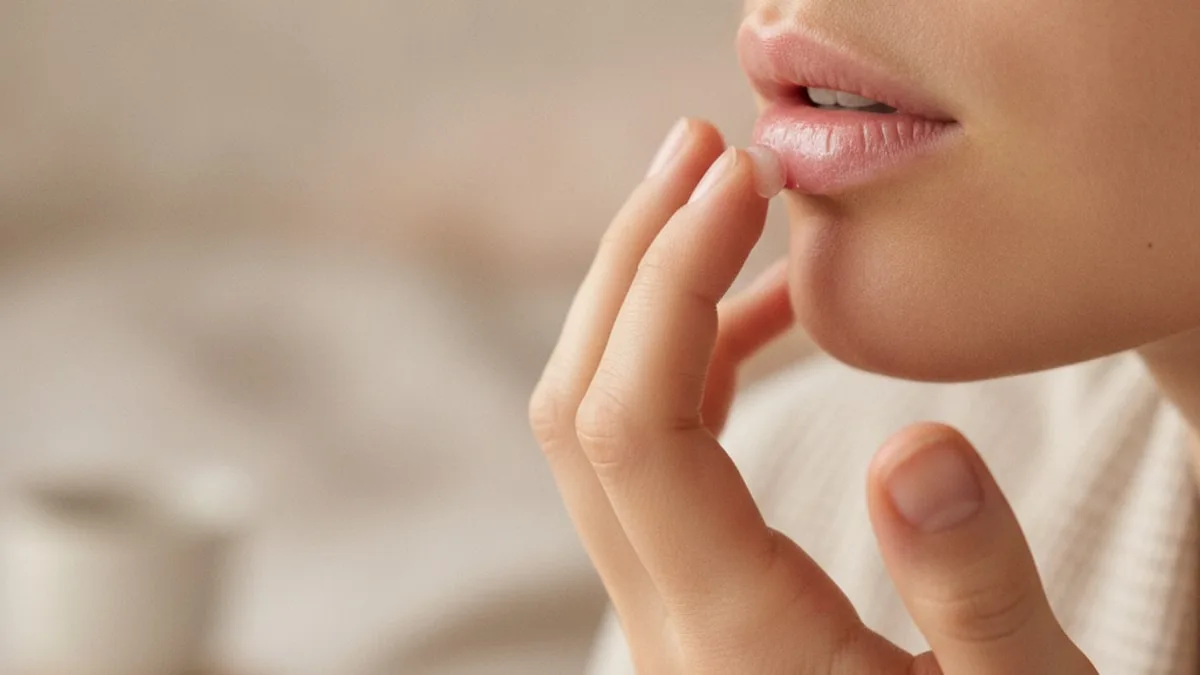
Chapped Lips: Causes and When to Get Checked
Lip swelling that comes with tongue or throat swelling, or with trouble breathing, means call 911 or go to the emergency department.
Dry, cracked or peeling lips sit at a spot that gets wet, dries out, moves all day and meets the weather with very little protection. Blood work does not replace someone looking at your lips, and it does not name a cause on its own. What it can do is flag nutritional and general health markers that a clinician reads next to what the lips actually look like. This article is educational and is not medical advice.
What can make lips dry, cracked or sore?
Cold air, wind, low indoor humidity, indoor heating, air travel and sun all pull water out of the thin skin on the lips, and the lips carry little of the oily film that shields the rest of the face. Dehydration through long training sessions, heavy sweating, alcohol and salty or acidic food push in the same direction.
Lip licking is a cause in its own right. Saliva feels like relief for a few seconds, then it evaporates and takes more water with it, which prompts more licking. The same loop runs with lip picking and biting. Mouth breathing does something similar overnight, particularly with a blocked nose, snoring or hard training that pushes breathing through the mouth.
Things that touch the lips can irritate them or set off an allergic reaction. Reviews of cheilitis, the medical word for inflamed lips, describe contact reactions to lip products, toothpastes, flavourings and foods among the categories a clinician sorts through when lips stay sore 12. Research suggests that cheilitis covers a wide group of underlying causes, from contact reactions and infection through to nutritional and systemic factors, which is why the examination comes before any test 1.
Cracking at the corners of the mouth is described separately, as angular cheilitis. Studies suggest that it can involve local factors such as saliva pooling in the corners, denture or bite changes and yeast or bacterial overgrowth, as well as nutritional factors including iron and B vitamins 3.
Sleep, stress and training load act mostly through behaviour. Short sleep and busy weeks bring mouth breathing, less water, more caffeine, more alcohol and more lip picking. Nothing there shows on a lab report, which is worth remembering before reading too much into a single number.
Life stage matters as well. Menstrual blood loss can draw down iron stores across months, and skin holds less water with age. Anyone who is pregnant or breastfeeding should ask their OB or midwife before changing anything. For a child with cracked lips or sore corners, ask your child's pediatrician.
Some medicines can leave skin and lips drier than they were. Ask your prescriber about anything you take before putting it all down to the weather.
Sun is the cause that slips past people, because it works slowly. Years of outdoor exposure change the lower lip, the part of the face angled toward the sky. Research suggests that actinic cheilitis is associated with long-term sun exposure and produces changes a clinician assesses by looking and, where needed, by taking a small sample 4.
Which blood tests can help explain it?
No blood test diagnoses chapped lips, and the look of the lips leads the assessment. Blood work is used to check nutritional and general health markers that can accompany cracked lips and sore mouth corners, and iron, vitamin B12 and zinc are three a clinician can consider alongside the picture in front of them 13.
| Marker | Why a clinician might check it | What a result can and cannot tell you |
|---|---|---|
| Iron (read with ferritin) | Iron status sits among the nutritional factors that reviews of cheilitis place among underlying causes of sore lips and cracked mouth corners 13. | A value outside the range printed on your lab report is worth discussing with a clinician, who decides what it reflects. It cannot confirm that iron explains your lips. |
| Vitamin B12 | B vitamins support the fast renewal of the lining of the mouth and lips, and reviews list B vitamin deficiency among the causes clinicians weigh 13. | A result sets the direction for further questions about diet, absorption and symptoms elsewhere. It does not rule a contact reaction or sun damage in or out. |
| Zinc | Zinc is used in skin barrier repair and wound healing, and reviews list zinc deficiency among the nutritional causes of cheilitis 1. | Serum zinc moves with recent illness and inflammation, so one value is read in context rather than alone. |
Ranges differ between laboratories and by age and sex, so compare your number with the range as printed on your lab report rather than a figure quoted in an article. A result outside that range is a reason to talk to a clinician, not a verdict on its own.
Can low iron explain cracked lips and sore corners?
Low iron is one possible contributor to sore, cracked lips, not an explanation on its own. Iron is used to build haemoglobin, which carries oxygen, and the lining of the mouth and lips renews itself quickly. That is the reason a clinician asks about the lips alongside tiredness, breathlessness on stairs, hair shedding and heavy periods.
Reviews of cheilitis place iron deficiency among the nutritional causes considered when the corners of the mouth crack and keep cracking 13. That link is one line of enquiry rather than a shortcut.
Several things move iron markers for reasons that have nothing to do with the lips. Menstrual blood loss, pregnancy, blood donation and bleeding in the gut draw stores down. Low dietary intake, coeliac disease and other absorption problems do the same from the other direction. Serum iron shifts across the day and after a meal, which is why a single serum iron value carries less weight than the pattern across markers. Ferritin behaves differently again, because it rises during inflammation and infection, so it can read higher than your stores justify.
The Iron marker page covers what the test measures and how it is read alongside ferritin and a blood count. The sensible sequence is to look at the lips first, then test, then let a clinician join the two.
Can low vitamin B12 show up in your mouth?
Low vitamin B12 is one possible contributor to a sore mouth and sore lips, and it is checked as part of a wider picture. B12 is needed for DNA synthesis and red cell production, and nerve tissue depends on it as well. Tissues that renew quickly, including the lining of the lips, cheeks and tongue, are sensitive to a shortfall, which is why mouth symptoms can appear beside tiredness or tingling in the hands and feet.
Reviews of cheilitis list B vitamin deficiency among the underlying causes clinicians consider, particularly where the corners of the mouth are involved 13. A clinician weighs that against how the lips look, how long symptoms have run and what else has changed.
B12 values move with absorption more than with intake alone. Absorption changes with age, and it changes in people with stomach or small bowel conditions and after gut surgery. Eating patterns with little or no animal food lower intake. Some medicines affect absorption, so ask your prescriber about anything you take. Supplements taken before the draw can lift a serum value, and a serum value can sit inside the range printed on your report while the clinical picture still points elsewhere, which is one reason a clinician reads the number next to your symptoms rather than on its own.
The Vitamin B12 marker page explains what the test captures and the follow-up markers a clinician may add when a result looks borderline.
Does zinc matter for cracked lips and mouth corners?
Zinc is one of the nutritional markers a clinician can check when lips stay cracked, and it is read with care rather than in isolation. Zinc is used across skin barrier repair, wound healing and the turnover of surface tissue, so a shortfall can leave skin slower to recover from everyday damage, including the kind of repeated damage licking and weather cause at the lips.
Reviews of cheilitis include zinc deficiency among the nutritional causes clinicians consider when lips and mouth corners stay inflamed 1. Skin and mouth changes can be part of the picture a clinician builds, alongside appetite, taste, bowel habit and how wounds heal.
Serum zinc is a moving target. It drops during acute illness and inflammation, shifts with the time of day and with how recently you ate, and can be affected by how the sample is handled. Absorption falls in people with inflammatory bowel disease, coeliac disease and other malabsorption conditions, and intake runs lower on eating patterns built mainly on plant foods, where zinc is less available. Heavy sweating through high training volumes adds a further loss. All of that is why one zinc value is a conversation starter rather than a conclusion.
The Zinc marker page sets out what the test measures and the conditions under which a result is best interpreted. Whether anything changes after a result is a decision for a clinician.
What can a normal panel still miss?
A clean set of results does not close the case. Weather exposure, licking, picking, biting and mouth breathing leave no trace in blood. Nor does a reaction to something applied to the lips, which a clinician may explore with patch testing when a product, toothpaste or flavouring is under suspicion 1.
Breathing through the mouth at night is another blind spot. Nasal blockage, snoring and disturbed sleep can keep the lips drying out through the night, and where a clinician suspects a sleep-related breathing problem, sleep tests are arranged for that question, not for the lips.
Sun damage on the lower lip is a visual and microscopic matter. A systematic review with meta-analyses set out the clinical and microscopic features of actinic cheilitis, features no blood test measures 4. Research suggests that actinic cheilitis can change over time, and a systematic review of observational studies examined its transformation into lip cancer, which is why a rough or scaly patch on the lower lip that does not heal is looked at in person rather than watched at home 5.
Persistent lip swelling belongs in its own category. A systematic review of cheilitis granulomatosa, orofacial granulomatosis and Melkersson-Rosenthal syndrome describes lasting lip swelling as a feature of that group of conditions, which a clinician assesses in person 6. Infection and colonisation at the mouth corners also need looking at, not testing from a distance, and denture fit or bite changes are judged in the chair 3.
Dry mouth is worth raising too. Where saliva flow is reduced, including by some medicines, the lips take the brunt of it. Ask your prescriber about anything you take, and describe the dryness rather than guessing at the cause.
When should you see a clinician quickly?
Some signs mean emergency care and nothing else. Call 911 or go to the emergency department for any of the following.
- Lip swelling together with tongue or throat swelling, or with trouble breathing
- Chest pain or pressure
- Fainting or passing out
- Blisters or peeling skin spreading beyond the lips, with fever and sore eyes, mouth or genitals
Other signs call for a prompt appointment rather than waiting things out.
- A rough, scaly or white patch on the lower lip that does not heal
- A sore, ulcer, lump or thickened area on the lip lasting weeks
- Cracking at the corners of the mouth that keeps coming back
- Lip swelling lasting days or returning, with no tongue or throat swelling and no trouble breathing
- Bleeding, crusting or pus at the lips or corners
- Lips that worsened after starting a new product applied near the mouth
- Cracked lips alongside a sore red tongue, mouth ulcers, tiredness, breathlessness on stairs, or numb or tingling hands and feet
- Cracked lips alongside weight loss, diarrhoea or a change in bowel habit
Do not set aside a result that sits outside the range printed on your report, even once the lips settle. A clinician decides what it reflects and what, if anything, comes next. Discuss your results and any treatment with a clinician or licensed provider.
If you are having thoughts of self-harm, call or text 988 (US) or your local emergency number now.
How can you check these markers?
Iron, vitamin B12 and zinc are all measured from a standard blood draw, and the FitScript Essential panel includes them alongside other markers, within a membership that covers 150+ biomarkers tested per year. Atlas, FitScript's AI health advisor, explains each result in plain language and shows which values sit outside the range printed on your report.
Testing works best when it answers a question that the examination has already shaped. Tell a clinician how long the lips have been cracked, whether the corners are involved, what you apply to them, how you breathe at night and what else has changed. Then the numbers have something to attach to. A licensed clinician reviews the whole picture and decides on any next step, and treatment decisions belong to a licensed provider.
Key takeaways
- Reviews of cheilitis group the causes into contact reactions, infection, nutritional factors and systemic conditions, which is why the examination leads and testing follows 12.
- Iron, vitamin B12 and zinc are three markers a clinician can check when lips and mouth corners stay sore, and each moves for reasons unrelated to the lips.
- A value outside the range printed on your lab report is worth discussing with a clinician, who decides what it reflects.
- A rough or scaly patch on the lower lip that does not heal, or a sore or lump lasting weeks, needs a prompt in-person look 5.
- Lip swelling with tongue or throat swelling, or with trouble breathing, means call 911 or go to the emergency department.
If your lips come with other mouth symptoms, the pages on riboflavin deficiency symptoms and burning tongue causes cover the markers and patterns a clinician looks at next.
References
- Cheilitis: A Diagnostic Algorithm and Review of Underlying Etiologies. Dermatitis: contact, atopic, occupational, drug, 2024.
- Differential Diagnosis of Cheilitis - How to Classify Cheilitis?. Acta Clinica Croatica, 2018.
- Clinical inquiries. What is angular cheilitis and how is it treated?. The Journal of Family Practice, 2005.
- Clinicopathological Analysis of Actinic Cheilitis: A Systematic Review with Meta-analyses. Head and Neck Pathology, 2023.
- Malignant transformation of actinic cheilitis: A systematic review of observational studies. Journal of Investigative and Clinical Dentistry, 2018.
- A Systematic Review of the Literature of the Three Related Disease Entities Cheilitis Granulomatosa, Orofacial Granulomatosis and Melkersson - Rosenthal Syndrome. Current Pediatric Reviews, 2018.
Common questions
What causes dry lips?
Dry lips come from water loss at a thin patch of skin with little protection. Cold air, wind, low humidity, sun, dehydration, alcohol, mouth breathing and lip licking all pull moisture out. Products that touch the lips can irritate them, and some medicines can dry them, so ask your prescriber.
Why are my lips always chapped?
Lips that stay chapped point to something repeating rather than one bad day. Licking, picking, mouth breathing at night, a product used daily and sun exposure all repeat. Nutritional markers such as iron, vitamin B12 and zinc can also play a part, which is why a clinician looks at the lips and can check blood work.
Can a blood test show why my lips are chapped?
Not on its own. Blood work checks markers such as iron, vitamin B12 and zinc that can accompany sore, cracked lips, and a value outside the range printed on your report is worth discussing with a clinician. The clinician decides what it reflects after looking at your lips and asking what has changed.
What is angular cheilitis?
Angular cheilitis is the name for cracking, redness and soreness at the corners of the mouth. Saliva pooling in the corners, licking, bite or denture changes, infection and nutritional factors can all feed into it. A clinician examines the corners, asks about habits and decides whether blood work adds anything useful.
Can lip balm make chapped lips worse?
It can. Anything applied to the lips can irritate them or set off an allergic reaction, including flavourings and fragrances, and quick relief can hide a loop of reapplying and licking. If your lips worsened after a new product, stop using it and tell a clinician, who can arrange patch testing.
When should chapped lips be checked by a clinician?
Book a prompt appointment for a rough or scaly patch on the lower lip that does not heal, a sore or lump lasting weeks, corners that keep cracking, or lips that bleed and crust. Lip swelling with tongue or throat swelling, or trouble breathing, means call 911 or go to the emergency department.
Which markers can a clinician check for lips that stay cracked?
Iron, vitamin B12 and zinc are three a clinician can check, and all are measured from a standard blood draw. Results are read next to what the lips look like and what else is going on, never alone. A clinician decides whether anything needs changing and what the next step should be.
Will drinking more water clear chapped lips?
Water matters, but it is one piece of the picture. Lips lose moisture to air, wind, sun and licking faster than drinking alone can replace, so the exposures and habits need attention too. If lips stay cracked for weeks despite that, a clinician can look at them and decide whether blood work helps.