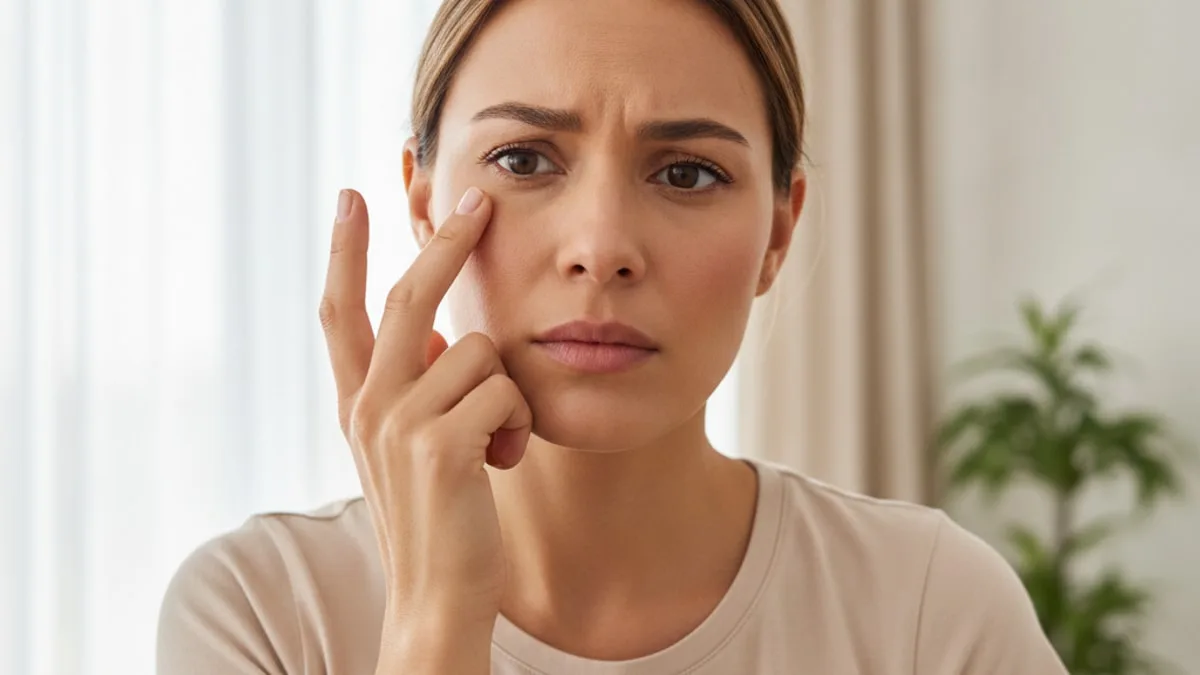
Conjunctivitis (Pink Eye): Causes and Signs
A red eye with severe eye pain, a sudden loss of vision, a chemical splash into the eye, or a blow or cut to the eye needs emergency eye care right now, so call 911 or go to the emergency department.
This page walks through the everyday reasons an eye turns pink, the signs that separate one form from another, the blood markers that add context when allergy is part of the picture, and the signs that call for care today.
What causes conjunctivitis?
Conjunctivitis begins when the conjunctiva, the clear membrane covering the white of the eye and lining the inner eyelids, becomes inflamed and its small blood vessels fill, which is what turns the eye pink. Reviews of conjunctivitis group the causes as infectious, covering viral and bacterial forms, and non-infectious, covering allergic and irritant forms 12.
Start with the everyday triggers, since they sit behind the version of a pink eye that walks into a clinic.
- Viral infection. A watery, red eye can show up around the same time as a sore throat or a runny nose, which is why the picture can blur with common cold symptoms.
- Bacterial infection. Bacteria on the eye surface can produce a thicker discharge and lids that gum together during sleep 1.
- Allergens. Pollen, dust mite, pet dander and mould spores can set off itching and watering in both eyes at once, the pattern covered on the eye allergies page.
- Irritants. Smoke, chlorinated pool water, wind, dust, workshop fumes, eye makeup and makeup remover can all leave the surface inflamed with no infection involved.
- Contact lenses. Long wear, sleeping in lenses, an old storage case, or solution that has been topped up rather than replaced can all irritate the eye surface.
- Hands and shared items. Rubbing the eyes, sharing a towel or pillowcase, and passing around eye makeup move material onto the eye surface.
- Sleep, screens and dry air. Short sleep, long screen sessions, air conditioning and heated indoor air can leave an eye feeling gritty and looking pink without infection or allergy.
- Some medicines. Some medicines can leave the eye dry or red, and your prescriber is the person to ask about that.
- Life stage. Tear production and lid function change across the years, and a drier eye surface reacts more to wind, dust and screens.
Allergic conjunctivitis is associated with allergic rhinitis, and the two together are described as allergic rhinoconjunctivitis 3. That is why an itchy, watery eye in spring can arrive in the same week as a blocked nose and sneezing. Inflammation of the eyelid margin is a separate story with its own pattern, and it is covered on blepharitis symptoms.
What does pink eye look and feel like?
The features described in reviews of conjunctivitis are redness across the white of the eye, watering, discharge, a gritty or burning feeling, and lids that stick together after sleep 12. Swelling of the lids and a sense of something sitting on the eye can run alongside those.
Itching is the feature that leans toward the allergic form, and it is described as the hallmark symptom of allergic conjunctivitis 4. Allergic symptoms can involve both eyes at once and can arrive together with nasal symptoms 34.
The discharge is worth noticing. Watery discharge, thicker discharge, and whether the lids are stuck shut on waking are among the bedside features a clinician weighs when assessing a red eye 5.
What sits outside the conjunctivitis picture described in those reviews is severe eye pain, a drop in vision, or strong light sensitivity 12. Those signs point elsewhere, and they are handled in the care-levels section further down.
Long-running allergic eye disease is described on its own terms. Diagnostic criteria set out for atopic keratoconjunctivitis and vernal keratoconjunctivitis combine the history, the signs seen on examination and allergy findings 6.
How do viral, bacterial and allergic forms differ?
They differ in the quality of the discharge, whether itching leads the picture, and what else is happening in the body at the time, though the three overlap enough that a clinician judges them together rather than one sign at a time.
| Form | Features described in reviews | What can come with it |
|---|---|---|
| Viral | Watery discharge, red and gritty eye, one eye then the second 12 | A sore throat or a runny nose in the same period 1 |
| Allergic | Itching, watering and lid swelling, both eyes involved 4 | Sneezing and an itchy or blocked nose 3 |
Research suggests that bedside features, including the pattern of discharge and whether the lids are stuck together on waking, carry real weight when a clinician assesses a red eye 5. Even so, no single sign settles the question on its own, and a systematic review of clinical practice guidelines for infectious and non-infectious conjunctivitis found differences between guidelines in how these forms are assessed and managed 7.
Which blood tests can help explain it?
No blood test diagnoses conjunctivitis, because the assessment is made by looking at the eye, the lids, the cornea and the pupil 18. Blood markers play a supporting role, mainly when allergy is part of the story or when a wider picture of inflammation is useful to a clinician.
| Marker | Why it comes up with eye symptoms | What a result can and cannot tell you |
|---|---|---|
| Eosinophils (part of a blood count differential) | Eosinophils are the white cells of allergic inflammation | A value outside the range printed on your lab report is worth discussing with a clinician, who decides what it reflects; it says nothing about the eye surface itself |
| Allergen-specific IgE | Allergy testing, including blood tests for allergen-specific IgE, is described as part of working out the trigger in allergic conjunctivitis 4 | Can show sensitisation to a particular allergen; a clinician decides whether that sensitisation explains the symptoms |
| C-reactive protein | A general marker of inflammation anywhere in the body | Does not localise to the eye; a value outside the printed range is worth discussing with a clinician |
Compare any value with the range printed on your own lab report, since ranges vary by lab, age and sex, and bring anything outside that range to a clinician rather than reading it alone.
Can a raised eosinophil count point to eye allergy?
It can add weight to an allergic explanation, and it cannot confirm one. Eosinophils are the white cells that gather where allergic inflammation is active. In chronic allergic eye disease, the diagnostic criteria described for atopic keratoconjunctivitis and vernal keratoconjunctivitis bring together the history, the examination findings and allergy findings rather than a single number 6.
Plenty of other things move an eosinophil count. Other allergic conditions, asthma, skin conditions, some infections and some medicines all shift it, and the count varies from one draw to the next. That is why an eosinophil result is read next to symptoms and timing, not on its own. A value outside the range printed on your report is worth discussing with a clinician, who decides what it reflects.
What does total IgE add?
Total IgE gives a broad read on how allergic the immune system is running, not a read on the eye.
What it cannot do is name a trigger or describe the eye surface. Total IgE also moves with other allergic conditions and with some infections, and a result inside the printed range does not close the door on allergy. The useful next step is a conversation with a clinician about whether more specific testing fits the history.
Can allergen-specific IgE testing name the trigger?
It can show sensitisation to a named allergen, which is a different claim from proving that allergen is behind today's symptoms. Allergy testing, including skin testing and blood tests for allergen-specific IgE, is described as part of identifying the trigger in allergic conjunctivitis 4.
Sensitisation on a blood test and symptoms in real life do not always line up, which is why a clinician reads the result against a symptom diary, the season, the home environment and any pets. Testing is ordered by a licensed clinician, who also decides what, if anything, follows from the result.
Does a white blood cell count sort a viral from a bacterial eye infection?
No. A white blood cell count reports what is circulating in the blood, while conjunctivitis is a surface problem assessed by examining the eye, and a swab can be taken by a clinician when the picture calls for it.
A white cell count also moves with infections elsewhere, with physical stress, with pregnancy, which is a question for your OB or midwife, and with some medicines. It is useful background for a clinician building a whole-body picture, and it is not a test of the eye. Treat the number as context, and let the eye examination do the work it is designed for.
Do general inflammation markers reflect a red eye?
Not in any eye-specific way. A general inflammation marker such as C-reactive protein rises with inflammation anywhere in the body, so it cannot point to the conjunctiva, the eyelid margin or the cornea. The pattern of redness, the discharge and the state of the cornea and pupil are what a clinician reads when sorting a red eye 58.
General inflammation markers still earn their place in a broader health picture, since they track with sleep debt, training load, body composition, infection and recovery. For a pink eye specifically, they are background rather than an answer, and a value outside the printed range is worth discussing with a clinician promptly.
What can a normal panel still miss?
A blood panel inside its printed ranges tells you nothing about the surface of the eye, and several causes of a red eye produce no blood marker at all. A careful look at the cornea, the pupil and the pattern of redness may help separate conjunctivitis from other causes of a red eye 89.
Things a panel does not capture include dry eye, inflammation of the eyelid margin, a foreign body or an eyelash sitting against the cornea, a lens-related problem on the corneal surface, inflammation inside the eye, and raised pressure inside the eye. Features such as a pupil that does not react normally, a cloudy cornea or redness concentrated in a ring around the cornea are described as pointers away from conjunctivitis and toward causes that need urgent eye assessment 9.
The practical takeaway is that labs answer a different question. They describe the internal environment, including allergic tendency and background inflammation, while the eye itself needs eyes on it.
When should you get eye care quickly?
Some red eyes are emergencies, and the signs are specific. Call 911 or go to the emergency department for any of these.
- Severe eye pain with a red eye
- A sudden loss of vision in one or both eyes
- A curtain or shadow across the vision, or new flashes with floaters
- A chemical splash into the eye
- A blow, a cut or a penetrating injury to the eye
- Eye pain with fever and a change in vision
- A red eye together with facial droop, one-sided weakness or numbness, slurred speech or confusion
A separate group of signs calls for a same-day appointment with an eye clinician.
- A red eye in a contact lens wearer
- Light sensitivity that makes a bright room hard to tolerate
- Discharge that keeps rebuilding through the day
- Symptoms that are not settling or that are getting worse across several days
- A red eye in a person whose immune defences are lowered by medicine, which is also a question for the prescriber
- A red eye after recent eye surgery or an eye procedure
- A red eye in a newborn or a young child, which is a call to your child's pediatrician
Nothing on this page replaces that assessment, and no symptom list substitutes for someone looking at the eye.
If you are having thoughts of self-harm, call or text 988 (US) or your local emergency number now.
How can you check these markers?
The markers in the table are ordered through a standard lab panel rather than through any eye-specific test. The FitScript Essential panel measures 40+ biomarkers. Allergen-specific testing is ordered by a licensed clinician when the history points that way.
Once results are back, Atlas, FitScript's AI health advisor, explains what each marker measures and how your values read against the ranges printed on the report, in plain language rather than lab shorthand. Treatment decisions belong to a licensed provider, who evaluates whether anything is appropriate after reviewing the person, the history and the eye itself.
This page is educational and is not medical advice. Discuss your results and any care decisions with a clinician or licensed provider.
Key takeaways
- Conjunctivitis is inflammation of the membrane over the white of the eye, and the causes group into infectious forms, meaning viral and bacterial, and non-infectious forms, meaning allergic and irritant 12.
- Itching leans toward the allergic form, and allergic eye symptoms can travel with nasal symptoms as allergic rhinoconjunctivitis 34.
- No blood test diagnoses a pink eye; eosinophils, IgE and inflammation markers add background, and the examination answers the question.
- A value outside the range printed on your lab report is worth discussing with a clinician, who decides what it reflects.
- Severe eye pain, sudden vision loss, a chemical splash or an eye injury means calling 911 or going to the emergency department.
- A red eye in a contact lens wearer, light sensitivity or symptoms that are not settling deserve a same-day eye appointment.
Related reading on neighbouring eye symptoms includes swollen eyelid causes and feeling something in eye causes.
References
- Conjunctivitis: Diagnosis and Management. American Family Physician, 2024.
- Conjunctivitis: A review. Australian Journal of General Practice, 2024.
- Relationship between allergic rhinitis and allergic conjunctivitis (allergic rhinoconjunctivitis) - review. Romanian Journal of Ophthalmology, 2022.
- ICON: Diagnosis and management of allergic conjunctivitis. Annals of Allergy, Asthma & Immunology, 2020.
- Bedside Diagnosis of the 'Red Eye': A Systematic Review. The American Journal of Medicine, 2015.
- Diagnostic criteria of chronic conjunctivitis: atopic keratoconjunctivitis and vernal keratoconjunctivitis. Current Opinion in Allergy and Clinical Immunology, 2023.
- A Systematic Review of Clinical Practice Guidelines for Infectious and Non-infectious Conjunctivitis. Ophthalmic Epidemiology, 2022.
- Diagnosis and management of red eye in primary care. American Family Physician, 2010.
- Differentiating Urgent and Emergent Causes of Acute Red Eye for the Emergency Physician. The Western Journal of Emergency Medicine, 2017.
Common questions
What are the symptoms of conjunctivitis?
Conjunctivitis shows as redness across the white of the eye, watering, discharge, a gritty or burning feeling, lid swelling, and lids that stick together after sleep. Itching points more toward an allergic form. Severe pain, a drop in vision or strong light sensitivity are not part of that picture and need eye care.
How do pinkeye symptoms start?
Pinkeye symptoms can start in one eye with watering, grittiness and a pink tinge across the white, then involve the second eye. Discharge can build overnight and gum the lids. Allergic forms can begin in both eyes together with itching. A clinician examining the eye decides which form fits.
What causes viral conjunctivitis?
Viral conjunctivitis is caused by a virus reaching the eye surface, which can happen through hands, shared towels, pillowcases or eye makeup, and it can appear around the same period as a sore throat or runny nose. The discharge tends toward watery rather than thick. A clinician confirms what is going on.
Can a blood test confirm pink eye?
No. Pink eye is assessed by examining the eye, the lids, the cornea and the pupil, and a swab can be taken when a clinician judges it useful. Blood markers such as eosinophils and IgE add background on allergic tendency, and inflammation markers reflect the whole body rather than the eye surface.
How is allergic pink eye different from an infection?
Itching leads the allergic picture, both eyes are involved together, and nasal symptoms such as sneezing can arrive at the same time. Infectious forms lean toward discharge, with lids that stick on waking. The two can overlap enough that a clinician decides rather than a symptom checklist.
Is pink eye contagious?
Viral and bacterial forms can spread through hands, shared towels, pillowcases and eye makeup, so washing hands and keeping personal items separate matters while symptoms last. Allergic and irritant forms do not pass from person to person. Ask a clinician about returning to work, school or the gym.
When should a red eye be seen the same day?
A red eye in a contact lens wearer, light sensitivity in bright rooms, discharge that keeps rebuilding, symptoms getting worse over several days, or a red eye after recent eye surgery all call for a same-day eye appointment. Severe eye pain or sudden vision loss means calling 911 or going to the emergency department.
What should you do about pink eye in a child?
Ask your child's pediatrician. A pink eye in a newborn or a young child needs assessment by the pediatrician rather than a symptom list at home, and they decide what the eye needs and whether childcare or school is affected. Any eye injury or chemical splash means calling 911 or going to the emergency department.