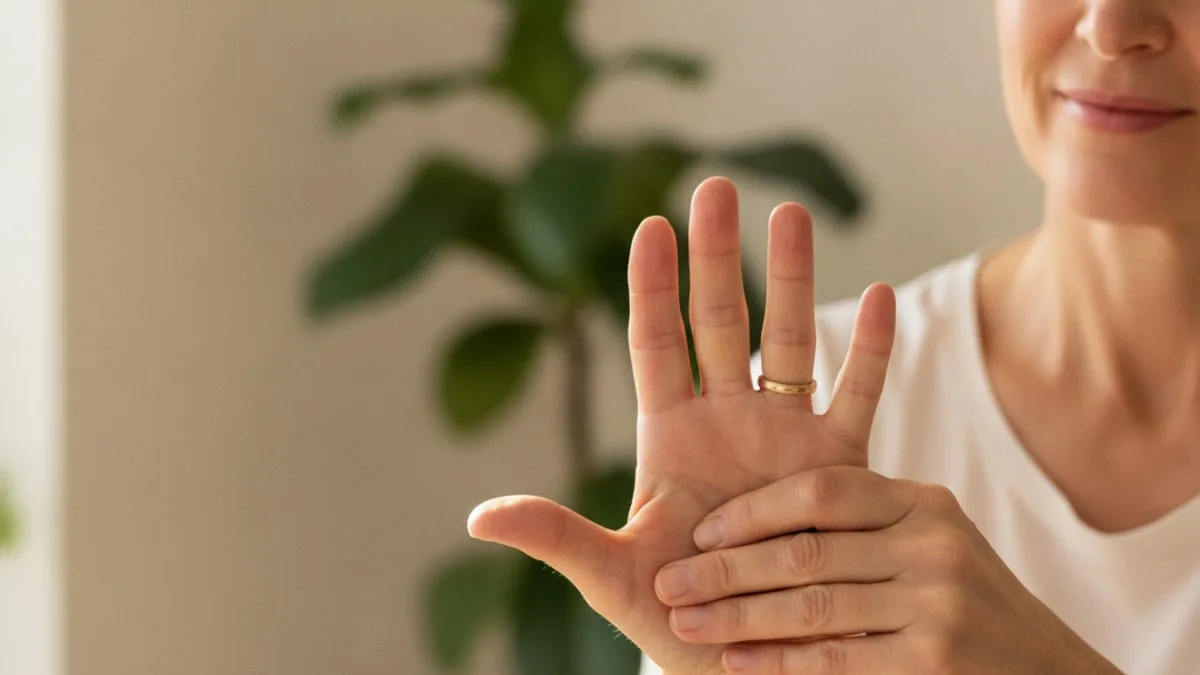
Dupuytren's Symptoms: Lumps, Cords and Bent Fingers
Sudden swelling of the hand together with trouble breathing means call 911 or go to the emergency department.
The rest of this page covers what the lumps and cords feel like in daily life, the everyday factors a clinician asks about, the blood marker that comes up when hand changes are assessed, what a hand examination adds that bloodwork cannot, and the signs that call for prompt or emergency care.
What do the lumps, cords and bent fingers feel like?
It can begin as a firm thickened spot in the palm and end with a rope-like cord that holds a finger bent toward the hand. The changes sit in the fibrous sheet that lies between the palm skin and the tendons, which is why the lump feels anchored rather than loose under the skin.
The early sign can be a small, firm nodule in the palm, near the base of the ring or little finger. The skin over it can dimple, pucker or look pitted, as if it is being tugged from underneath. The nodule can feel tender when pressed, and that tenderness can change over months while the thickening itself stays.
Later, a cord can form that runs from the palm into a finger. It feels like a taut band under the skin and stands out when you try to straighten the finger against it. Once the cord shortens, the finger can start to sit bent, and it can become hard to lay the hand flat on a tabletop.
The day-to-day signs are practical ones. A finger can catch when you reach into a pocket or pull on a glove. Washing your face, flattening your hand on a surface or taking an object from a shelf can feel awkward. A handshake can feel different because the hand no longer opens fully.
Both hands can be involved, and more than one finger in the same hand can be affected. Firm pads can also appear over the finger knuckles, and similar thickening can appear in the sole of the foot. The pace varies from person to person. Some hands change slowly across years, others change over months, which is why a clinician records what the hand does now and compares it at the next visit.
Other hand conditions can look and feel similar from the outside, so a hand examination does the sorting rather than a description or a photograph.
What makes the palm thicken and a finger bend?
There is no single cause. The thickening happens in the fibrous layer under the palm skin, and a set of everyday factors sits alongside that process rather than explaining it on its own.
Age and family background. The changes can appear in later adult life, and they can run in families, so a clinician asks whether a parent, grandparent or sibling had the same hand. Research suggests the condition occurs across world regions, with prevalence differing between the populations studied 1.
Alcohol, smoking and blood sugar. A systematic review of nongenetic factors reports that alcohol intake, smoking and diabetes are associated with Dupuytren's disease 2. Research suggests that smoking is associated with Dupuytren contracture 3. That overlap with blood sugar is the reason a glucose marker comes up when hand changes are assessed.
Hand-loading work. Studies indicate that occupational mechanical exposures, including heavy manual handling, are associated with Dupuytren's disease 4. A clinician asks what your hands do for a living and for how many years they have done it.
Vibrating tools. Research suggests that exposure to vibration is associated with Dupuytren's disease 5. Regular work with hand-held powered tools is worth mentioning at the appointment even if the hand feels fine between shifts.
A hand injury or a spell in a cast. An injury can be the moment someone first notices a lump that was already forming, so the timeline matters to the person examining the hand.
Medicines. Some medicines can shift blood sugar and other values on a panel. Ask your prescriber before changing anything you take, and bring the list to your appointment.
Sleep, stress and training load. These do not thicken the palm, but they move blood sugar and other panel markers around from week to week. That is one more reason the hand examination leads and the labs sit alongside it.
None of these factors, alone or stacked, decides the outcome for one person. They shape the questions a clinician asks and the markers that get checked.
Which blood tests can help explain it?
No blood test identifies this condition, and none measures how far a finger bends. One marker still comes up when hand changes are assessed, because of the factors above.
| Marker | Why it comes up with this symptom | What a result can and cannot tell you |
|---|---|---|
| Hemoglobin A1C | Reflects average blood sugar exposure over the preceding weeks to months | Can show how glucose has been running against the range printed on your lab report. Cannot identify the cause of a lump or cord, and cannot measure the bend in a finger. A value outside the printed range is worth discussing with a clinician, who decides what it reflects |
Reference ranges vary by laboratory, by the method used and by personal factors including age and sex, so read any value against the range printed on your own report rather than against a number from another source.
Can blood sugar explain a lump in the palm?
Not on its own. A systematic review of nongenetic factors reports that diabetes is associated with Dupuytren's disease 2, which is why a clinician can look at how blood sugar has been running while the hand is being assessed.
Hemoglobin A1C measures the share of your hemoglobin that has glucose attached to it. Because red blood cells circulate for a stretch of weeks to months, the value gives an average picture of glucose exposure across that window rather than a snapshot of this morning. That makes it steadier than a single fasting reading, which can move with a short night, a stressful week or a hard training block.
Several things other than glucose can move the number. Anemia, recent blood loss, a recent transfusion, inherited differences in hemoglobin, and kidney or liver conditions can all change how the value reads. Some medicines can shift it too, so ask your prescriber rather than adjusting anything yourself. If you are pregnant, ask your OB or midwife which blood sugar tests apply to you.
Here is how to read it without over-reading it. The observation is a number against the range printed on your report. What it may reflect is a pattern of glucose exposure over recent months, which is one of the factors a clinician asks about alongside family background, smoking, alcohol and hand-loading work. The next step is a conversation. A value outside the printed range is worth discussing with a clinician promptly, who decides whether to repeat it, look wider or leave it.
A value sitting inside the printed range does not settle the question about your hand. The palm is assessed by examination.
What does a hand specialist look at?
A hand specialist examines the palm and fingers directly, feeling for nodules and cords and testing how far each finger straightens. The examination records where the thickening sits, which fingers are involved, and how much extension is lost at each joint, so the next visit has something to compare against.
A clinician can ask you to lay your palm flat on a tabletop and watch whether the hand makes full contact. They can ask you to show the movements that have become awkward, since function matters as much as the measurement. They will also ask when you first noticed the lump, whether it has changed, whether the other hand is involved, and what your hands do at work and at home.
Imaging is not the starting point for every hand. A systematic review of imaging for Dupuytren disease describes ultrasound and MRI being used to look at the thickened tissue in the palm 6. Whether any scan adds something to the examination in your case is a decision for the clinician in front of you, and any scan preparations are explained at the time.
A referral to a hand specialist is worth raising when a finger no longer straightens, when the hand will not lie flat, when the changes are moving quickly, or when the hand is limiting work or daily tasks. Treatment decisions belong to a licensed provider, who weighs what the examination shows against what you need your hand to do.
What can a normal panel still miss?
A full panel can sit inside the printed ranges while the palm is thickening, because blood markers do not look at the tissue in the hand. This is the honest limit of bloodwork for this symptom.
Several things that matter here never appear on a lab report. Family background is a history question, not a measurement. The degree of bend in a finger is recorded by examination with the hand flat and the joints tested. Years of heavy hand work and time spent with vibrating tools are asked about, not assayed. Alcohol and smoking history come from the conversation. How fast the hand is changing needs a second look weeks or months later, not a single draw.
Blood tests also cannot separate this from other hand conditions that produce lumps, catching or stiffness. That separation comes from examining the hand and, when a clinician judges it useful, imaging.
What a panel does give you is context. It shows how glucose has been running, which is one of the factors a clinician asks about in this setting, and it gives a baseline you can compare against later. That is useful information to walk into an appointment with. It is not a verdict on your hand, and a result inside the printed range is never a reason to leave a finger that will not straighten unexamined.
When should you see a clinician quickly?
Some signs mean emergency care and some mean a prompt appointment. Keep them separate.
Call 911 or go to the emergency department for any of these.
- Sudden swelling of the hand together with trouble breathing.
- Chest pain or pressure.
- Trouble breathing.
- Fainting or passing out.
- A hand that suddenly turns cold, pale or blue, or suddenly loses all feeling.
- Weakness or numbness on one side of the body, facial droop, slurred speech or confusion.
- Bleeding from a hand wound that does not stop with firm pressure.
- A hand that is red, hot and swollen with fever: go to the emergency department now.
Seek same-day care for these.
- A hand that is red, hot and swollen without fever.
- A break in the skin of the palm that is draining or spreading redness.
- Pain in the hand that came on quickly and is getting worse hour by hour.
Arrange a prompt visit for these.
- A new lump or cord in the palm, or one that is changing in size.
- A finger that no longer straightens, or a hand that will not lie flat on a table.
- Catching, snagging or loss of grip that is interfering with work or daily tasks.
- Thickening that is spreading to the other hand or to another finger.
- Pain that limits how you use the hand.
Do not try to work out which category you fall into by matching a description online. Bring the hand to someone who can examine it, and say plainly what has changed and when.
If you are having thoughts of self-harm, call or text 988 (US) or your local emergency number now.
How can you check these markers?
The FitScript Essential panel includes Hemoglobin A1C alongside other routine blood markers, drawn at a lab and returned with the range printed on your report. That gives you a measured starting point for the blood sugar question rather than a guess.
Atlas, FitScript's AI health advisor, reads the results back in plain language, points out what sits outside the printed ranges and explains what each marker measures. It is an explainer, not a decision maker. A licensed clinician reviews what comes back and decides on any next step, including whether a hand examination or a specialist assessment makes sense for you.
If your hand has changed, book the examination regardless of what the panel says. Bloodwork adds context to the conversation; it does not replace the hand on the table.
Discuss your results, and any treatment, with a clinician or licensed provider. This page is educational and is not medical advice.
Key takeaways
- Dupuytren's contracture is a thickening of the fibrous layer under the palm skin that can form a nodule, then a cord, and can hold a finger bent toward the palm.
- Skin dimpling, a taut band running into a finger, and a hand that will not lie flat on a table are the signs a clinician wants to see in person.
- There is no single cause. A systematic review of nongenetic factors reports that alcohol intake, smoking and diabetes are associated with Dupuytren's disease 2.
- Studies indicate that occupational mechanical exposures are associated with Dupuytren's disease 4, and research suggests that exposure to vibration is associated with it as well 5.
- Hemoglobin A1C reflects glucose exposure over recent weeks to months. It gives context, it does not identify a hand condition, and a value outside your printed range is worth discussing with a clinician.
- Sudden hand swelling with trouble breathing, chest pain, fainting or a hand that turns cold and pale means call 911 or go to the emergency department.
- A hand that is red, hot and swollen with fever means go to the emergency department now.
- A finger that no longer straightens is a reason to book a prompt examination, and any next step is decided by a licensed provider.
References
- The worldwide prevalence of the Dupuytren disease: a comprehensive systematic review and meta-analysis. Journal of Orthopaedic Surgery and Research, 2020.
- Nongenetic Factors Associated with Dupuytren's Disease: A Systematic Review. Plastic and Reconstructive Surgery, 2020.
- Association between Smoking and Dupuytren Contracture: A Systematic Review and Meta-Analysis. Plastic and Reconstructive Surgery, 2026.
- Dupuytren's disease and occupational mechanical exposures: a systematic review and meta-analysis. Occupational and Environmental Medicine, 2024.
- Dupuytren's Disease and exposure to vibration: Systematic review and Meta-analysis. Joint Bone Spine, 2020.
- Imaging for Dupuytren disease: a systematic review of the literature. BMC Musculoskeletal Disorders, 2019.
Common questions
What is the cause of Dupuytren contracture?
There is no single cause. The fibrous layer under the palm skin thickens and can shorten, pulling a finger toward the palm. A clinician asks about family background, age, smoking, alcohol intake, diabetes, hand-loading work and vibrating tool use, then examines the hand and decides what is worth checking next.
What are the known causes of Dupuytren's disease?
The causes are not fully mapped. What is understood is a set of factors a clinician asks about, including age, family background, smoking, alcohol, diabetes and years of heavy hand work or vibrating tools. None of them alone explains it, and the assessment comes from a hand examination rather than a blood test.
Is Dupuytren's contracture painful?
It can be. A nodule can feel tender when pressed, and that tenderness can change over time while the thickening itself stays. Some people notice no pain and only see a finger that will not lie flat. Pain that limits how you use the hand is worth a prompt visit.
Can a blood test show Dupuytren's contracture?
No. Blood markers do not look at the tissue in the palm and cannot measure how far a finger bends. A panel can still add useful context about things such as blood sugar, and it gives you a baseline. The hand itself is assessed by examination.
Why would a clinician check HbA1c when the palm thickens?
Blood sugar is one of the things a clinician asks about when hand changes are assessed. Hemoglobin A1C reflects average glucose exposure over the preceding weeks to months, which is steadier than a single fasting reading. A value outside the range printed on your report is worth discussing with a clinician, who decides what it reflects.
Can it affect both hands or more than one finger?
Yes. Both hands can be involved, and more than one finger in the same hand can be affected. Firm pads can also appear over the finger knuckles, and similar thickening can appear in the sole of the foot. Mention everything you have noticed at the appointment, not just the worst finger.
When should I ask to see a hand specialist?
Raise it when a finger no longer straightens, when your palm will not lie flat on a table, when the changes are moving quickly, or when the hand is getting in the way of work or daily tasks. Your clinician decides on referral, and any further step belongs to a licensed provider.
Can I stop it from getting worse?
No one can promise that. What you can do is get the hand examined, give an accurate history of your work, tools, alcohol and smoking, and have the blood sugar question answered with an actual measurement. What happens next, including any treatment, is decided by a licensed provider after reviewing you.