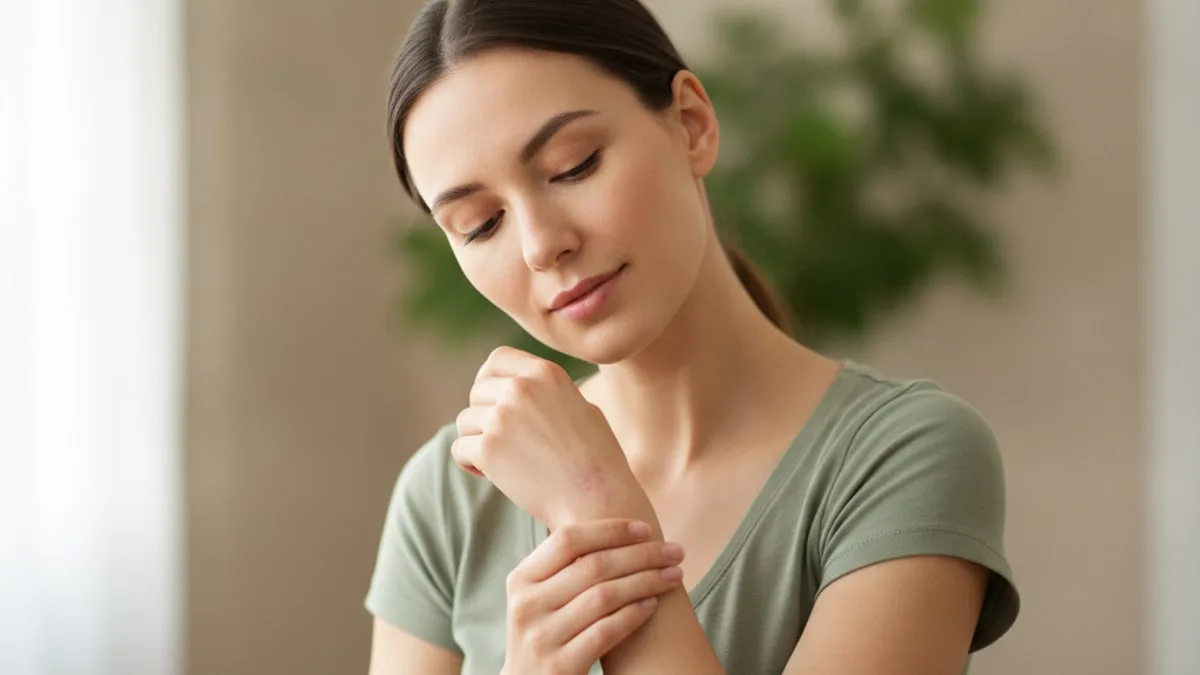
What Causes Eczema in Adults? Triggers and Types
Eczema is not an infection and it is not contagious. Guidelines of care for adults with atopic dermatitis describe a chronic, relapsing itchy skin disease with flares and quieter stretches rather than a one off event 1.
What usually sets off a flare?
Most adult flares come from ordinary exposures acting on a barrier that is already fragile, not from one hidden allergy waiting to be found.
Healthy skin holds water in and keeps irritants out. In eczema prone skin the outer layer is short on the fats and structural proteins that seal it, so water escapes, the surface dries and cracks, and irritants and microbes reach the immune cells underneath. The immune response that follows produces redness, swelling, heat and itch. Scratching then breaks the barrier further, which is why a patch can keep going for weeks after the original trigger has gone.
The exposures people notice most are the dull ones. Harsh soaps and detergents, frequent hand sanitising, hard water, long hot showers, wool and rough seams, dry indoor heating in winter, sudden cold air, heavy humidity, dust and pet dander all strip or irritate the surface. Occupational wet work matters too, and hands that spend the day in water, gloves, food, hair products or cleaning chemicals take the brunt of it.
Sleep and stress rarely start eczema on their own, but many adults recognise the pattern of a flare arriving during a pressured month of short nights. Training load works the same way. Sweat sitting on skin after a session, friction from kit and straps, chlorinated pools and very hot post workout showers can all provoke itch in skin that is already reactive. Rinsing soon after training and dressing in dry clothing is simple friction control rather than a cure for anything.
Food is a less common driver in adults than most people expect, and chasing it with elimination rarely answers the question. Genuine food triggers do exist, and they are identified by a clinician using your history and appropriate testing rather than by guesswork. Alcohol is more straightforward in its effects, since it raises skin temperature, encourages flushing and fragments sleep, and all three can make itch feel worse that night.
Skin reactions can also begin after a change in some medicines. If a rash started within weeks of a new prescription, ask your prescriber about it rather than stopping anything on your own. Life stage plays a part as well, because hormonal shifts across adulthood, a change of climate, a new job and a new home water supply all alter what the skin meets each day. Research suggests that a meaningful share of adult atopic dermatitis begins in adulthood rather than carrying over from childhood, so a first flare at 35 or 55 is not a contradiction 2.
Eczema also arrives in recognisable patterns. Nummular eczema forms coin shaped patches, often on the lower legs, forearms or backs of the hands, and tends to show up on dry skin in cold months. Dyshidrotic eczema produces small deep blisters along the sides of the fingers, on the palms and on the soles, usually with fierce itch, and is often provoked by sweat, wet work and friction. Hand eczema, head and neck involvement and flexural patches behind the knees and inside the elbows are common too. Clinical descriptions of adult atopic dermatitis note that presentation varies widely between adults, including head and neck, hand and nummular forms 3.
Which blood tests can help explain itchy, inflamed skin?
No blood test diagnoses eczema, but a small set of markers can show whether allergic type inflammation is active and whether anything else deserves a clinician's attention. An Italian consensus on moderate to severe adult atopic dermatitis sets out that diagnosis rests on clinical features and history rather than on a single laboratory value 4.
| Marker | Why it is checked when skin is inflamed | What a result can and cannot tell you |
|---|---|---|
| Eosinophils | A white cell type that rises during allergic type inflammation, reported as a percentage of total white cells | A raised percentage can support an allergic pattern. It cannot confirm eczema, name a trigger or measure how severe the skin is |
| Eosinophils Absolute | The actual number of eosinophils per volume of blood, so it is not distorted when other white cells move | Better for tracking the same person over time. It still reflects many causes of allergic inflammation, not eczema specifically |
| Vitamin D (25-OH) | The stored form of vitamin D in blood, which reflects sun exposure, skin coverage and intake | Shows current status. It does not explain a flare on its own and is not a test for eczema |
Compare any value against the range printed on your lab report, since ranges differ by laboratory, age and sex.
Can a high eosinophil count explain itchy skin?
A raised eosinophil percentage can be a sign that allergic type inflammation is active, but on its own it does not explain an itchy rash.
Eosinophils are white cells made in the bone marrow and recruited into tissue during allergic responses and certain infections. On a standard differential they appear as a share of total white cells. When allergic inflammation is running, that share often climbs, which is why Eosinophils turns up so often when skin symptoms are assessed. Descriptions of adult atopic dermatitis phenotypes note that an extrinsic pattern is associated with raised total immunoglobulin E and higher blood eosinophils, while an intrinsic pattern runs with normal immunoglobulin E 3.
Plenty of other things move the same number. Seasonal allergy, asthma, reactions to some medicines, parasitic infection and several unrelated conditions can all raise eosinophils. The percentage also shifts when the total white cell count changes, so a value can look higher simply because other cell lines fell. That is the observation. What it may reflect is an allergic style of inflammation somewhere in the body. What it is worth doing next is bringing the result, the timing of your flares and photographs of the skin to a clinician who can put the three together.
What does an absolute eosinophil count add?
The absolute count reports the real number of eosinophils per volume of blood, so it does not rise or fall just because other white cells moved.
This is the version clinicians usually prefer when they want to follow a person over months. A percentage is a ratio and can mislead after a recent infection or during a stress response, while Eosinophils Absolute gives a figure you can compare directly with your own earlier draws. Total immunoglobulin E is often measured in the same sitting, since the two tend to tell a similar story about allergic activity.
Several ordinary factors shift the absolute count, including time of day, a recent viral illness, allergy season and some medicines. One value outside the range is a prompt to repeat the test rather than a conclusion. Consensus guidance for adults with atopic dermatitis devotes a full section to evaluating patients for related conditions, including other allergic disease and the sleep and mood problems that persistent itch brings with it 5. A result outside the printed range is worth discussing with a clinician promptly, not ignoring and not self interpreting.
Does vitamin D status matter for skin?
Vitamin D (25-OH) measures the stored form of vitamin D in blood, and while it will not explain a flare by itself, it is one of the markers clinicians commonly check when long running skin inflammation is being assessed.
The reason is partly practical. Skin makes vitamin D when ultraviolet B light reaches it, and people with uncomfortable, visible eczema often cover up, avoid strong sun or spend more time indoors. Winter months, higher latitudes, indoor work and deeper skin tones all reduce how much vitamin D the skin produces from the same amount of time outside. Body composition and conditions that reduce fat absorption affect the stored level too.
A status check tells you where you currently sit. It does not tell you why your hands cracked last month. A consensus on the diagnosis and follow up of adult atopic dermatitis describes reviewing adults over time rather than acting on one snapshot, because the picture changes with season, work and life stage 6. If your level sits below the range printed on your report, that is worth raising with a clinician, and any next step including supplementation or prescribed care belongs to a licensed provider who has reviewed you.
What can a normal panel still miss?
A completely normal panel does not rule eczema out, because the diagnosis comes from the skin and the history rather than from blood.
Barrier biology is largely inherited and no routine panel measures it. The same goes for the texture of your water, the detergent in your washing machine, the gloves you wear at work and the number of times a day your hands are wet. Contact allergy is a frequent passenger alongside eczema, and a patch test may help when contact allergy is suspected in an adult being assessed for dermatitis.
Blood also says nothing about which pattern you have. Nummular patches, dyshidrotic blisters and hand eczema look different on the skin and behave differently, yet they can share identical bloodwork. Severity is tracked with structured scoring tools applied to the skin, not with a laboratory number 8. Look alike conditions matter here as well, because psoriasis, fungal infection, scabies and irritant dermatitis can all itch and scale, and only someone examining the skin can separate them.
Finally, a panel cannot see the itch scratch cycle, the three hours of broken sleep every night, or the fact that you have stopped swimming because chlorine stings. Those details change what a clinician recommends more than most markers do.
When should you see a clinician quickly?
Seek prompt care if the skin is spreading fast, weeping, crusting, painful or filling with blisters, or if you feel unwell with fever, because broken skin can become infected.
Get urgent help if redness covers most of your body and you feel cold or shivery, if a rash involves the skin around the eyes with eye pain or changing vision, or if any rash comes with swelling of the lips, tongue or throat or with difficulty breathing. Call emergency services for that last group. If a rash appeared soon after a change in some medicines, contact your prescriber promptly rather than stopping anything yourself. Book an appointment too if itch has wrecked your sleep for weeks, if the skin is not settling with the care you have been given, or if patches keep returning in the same place.
None of this is a self diagnosis exercise. A clinician who can see the skin decides what it is, and consensus statements on moderate to severe adult disease place assessment and management decisions with the clinician after a proper review 9.
If you are having thoughts of self-harm, call or text 988 (US) or your local emergency number now.
How can you check these markers?
The FitScript Essential panel measures eosinophils, the absolute eosinophil count and vitamin D (25-OH) from a single blood draw, so you can see all three together rather than one at a time.
Atlas, FitScript's AI health advisor, reads those results back in plain language, shows how each one sits against the range on your report and tracks the direction of travel across repeat draws, with 150+ biomarkers tested per year across the membership. Interpretation is not the same as a decision. A licensed clinician reviews the full picture, examines the skin where that is needed and decides whether any treatment is appropriate.
This article is educational and not medical advice. Discuss your own results, your flares and any treatment with a clinician or licensed provider.
Key takeaways
- Adult eczema starts with a leaky skin barrier and an immune system that reacts too readily, then gets provoked by soap, hard water, sweat, friction, dry air, short sleep and stress.
- Patterns differ. Nummular eczema makes coin shaped patches, dyshidrotic eczema makes deep blisters on hands and feet, and hand eczema tracks closely with wet work.
- Eosinophils and the absolute eosinophil count can show that allergic type inflammation is active, but neither names a trigger or confirms eczema.
- Vitamin D (25-OH) reflects sun exposure, skin coverage and intake, and is checked as part of a wider picture rather than as a skin test.
- A normal panel does not rule eczema out, and patch testing is the route when contact allergy is suspected.
- Spreading, weeping, painful or feverish skin deserves prompt care, and management decisions belong to a licensed provider.
For more on the markers mentioned above, see the explainer on the ige blood test and the overview of what food sensitivity tests can and cannot show.
References
- Focused update: Guidelines of care for the management of atopic dermatitis in adults. Journal of the American Academy of Dermatology, 2025.
- A systematic review and meta-analysis of the prevalence and phenotype of adult-onset atopic dermatitis. Journal of the American Academy of Dermatology, 2019.
- Clinical phenotypes of adult atopic dermatitis and related therapies. Current Opinion in Allergy and Clinical Immunology, 2022.
- Diagnosis and management of moderate to severe adult atopic dermatitis: a Consensus by the Italian Society of Dermatology and Venereology (SIDeMaST), the Italian Association of Hospital Dermatologists (ADOI), the Italian Society of Allergy, Asthma and Clinical Immunology (SIAAIC), and the Italian Society of Allergological, Environmental and Occupational Dermatology (SIDAPA). Giornale Italiano di Dermatologia e Venereologia, 2018.
- Approach to the Assessment and Management of Adult Patients With Atopic Dermatitis: A Consensus Document. Section III: Evaluation of Atopic Dermatitis Patients for Comorbidities. Journal of Cutaneous Medicine and Surgery, 2018.
- Tuscan Consensus on the diagnosis, treatment and follow up of adult atopic dermatitis. Giornale Italiano di Dermatologia e Venereologia, 2020.
- Approach to the Assessment and Management of Adult Patients With Atopic Dermatitis: A Consensus Document. Section II: Tools for Assessing the Severity of Atopic Dermatitis. Journal of Cutaneous Medicine and Surgery, 2018.
- Approach to the Assessment and Management of Adult Patients With Atopic Dermatitis: A Consensus Document. Section V: Consensus Statements on the Assessment and Management of Adult Patients With Moderate-to-Severe Atopic Dermatitis. Journal of Cutaneous Medicine and Surgery, 2018.
Common questions
what is eczema
Eczema is a long-running inflammatory skin condition in which the skin barrier leaks moisture and reacts to irritants, producing dry, itchy, red or darkened patches that flare and settle. Atopic dermatitis is the most common form in adults. A clinician diagnoses it from the skin and your history, not from a blood test.
eczema rash
An eczema rash usually looks dry, scaly and itchy, with redness on lighter skin and grey, purple or darker brown tones on deeper skin tones. It can weep or crust during a bad flare and thicken where it has been scratched for weeks. Patterns vary by body area and by person.
nummular eczema
Nummular eczema forms round or oval coin shaped patches, most often on the lower legs, forearms or backs of the hands. The patches are intensely itchy and can weep before drying into scale. Dry skin, cold weather, hot showers and small skin injuries often precede it, and a clinician confirms what the patches are.
What is dyshidrotic eczema?
Dyshidrotic eczema produces small, deep, intensely itchy blisters along the sides of the fingers, on the palms and on the soles. It often flares with sweat, wet work, friction and heat. The blisters usually dry into peeling skin over a couple of weeks, and a clinician can confirm the pattern and advise on next steps.
Can a blood test tell me what triggers my eczema?
No. Blood markers such as eosinophils, the absolute eosinophil count and vitamin D can show whether allergic type inflammation is active and where your vitamin D status sits, but they cannot name a trigger. Triggers are identified from your history, your exposures and, when contact allergy is suspected, patch testing arranged by a clinician.
Does stress make eczema worse?
Many adults notice flares during pressured periods with short, broken sleep. Stress does not create eczema on its own, but it sits alongside heat, sweat, scratching and skipped skincare, and those stack up. Tracking when flares arrive, and what changed in the week before, gives a clinician something useful to work with.
Can eczema start for the first time in adulthood?
Yes. Plenty of adults develop eczema for the first time with no childhood history, sometimes after a job change, a house move, a new water supply or a long run of hand washing. A clinician examines the skin to separate it from other itchy conditions that can look similar.
How is eczema different from psoriasis?
Eczema patches tend to be itchy, dry and poorly defined, and often sit in skin folds or on the hands. Psoriasis plaques are usually thicker, sharply edged and silvery, and favour elbows, knees and the scalp. The two can be hard to tell apart on photos, so an in-person examination decides it.