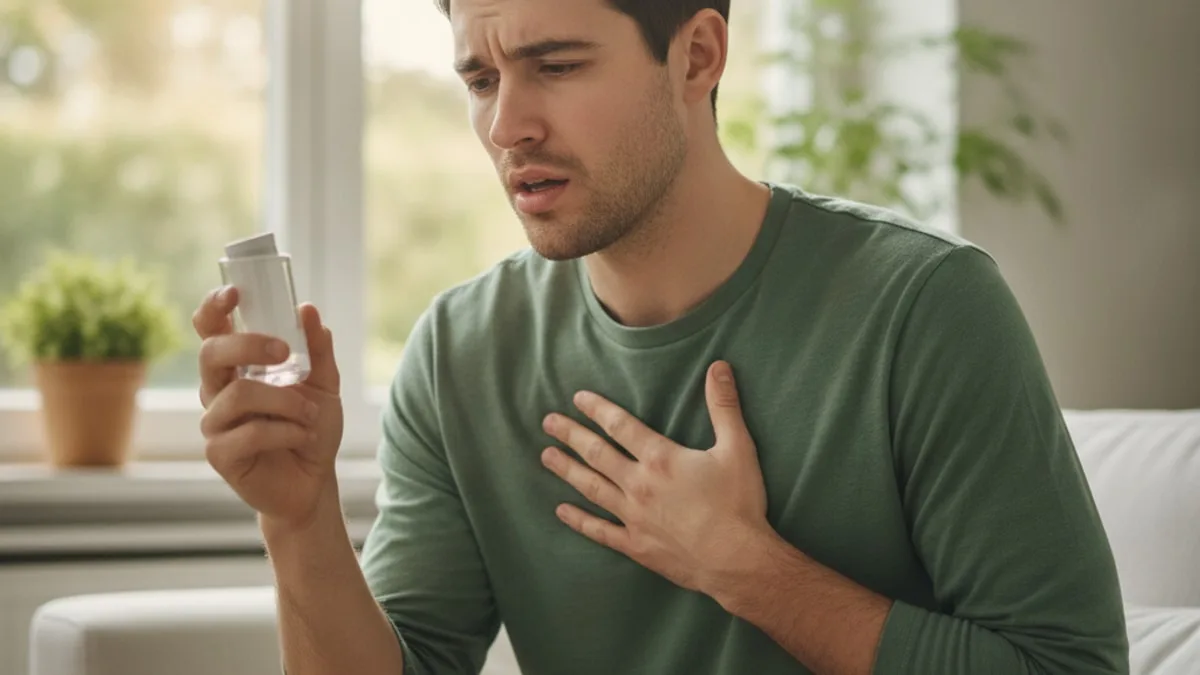
EVALI: Vaping Lung Injury Symptoms
Trouble breathing, chest pain or pressure, blue or grey lips or fingertips, fainting or passing out, or new confusion after vaping means call 911 or go to the emergency department.
This page is health education and not medical advice. Discuss your symptoms, your history and any lab results with a clinician or licensed provider who can see the whole picture.
What can bring on symptoms like these?
Cough, breathlessness, fever and stomach upset have many everyday explanations, and lung injury after vaping is one possible reason among them. Several ordinary causes can stack up at once. Viral respiratory infections can produce cough, fever and days of flat energy. Allergy and asthma flares can tighten the chest and make a stair climb feel harder than it did a week earlier. Acid reflux can irritate the throat and set off a dry cough at night.
Load and lifestyle matter as well. Short sleep, a heavy training block and alcohol can leave the body feeling worn down and can make breathlessness during exercise more noticeable. Smoke, dust and poor air quality can irritate the airways for days after the exposure has passed. Some medicines can cause cough or stomach upset, so ask your prescriber if a new symptom lines up with a recent change. Life stage counts too, since pregnancy changes how breathing feels, and anyone who is pregnant can ask their OB or midwife about new chest symptoms.
Vaping-associated lung injury sits alongside those everyday explanations rather than replacing them. It describes lung damage connected to the use of e-cigarette and vaping products 2. Research suggests that vitamin E acetate added to THC containing vaping cartridges is associated with the cluster of lung injury cases described during the outbreak 3. Studies indicate that some people assessed for this injury reported using nicotine containing products only, so the picture is not limited to THC products 2.
Which symptoms have been described after vaping?
Three groups of symptoms have been described, respiratory, whole body and digestive 1. The respiratory group covers cough, chest discomfort and shortness of breath. The whole body group covers fever, chills, fatigue and weight loss. The digestive group covers nausea, vomiting, diarrhea and abdominal pain 2.
Studies indicate that digestive symptoms can appear before breathing symptoms in some people, which is part of why the early picture can look like a stomach bug 4. Research suggests that symptoms can build across days to weeks rather than arriving in a single hour 5. Low blood oxygen and breathing failure have been described in people admitted to hospital with this injury 4.
Trouble breathing, chest pain or pressure, blue or grey lips, fainting or new confusion mean call 911 or go to the emergency department.
Which blood tests can help explain it?
No single blood test names this injury. Blood work is used to show how much inflammation is present, to look for other explanations such as infection, and to see which organs are being affected 4. The table below sets out the markers a clinician can reach for when someone reports these symptoms after vaping.
| Marker | Why it is linked to these symptoms | What a result can and cannot tell you |
|---|---|---|
| Total white blood cells (WBC) | White cells rise when the immune system is activated, and a raised white cell count has been described in people assessed for vaping-associated lung injury 4. | A raised count shows the body is responding to something. It does not say what. |
| C-reactive protein (an inflammation marker) | Raised inflammatory markers have been described in this injury 5. | Shows inflammation is present somewhere in the body. It cannot point to the organ or the cause on its own. |
| Erythrocyte sedimentation rate (ESR) | Another general inflammation measure reported alongside raised white cells in these cases 5. | Moves with many inflammatory states, so it adds context rather than an answer. |
| Liver enzymes (ALT, AST) | Raised liver enzymes have been described in people assessed for this injury 5. | Can reflect alcohol, infection, body composition or some medicines, so ask your prescriber about anything you take. |
Compare any value against the range printed on your lab report, since ranges vary by lab, by age and by sex. A value outside that printed range is worth discussing with a clinician, who decides what it reflects.
Can a raised white blood cell count explain feeling ill after vaping?
A raised white cell count can show that the immune system is responding, but on its own it does not say to what. White blood cells are the circulating arm of the immune system, and their number shifts when the body meets an infection, an irritant or tissue injury. A differential count breaks the total into neutrophils, lymphocytes and other cell types, which gives a clinician a little more direction without naming a cause.
Research suggests that a raised white cell count is associated with the inflammatory picture reported in people assessed for vaping-associated lung injury 4. The same finding appears in reviews of clinical, imaging and tissue features of these cases 5. That overlap is exactly why the number cannot stand alone, because a chest infection produces the same shift.
Plenty of other things move this marker. Any infection can raise it. Hard training, physical stress, smoking, pregnancy and inflammation anywhere in the body can nudge it as well, and some medicines change white cell counts in either direction, so ask your prescriber. Counts can also sit below the printed range for reasons that have nothing to do with the lungs. You can read what the marker measures on the Total WBCs page, and bring the result to a clinician rather than drawing a conclusion from it.
What do chest scans add that blood work cannot?
Imaging looks at the lungs directly, which no blood test does. Research suggests that the pattern described on chest scans in these cases is a hazy change through both lungs, with the regions closest to the chest wall sometimes spared 8. A plain chest x-ray can look unremarkable early on while a chest scan shows those changes, which is one reason a clinician can order more than one test 7.
Studies indicate that lung tissue from these cases shows patterns of acute lung injury rather than one unique signature, and that fat filled immune cells seen under the microscope are not specific to this injury 6. Clinicians therefore work through other explanations such as infection before settling on vaping-associated lung injury, using history, blood work and imaging together 4. Breathing tests can also be used to measure how well the lungs move air and transfer oxygen 7.
If you are booked for a scan, ask the ordering clinician about any scan preparations in advance, since those instructions differ by test and by site.
What can a normal panel still miss?
Normal blood work does not rule out lung injury. Research suggests that the blood findings described in these cases are non-specific, so history and imaging carry much of the weight in the assessment 4. No blood marker is specific to this injury 1.
Several things that drive the same symptoms never show in a tube of blood. Airway irritation from smoke or vapour does not have a marker. Reduced lung function shows on a breathing test, not on a panel. Reflux, poor sleep, anxiety, deconditioning after a layoff and allergy exposure all shape how breathing and energy feel, and none of them appear in bloodwork. What you inhaled, how recently and how much is history, not chemistry, which is why a clinician asks about it directly.
The reverse is also true. A marker can sit outside the printed range for a reason unrelated to the lungs, including recent training, an unrelated infection or something you take. That is why a result is a starting point for a conversation rather than an answer.
When should you see a clinician quickly?
Some signs need emergency care now, and a separate set needs a prompt visit. Call 911 or go to the emergency department for any of these.
- Trouble breathing, or breathlessness at rest or with light activity
- Chest pain or pressure
- Blue or grey lips, face or fingertips
- Fainting or passing out
- New confusion, or difficulty staying awake
- Coughing up blood
Contact a clinician promptly, the same day where possible, for these.
- A new cough, or a cough that keeps getting worse, after using vaping products
- Fever or chills
- Nausea, vomiting, diarrhea or abdominal pain that keeps going
- Unexplained weight loss
- New fatigue that does not lift with rest
- Symptoms that keep returning after you stop using vaping products
Bring the details with you. What you used, what was in it, when it started and what has changed since all shape the assessment. Do not try to work out the cause yourself from a single lab value or a symptom list, and do not let a result sit unexplained. A clinician decides what the findings reflect and what comes next.
If you are having thoughts of self-harm, call or text 988 (US) or your local emergency number now.
How can you check these markers?
The FitScript Essential panel measures markers from this page, including total white blood cells with a differential, inflammation markers and liver enzymes, alongside the rest of a broad baseline draw. Members have 150+ biomarkers tested per year, which means a value can be read against your own earlier results rather than a single snapshot.
Atlas, the AI health advisor, explains what each result means in plain language and flags what is worth raising with a clinician. Interpretation is not a substitute for care. A licensed provider evaluates symptoms, history and examination together, and treatment decisions belong to a licensed provider.
Key takeaways
- Lung injury linked to vaping has been described with respiratory, whole body and digestive symptoms, including cough, breathlessness, chest pain, fever, chills, weight loss, nausea, vomiting and abdominal pain 1.
- Trouble breathing, chest pain or pressure, blue or grey lips, fainting or new confusion mean call 911 or go to the emergency department.
- Everyday causes such as viral infections, allergy and asthma flares, reflux, short sleep and air quality can produce overlapping symptoms, so the history matters as much as the symptom list.
- Research suggests that vitamin E acetate in THC containing cartridges is associated with the cluster of cases described during the outbreak 3.
- White cell count, inflammation markers and liver enzymes add context, and studies indicate that these blood findings are non-specific rather than confirmatory 4.
- A plain chest x-ray can look unremarkable while a chest scan shows changes, so normal results on one test do not close the question 7.
- Any value outside the range printed on your lab report is worth discussing with a clinician promptly, who decides what it reflects.
For related reading on this site, see does vaping cause brain fog for how vaping can show up in thinking and energy, and shortness of breath causes for a wider look at the reasons breathing can feel harder than it should.
References
- Vaping-Associated Lung Injury: A Review. Medicina (Kaunas, Lithuania), 2022.
- E-Cigarette or Vaping Product Use-Associated Lung Injury: A Comprehensive Review. International Journal of Environmental Research and Public Health, 2025.
- Review of Health Consequences of Electronic Cigarettes and the Outbreak of Electronic Cigarette, or Vaping, Product Use-Associated Lung Injury. Journal of Medical Toxicology, 2020.
- Guidance on the Clinical Management of Electronic Cigarette or Vaping-Associated Lung Injury. Journal of Thoracic Oncology, 2020.
- E-cigarette or vaping product use-associated lung injury: A review of clinico-radio-pathological characteristics. Respiratory Investigation, 2022.
- E-Cigarette or Vaping Product Use-Associated Lung Injury: A Review for Pathologists. Archives of Pathology & Laboratory Medicine, 2020.
- Radiologic, Pathologic, Clinical, and Physiologic Findings of Electronic Cigarette or Vaping Product Use-associated Lung Injury (EVALI): Evolving Knowledge and Remaining Questions. Radiology, 2020.
- Radiological findings of e-cigarette or vaping product use associated lung injury: A systematic review. Heart & Lung, 2021.
Common questions
What does EVALI stand for?
EVALI is short for e-cigarette or vaping product use-associated lung injury. It is a term clinicians use for lung damage connected to the use of vaping products. A clinician works through other explanations such as infection before applying it.
How soon after vaping can symptoms start?
Symptoms can build over days to weeks rather than appearing within an hour of use. That delay is part of why the connection to vaping can be missed at first. Tell the clinician what you used and when, even if the use was a while ago.
Can vaping cause stomach symptoms as well as breathing symptoms?
In some people the stomach symptoms come first, so the early picture can resemble a stomach bug. Mention vaping to the clinician even when the main complaint is digestive.
Which blood tests might a clinician order for these symptoms?
A clinician can order a complete blood count with a white cell differential, inflammation markers such as C-reactive protein and ESR, and liver enzymes. These show how active inflammation is and help look for other explanations. The clinician decides which tests fit your situation.
Does a normal white blood cell count rule this out?
No. Blood findings in this condition are not specific, so a count inside the printed range does not close the question. History, examination and imaging carry a large part of the assessment.
Is a chest x-ray enough to check the lungs?
Not always. A plain chest x-ray can look unremarkable while a chest scan shows changes, so a clinician can order more than one test. Breathing tests can also be used to measure how well the lungs move air and transfer oxygen.
What should I do if I am struggling to breathe after vaping?
Call 911 or go to the emergency department. The same applies to chest pain or pressure, blue or grey lips, fainting or new confusion. Do not wait to see whether it settles.
I stopped vaping and still feel unwell. What now?
Book a prompt visit with a clinician and bring the details of what you used, when you stopped and how your symptoms have changed. Ongoing cough, fever, weight loss or fatigue deserves an in-person assessment rather than watchful waiting at home. The clinician decides what testing and what next step make sense.