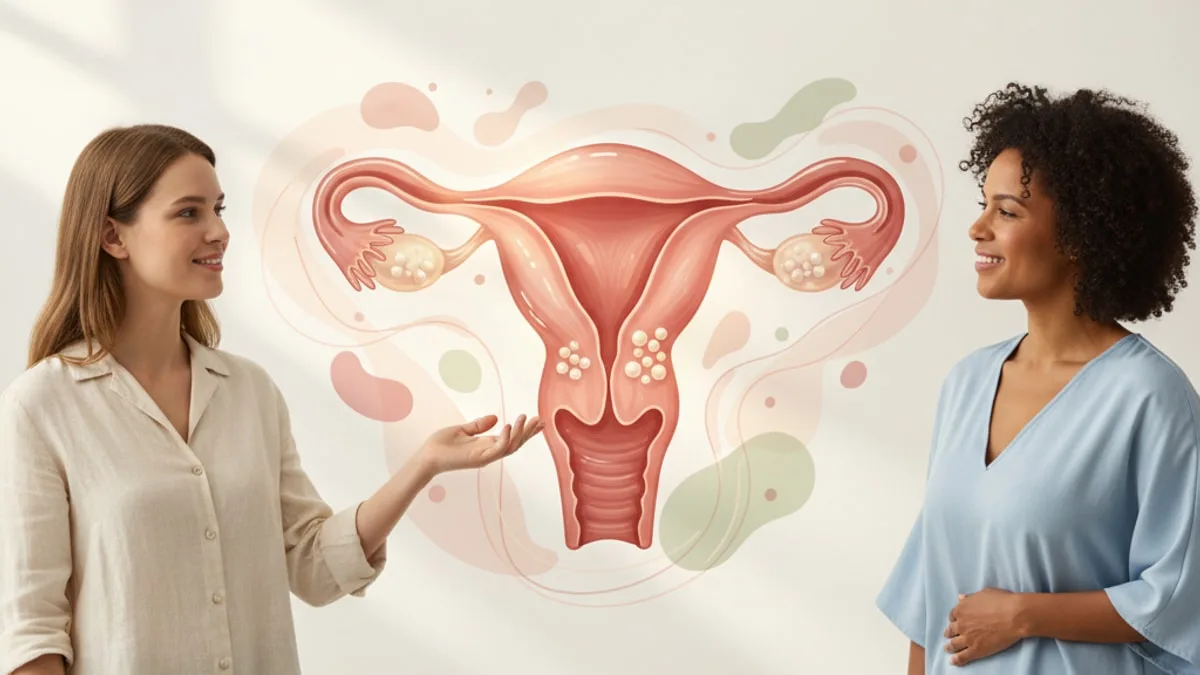
Uterine Fibroids: Symptoms, Causes and Ultrasound
Soaking through a pad or tampon every hour, or fainting, needs emergency care. Call 911 or go to the emergency department.
Why do fibroids form in the uterine wall?
Fibroids form when smooth muscle cells inside the wall of the uterus multiply into a firm, rounded mass, and the influences on that process are hormonal, genetic and age related rather than one identifiable trigger 2. Research describes them as non-cancerous growths of uterine smooth muscle, and one uterus can hold a single growth or several at the same time 2.
Several background factors shift the odds. Research suggests age during the reproductive years, a family history of fibroids, an early first period and higher body weight are associated with fibroid development 1. Reproductive history, including the number of previous births, is also associated with risk in the same work 1. None of these is a cause in the sense of a switch being flipped. They move the background odds, and carrying one or more of them does not mean a fibroid will develop.
Hormone exposure is the part that explains growth over time. Fibroid tissue responds to the hormonal environment of the reproductive years, and studies indicate that estrogen and progesterone signalling is linked to fibroid growth 2. This is why the same growth can behave differently at different life stages, and why a clinician asks about cycle history before anything else.
Everyday life does not create a fibroid, but it changes how loudly one is felt. Short sleep, heavy training blocks, under-eating, alcohol and long stretches of stress all drag on energy. When those stack on top of monthly blood loss, tiredness can feel far bigger than the bleeding alone would suggest. Diet matters in a narrow, practical way as well, because iron intake has to keep pace with the iron lost each cycle. A hard training block during a run of heavy periods is a particularly easy way to feel flat without understanding why.
Some medicines change how heavily a period runs, which can make bleeding look new when the underlying picture has not changed. Ask your prescriber about anything on your list rather than stopping it on your own.
Few of these influences appear on a blood test, and that is worth saying plainly. Lab work in this situation is not there to find the fibroid. It is there to measure what heavy bleeding has done to iron stores and red blood cells, so the conversation about next steps starts with facts rather than guesses.
Which blood tests help explain heavy bleeding and fatigue?
Two markers carry the load here, hemoglobin and ferritin, because they measure what repeated heavy periods take out of the body rather than the growth itself. Research suggests that checking for anemia is part of assessing fibroid related heavy menstrual bleeding 3. A clinician can add other markers depending on the history, but these two are the starting pair when bleeding is heavy and energy is low.
| Marker | Why it is linked to this symptom | What a result can and cannot tell you |
|---|---|---|
| Hemoglobin | Hemoglobin is the protein inside red blood cells that carries oxygen. Repeated blood loss across cycles can lower it, which can show as breathlessness on stairs, a racing heart or tiredness that sleep does not fix. | A value below the range printed on your lab report reflects less oxygen carried per unit of blood. It cannot see a fibroid, and it cannot say where the blood loss came from. A clinician decides what it reflects. |
| Ferritin | Ferritin reflects stored iron. Stores can be drawn down over months of heavy cycles, and low iron can affect energy, recovery and concentration. | A low value points to low iron stores. Inflammation can push ferritin up, so a mid range value does not rule low iron out, and a clinician decides what the pattern reflects. |
Your laboratory prints its own reference range beside each result, as printed on your lab report, and those ranges vary by lab, age and sex. Read your number against the range on your own report rather than against someone else's.
Can low hemoglobin explain the tiredness that comes with heavy periods?
Low hemoglobin is one possible reason for the tiredness that travels with heavy periods, because hemoglobin carries oxygen from the lungs to muscle and brain. When monthly blood loss outruns the body's ability to replace red cells, less oxygen is delivered with each heartbeat. That can show first as breathlessness climbing stairs, a heart rate that runs high during easy exercise, cold hands, pale skin, or a flatness that a long weekend of sleep does not shift.
Heavy menstrual bleeding is the link between fibroids and this marker. Research suggests that heavy menstrual bleeding in people with fibroids is associated with anemia 3. The anatomy fits that pattern. A dense network of vessels supplies fibroid tissue, and research links that vascular arrangement to the bleeding seen with fibroids 4. Position matters as well, and growths that sit against or bulge into the lining of the uterine cavity are associated with heavier bleeding 3.
Hemoglobin also moves for reasons that have nothing to do with the uterus. Dehydration concentrates the blood and can nudge the number up. Living at altitude raises it. Recent blood donation, inflammation, kidney conditions and several long term conditions all pull it in one direction or another, so a single value is a snapshot rather than a verdict. During pregnancy the number behaves differently again, and the right move there is to ask your OB or midwife what it means in your situation.
The practical sequence is simple. The observation is the number against the range on your report. The possible meaning is blood loss outpacing replacement, which can be one reason for the fatigue. The next step is a conversation. If a Hemoglobin result sits outside the printed range, that is worth discussing with a clinician promptly, and the clinician decides what it reflects and what else needs checking.
Can ferritin be low while hemoglobin still looks in range?
Yes. Ferritin reflects stored iron, and those stores can be drawn down over months of heavy cycles while hemoglobin still sits inside the range printed on the report. That gap is the whole reason ferritin is measured alongside hemoglobin rather than instead of it. Low iron stores can show up as fatigue, slow recovery between training sessions, brain fog, hair shedding or restless legs at night, sometimes before red cell numbers change at all.
Iron status belongs in this conversation because of what heavy bleeding does month after month. Research suggests that anemia and iron deficiency are central concerns when fibroid related heavy menstrual bleeding is assessed 3. Iron leaves the body with every heavy cycle, and the replacement pathway through food and absorption is slower than the loss.
Ferritin has a catch worth knowing. It rises with inflammation, infection and some liver conditions, so a result can land mid range while iron stores are genuinely low. A recent illness, a hard training block or a flare of an inflammatory condition can all lift it. That is why a clinician can order other iron markers next to it, and why one ferritin value on its own answers less than people expect. Recent iron intake can also raise a reading, so timing around a blood draw matters.
A Ferritin value below the range on the report, or one that keeps sliding across repeat tests, is worth raising with a clinician promptly, particularly alongside heavy bleeding. The clinician decides what the pattern reflects and what comes next. Repeat testing across months is more informative than one draw, because iron stores move slowly and a trend line tells a cleaner story than a single dot.
What can a normal panel still miss?
A completely unremarkable blood panel does not rule a fibroid out, because no blood test sees inside the uterus. Hemoglobin and ferritin can both sit comfortably within the printed ranges while a fibroid is present, particularly when bleeding is moderate or when iron intake has kept pace with iron lost.
Imaging answers the anatomical question. Ultrasound is described as the first line test for identifying fibroids, with further scanning when the picture is not clear 5. A pelvic ultrasound can show how many growths are present, how large each one is and where it sits within the wall 6. Where a scan is harder to read, or where other conditions can resemble fibroids on images, research describes additional imaging as the way to sort them apart 6. Your clinic will explain any scan preparations beforehand.
Position has its own shorthand. A classification system numbers fibroids from 0 through 8 according to where they sit, with the lowest numbers describing growths that project into the cavity of the uterus, the middle numbers describing growths within the muscle wall, and the higher numbers describing growths on the outer surface or in other positions such as the cervix 5. That number lets a clinician describe exactly what was seen, which carries more information than size alone.
Blood work also misses the symptoms that are not about bleeding. Pelvic pressure, a sense of fullness low in the abdomen, passing urine more than before, waking at night to do so, back ache and pain with intercourse are described with fibroids 3, and none of them moves a lab number. Cycle history, pelvic examination and imaging carry that part of the assessment.
And not every heavy or painful period involves a fibroid. Thyroid conditions, clotting disorders, other uterine conditions and hormonal changes across life stages can all produce similar bleeding, which is one reason assessment at home has a ceiling. A clinician puts symptoms, examination, imaging and labs together, and no one of those four works alone.
When should you see a clinician quickly?
Some bleeding patterns need emergency care now. Call 911 or go to the emergency department for any of the following.
- Soaking through a pad or tampon every hour
- Fainting, collapsing or feeling about to pass out
- Chest pain, shortness of breath or a racing heart alongside heavy bleeding
- Severe pelvic pain that comes on suddenly, particularly with vomiting
- Being unable to pass urine at all
Other signs are worth a prompt appointment with a clinician rather than emergency care.
- Periods that run longer than they used to, or that have changed in a way you cannot account for
- Bleeding between periods or after sex
- New pelvic pressure, a waistband that no longer fits, or a firm swelling low in the abdomen
- Passing urine far more than before, or waking at night to do so
- Pain with intercourse, or pelvic pain that keeps returning
- Tiredness, breathlessness or dizziness that has built up over weeks
- Any bleeding after menopause
If a pregnancy is involved, ask your OB or midwife rather than waiting for a routine visit. None of this is a self-assessment exercise. A clinician decides what symptoms and results reflect, and no single number settles the question on its own.
If you are having thoughts of self-harm, call or text 988 (US) or your local emergency number now.
How can you check these markers?
Both markers sit on a standard baseline blood panel, so checking them is straightforward. The FitScript Essential panel includes hemoglobin and ferritin alongside the rest of a baseline workup, drawn from one blood sample. The membership runs on repeat testing rather than a single snapshot, with 150+ biomarkers tested per year, which matters here because iron stores move slowly and a trend across months says more than one draw.
Atlas, the AI health advisor, reads results back in plain language, showing where each value sits against the range printed on your report and what is worth raising with a clinician. Atlas does not diagnose. A licensed provider reviews the full picture and evaluates whether any treatment is appropriate, and treatment decisions belong to a licensed provider.
This page is health education, not medical advice. Discuss your results, your symptoms and any treatment with a clinician or licensed provider who knows your history.
Key takeaways
- Fibroids are growths of uterine smooth muscle, and no single trigger explains them 2.
- Research suggests age, family history, body weight and reproductive history are associated with fibroid development 1.
- Studies indicate that estrogen and progesterone signalling is linked to fibroid growth 2.
- Research suggests heavy menstrual bleeding in people with fibroids is associated with anemia 3, which is why hemoglobin is checked.
- Ferritin can fall while hemoglobin still sits inside the printed range, so measuring both gives a fuller view.
- Blood tests cannot see a fibroid. Ultrasound is described as the first line test for identifying them 5.
- Soaking a pad every hour or fainting means calling 911 or going to the emergency department.
Related reading on why cycles turn heavy and what else can sit behind them is in the guide to heavy periods causes.
References
- Epidemiology of uterine fibroids: a systematic review. BJOG: An International Journal of Obstetrics and Gynaecology, 2017.
- Clinical practice. Uterine fibroids. The New England Journal of Medicine, 2015.
- Uterine Fibroids: Rapid Evidence Review. American Family Physician, 2025.
- Uterine fibroid vascularization: from morphological evidence to clinical implications. Reproductive BioMedicine Online, 2022.
- Diagnosis and classification of uterine fibroids. International Journal of Gynaecology and Obstetrics, 2025.
- Review of uterine fibroids: imaging of typical and atypical features, variants, and mimics with emphasis on workup and FIGO classification. Abdominal Radiology, 2022.
Common questions
What are fibroids?
Fibroids are growths made of the smooth muscle that forms the wall of the uterus. One uterus can hold a single growth or several at once, and they vary in size and position. Some produce heavy bleeding or pressure, others produce nothing noticeable, and a pelvic ultrasound is the test that shows them.
What are the symptoms of fibroid disease?
Reported symptoms include heavy or prolonged menstrual bleeding, clots, pelvic pressure or fullness, passing urine more than before, waking at night to do so, back ache, pain with intercourse and tiredness from blood loss. Some fibroids produce no symptoms at all. A clinician decides what any symptom pattern reflects.
What does a uterus with fibroids look like on a scan?
On a pelvic ultrasound, a uterus with fibroids can look enlarged or irregular in outline, with one or more rounded areas in the muscular wall. The report notes how many growths are seen, their size and where each one sits, from inside the cavity to the outer surface. Your clinician explains the findings.
Can a blood test find a fibroid?
No. No blood test can see inside the uterus, so a panel cannot confirm or exclude a fibroid. Blood work measures the knock-on effects of heavy bleeding, mainly through hemoglobin and ferritin. Imaging answers the anatomical question, and a clinician decides which tests make sense for your situation.
Why are hemoglobin and ferritin checked when periods are heavy?
Hemoglobin measures the oxygen-carrying protein in red blood cells, and ferritin reflects stored iron. Both can fall when blood loss across cycles outpaces replacement, which can affect energy, exercise tolerance and concentration. A result outside the range printed on your report is worth discussing with a clinician, who decides what it reflects.
Can ferritin be low while hemoglobin is still in range?
Yes. Iron stores can be drawn down for months before red cell numbers change, so ferritin can sit low while hemoglobin still falls inside the printed range. Inflammation can also lift ferritin, so a mid range value does not settle the question. A clinician can order further iron markers and interpret them together.
Do fibroids run in families?
Family history is one of the background factors clinicians consider when discussing why fibroids develop, alongside age, reproductive history and body weight. Having a relative with fibroids does not mean you will develop them. If fibroids are in your family and your cycles have changed, mention both to your clinician.
When does heavy bleeding need emergency care?
Call 911 or go to the emergency department if you are soaking through a pad or tampon every hour, fainting or feeling about to pass out, or if you have chest pain, shortness of breath or a racing heart alongside heavy bleeding. Sudden severe pelvic pain and being unable to pass urine also need emergency care.