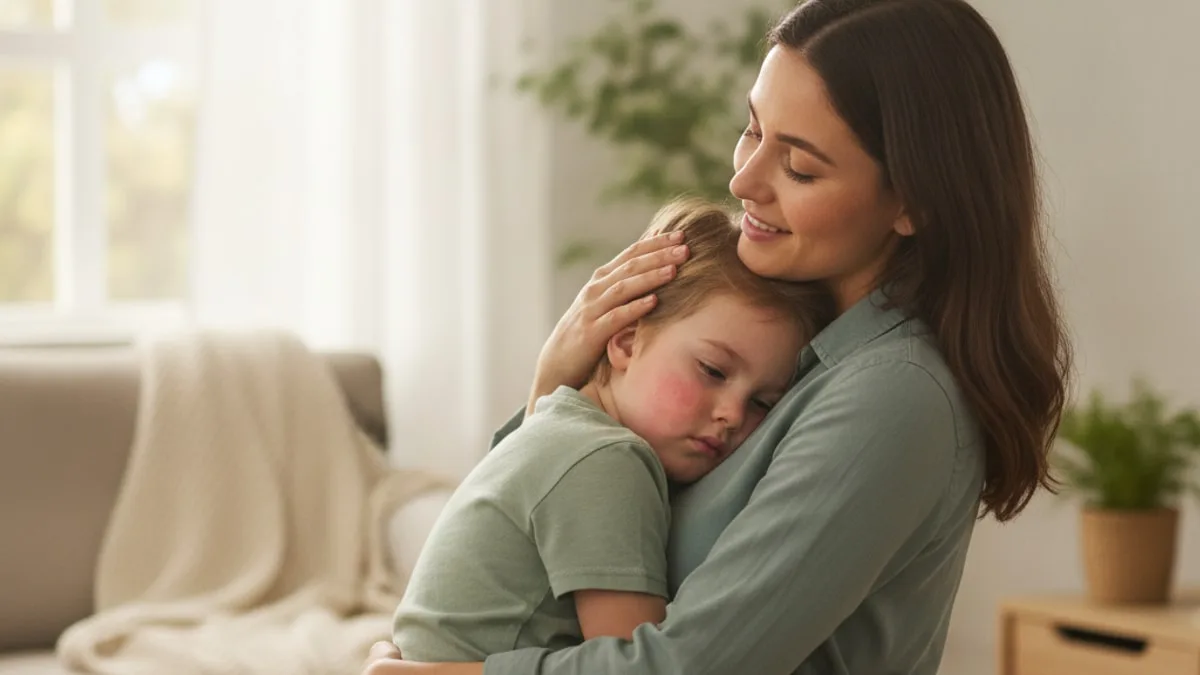
Fifth Disease Symptoms: Slapped Cheek Rash
Call 911 or go to the emergency department for trouble breathing, confusion, a seizure, fainting, or a rash with purple spots or bruise like patches that do not fade when pressed.
Call a clinician the same day if someone looks pale and unusually tired and has a known blood disorder such as sickle cell disease or hereditary spherocytosis, or if immune function is reduced by illness or medical care. If you are pregnant and have been around someone with this rash, tell your OB or midwife the same day rather than waiting for the next scheduled visit.
What usually causes this?
Fifth disease has one cause, human parvovirus B19, but red cheeks and a blotchy body rash have many everyday explanations that have nothing to do with that virus. Most of those explanations never show up on a blood test. It is worth running through them before assuming a specific infection.
- Heat, exercise and a warm room. Flushed cheeks after a hard session or a hot bath are a circulation response.
- Cold air and wind, which can leave the cheeks red and rough for hours.
- Sun exposure, which can redden the face and bring out patterns on the arms and chest.
- Friction, rubbing and contact with something new against the skin.
- Skin conditions that run a flare and settle pattern, such as eczema in children or facial flushing in adults.
- Fever from any of the many common viruses that circulate in schools and households.
- Alcohol, which widens small blood vessels in the face in some people.
- Some medicines can change the skin or bring on a rash, so ask your prescriber rather than stopping anything on your own.
When parvovirus B19 is the reason, it spreads through respiratory droplets and hands, and it can also pass through blood 2, 3. Studies indicate that the interval between exposure and the first symptoms is roughly one to two weeks 1. The first phase often looks like an ordinary cold, with a mild fever, headache, sore throat and a runny nose, and research suggests that the most contagious period falls in that phase, before any rash shows up 2. The rash arrives later, which is part of why the infection moves quietly through classrooms and homes 4.
If the main thing you notice is tiredness rather than a rash, start with the ordinary explanations. Short sleep, a heavy training block, stress, under eating, alcohol and a recent illness all drag energy down. None of them is a lab finding, and all of them are worth sorting out before reading too much into a single blood value.
Which blood tests can help explain it?
Blood tests cannot see a rash, but they can answer two separate questions. One is whether the body has met parvovirus B19, and the other is whether red cell production has slowed.
| Marker | Why it is linked to this symptom | What a result can and cannot tell you |
|---|---|---|
| Hemoglobin | Parvovirus B19 infects the bone marrow precursor cells that mature into red blood cells, so red cell production can pause for a period 2. | A value outside the range printed on your lab report is worth discussing with a clinician, who decides what it reflects. It does not name a cause on its own, because iron status, bleeding, inflammation and nutrition all move this number. |
| Reticulocyte count | Reticulocytes are newly released red cells, so the count tracks how actively the marrow is producing them. | A low count alongside low hemoglobin tells a clinician that production has slowed rather than that cells are being lost. It still does not name the reason. |
| Parvovirus B19 IgM antibodies | This antibody type appears in blood around the time of a recent infection 3. | It speaks to recent contact with the virus, and the timing of the sample changes what is found. A clinician decides what the result reflects. |
| Parvovirus B19 IgG antibodies | This antibody type reflects exposure further in the past and is checked when someone needs to know whether they have met the virus before 3. | It describes earlier exposure, not what is happening today. In people with reduced immune function, antibody results can be harder to read 2. |
This table carries no numbers on purpose. Read any value against the range as printed on your lab report, and remember that printed ranges vary by lab, age and sex.
Can low hemoglobin explain looking pale and tired after this infection?
Low hemoglobin is one possible reason for looking pale and feeling drained after a parvovirus B19 infection, because the virus targets the cells that become red blood cells. Hemoglobin is the oxygen carrying protein inside red cells, and it is the marker clinicians check when pallor and fatigue are being evaluated.
The mechanism is well described. Parvovirus B19 enters erythroid progenitor cells in the bone marrow and interrupts the production line for new red cells, so output falls for a stretch of days 2, 5. In someone whose red cells live a normal lifespan, research suggests the resulting fall in hemoglobin is often modest 2. The picture changes in people whose red cells are already turning over fast. Studies indicate that in people with a shortened red cell lifespan, such as sickle cell disease, thalassemia or hereditary spherocytosis, the pause in production can cause a steep drop in hemoglobin that needs prompt medical attention 5. Research suggests that in people with reduced immune function the infection can persist and keep red cell production suppressed for longer 3.
A low hemoglobin result on its own never settles the question, because plenty of other things move it. Iron deficiency, heavy menstrual bleeding, slow gut blood loss, low vitamin B12 or folate, kidney conditions, ongoing inflammation, pregnancy and hydration status all shift the number. Altitude, recent intense endurance training and even posture at the time of the draw can nudge it. That is why a value outside the printed range is a conversation starter with a clinician rather than an answer.
What does the cheek and body rash look like?
The classic pattern begins with firm redness across both cheeks, with the skin immediately around the mouth left pale, and is followed by a pink net like or lace like rash on the arms, trunk and legs 6. The lacy stage can fade and return over days or weeks, and research suggests that heat, sunlight, exercise and emotional stress can bring it back temporarily 1.
The rash can itch, particularly on the legs. It is not always tidy. Studies indicate that adults and older teenagers frequently have no cheek rash at all, or only a vague blotchy rash, which makes the picture harder to read without other clues 5. Other patterns linked to the same virus have been described, including a glove and sock distribution of redness and swelling on the hands and feet 4.
For a child, the practical step is to ask your child's pediatrician rather than matching photographs online. Several childhood illnesses produce a red face and a spreading rash, and some of them need different care. A clinician looks at the full picture, including fever, how the child is feeding and playing, and any contact with others who are unwell.
Why do adults get joint pain from the same virus?
Research suggests that adults, and women in particular, are more likely than children to develop joint symptoms with this infection 5.
This is where things get confusing, because the same pattern of symmetrical small joint pain appears in other conditions. Parvovirus B19 is associated with features that overlap several autoimmune diseases, including joint inflammation and antibody findings that can appear in blood work 7. That overlap is a reason to bring new, persistent joint swelling to a clinician rather than filing it under a recent viral illness and moving on. A clinician decides which tests fit and what the results reflect.
If you are in a training block, joint ache after a virus can also reflect a few weeks of poor sleep, reduced load tolerance and a slow return to normal activity. Both things can be true at once, and a clinician can sort out what deserves further testing.
What should you do about exposure during pregnancy?
Tell your OB or midwife the same day, because the next steps are time sensitive and depend on when the exposure happened. Parvovirus B19 can cross the placenta, and research suggests that infection in the first half of pregnancy carries the greatest risk of complications for the fetus, including severe fetal anemia and fluid accumulation known as hydrops 8.
The usual approach after a known exposure is a maternal blood test that looks for antibodies to the virus, which tells the clinical team whether there has been past exposure or a recent infection 9. Obstetric practice guidance describes antibody testing of maternal blood after exposure, with further monitoring arranged when recent infection is suspected 10. Studies indicate that when recent maternal infection is identified, serial ultrasound monitoring is used to watch for signs of fetal anemia 8.
Two practical points help your clinician. Write down when the exposure happened and who was unwell, and mention any work with young children, since that comes up in the risk conversation. Decisions about monitoring and any further care belong to the clinical team looking after the pregnancy.
What can a normal panel still miss?
A normal blood panel does not settle what is causing a rash, and it never rules out everything on the list. Blood work measures what is circulating at the moment of the draw, and a face that reddens with heat, a contact reaction on the cheeks, an eczema flare, a sun reaction or one of the many other viral rashes of childhood leaves no fingerprint in a standard panel.
Timing is the other blind spot. Antibody results depend heavily on when the sample is taken relative to the infection, so a test drawn very early can read differently from one drawn later 3. Research suggests that in people with reduced immune function, antibody responses can be weak or absent, so other laboratory approaches are used instead 2.
A single hemoglobin value has the same limitation. One reading is a snapshot, and a falling trend across two readings carries information that neither reading holds alone. The honest summary is that blood work narrows the field and tracks what the marrow is doing, while the diagnosis itself comes from a clinician who puts the history, the examination and the results together.
When should you see a clinician quickly?
Some signs need emergency care, not a wait and see approach, and no article can substitute for an assessment.
Call 911 or go to the emergency department for any of these.
- Trouble breathing, or breathing that looks fast and laboured.
- Confusion, a seizure, unresponsiveness or a child who is very difficult to wake.
- Fainting, or a very fast heartbeat with extreme paleness.
- A rash with purple spots or bruise like patches that do not fade when pressed, especially with fever.
Call a clinician the same day for these.
- Marked paleness and unusual tiredness in someone with a known blood disorder such as sickle cell disease, thalassemia or hereditary spherocytosis.
- Any of these symptoms in someone whose immune function is reduced by illness or medical care.
- Exposure to this rash during pregnancy, reported to your OB or midwife.
Arrange a prompt appointment for a rash you cannot place, a fever that is not settling, joint pain and swelling that persists, or a child who is not drinking, not passing urine normally or not behaving like themselves. This page is educational information and not medical advice, and self diagnosis from a photograph or a symptom list is not a safe substitute for an examination. Discuss any symptom, any result and any treatment question with a clinician or licensed provider, who decides what the findings reflect and what comes next.
If you are having thoughts of self-harm, call or text 988 (US) or your local emergency number now.
How can you check these markers?
Hemoglobin is measured on the FitScript Essential panel, alongside the other markers that describe red blood cells, so a baseline reading exists before anyone needs to interpret a drop. A baseline is useful precisely because one isolated value is hard to read, while a change from your own previous number is far more informative.
Testing for parvovirus B19 antibodies is a separate test that a clinician orders when the history calls for it, and the same applies to urgent testing during pregnancy or in someone with a known blood disorder. Lab work is one input, not the whole picture.
FitScript membership includes 150+ biomarkers tested per year, and Atlas, the AI health advisor, explains what each result means in plain language and how it sits against your previous readings. Interpretation is not the same as care. A licensed clinician reviews the findings, decides whether anything needs further testing, and makes any treatment decision.
Key takeaways
- Fifth disease is caused by human parvovirus B19, and the slapped cheek appearance is followed in many people by a lacy rash on the limbs and trunk 1.
- Red cheeks have plenty of ordinary explanations, including heat, exercise, cold air, sun, friction and skin conditions, none of which show up on a blood panel.
- The virus interrupts red blood cell production, so hemoglobin and a reticulocyte count are the markers that describe what the marrow is doing 2.
- A steep fall in hemoglobin is a particular concern in people with a shortened red cell lifespan, which is why paleness plus extreme tiredness in that group is a same day call 5.
- Adults often get joint pain rather than a clear rash, and persistent joint swelling deserves a clinician's assessment 5.
- Exposure during pregnancy goes to your OB or midwife the same day, because antibody testing and monitoring are arranged on a timeline 9.
References
- Erythema Infectiosum: A Narrative Review. Current Pediatric Reviews, 2024.
- Human parvovirus B19. Clinical Microbiology Reviews, 2002.
- Parvovirus B19. Microbiology Spectrum, 2016.
- Parvovirus B19 infection in children: a comprehensive review of clinical manifestations and management. Italian Journal of Pediatrics, 2024.
- Parvovirus B19. The New England Journal of Medicine, 2004.
- Erythema infectiosum. Journal of Cutaneous Medicine and Surgery, 2005.
- Human parvovirus B19 and autoimmune diseases. Review of the literature and pathophysiological hypotheses. Journal of Clinical Virology, 2015.
- Prenatal parvovirus B19 infection. Archives of Gynecology and Obstetrics, 2024.
- Parvovirus B19 in Pregnancy. Obstetrical & Gynecological Survey, 2024.
- Practice bulletin no. 151: Cytomegalovirus, parvovirus B19, varicella zoster, and toxoplasmosis in pregnancy. Obstetrics and Gynecology, 2015.
Common questions
What is slapped cheek syndrome?
Slapped cheek syndrome is another name for fifth disease, a viral illness caused by parvovirus B19. The name comes from the bright red color that can appear across both cheeks. A clinician looks at the pattern of the rash and the story of the illness, and decides whether any testing is needed.
Is fifth disease the same thing as slapped cheek?
Yes. Fifth disease and slapped cheek are two names for the same illness, which clinicians also call erythema infectiosum. The word fifth refers to its old place in a numbered list of childhood rashes. The red cheeks gave it the everyday name, and the virus behind it is parvovirus B19.
What does the fifth disease skin rash look like?
It can start as firm redness over both cheeks, with the skin right around the mouth left pale. A pink, lace like or net like pattern can then spread across the arms, trunk and legs, and it may come and go with heat, sunlight or exercise. Ask a clinician about any rash you cannot place.
How long is someone contagious?
Spread happens mainly in the days before the rash appears, while symptoms resemble an ordinary cold. Once the lacy rash is visible, the contagious stage has generally passed, which is why the virus moves quietly through households and classrooms. Ask your clinician about returning to school or work.
Can adults catch it from a child?
Yes. Adults can catch parvovirus B19 from a child at home, at school or at work, through coughs, sneezes and hands. Adults may notice aching, swollen joints in the hands, wrists, knees or ankles more than a bright facial rash. Anyone with new joint pain and swelling should speak with a clinician.
Does a child need to stay home from school?
That depends on the child, the setting and local policy, so ask your child's pediatrician. Because spread happens before the rash appears, keeping a child home once the rash shows up does not reliably stop it reaching others. A clinician can advise on fever, other symptoms and any child at higher risk.
Which blood tests are used when parvovirus B19 is suspected?
A blood test looks for antibodies to parvovirus B19. One antibody type reflects a recent infection and another reflects exposure in the past. Hemoglobin and a reticulocyte count can also be checked to see how red cell production is doing. A clinician decides which tests fit and what the results reflect.
What should a pregnant person do after exposure?
Tell your OB or midwife the same day rather than waiting for your next appointment. They can arrange a blood test for parvovirus antibodies and decide whether extra ultrasound monitoring is appropriate. Bring the details of the exposure, including when it happened and who was unwell.