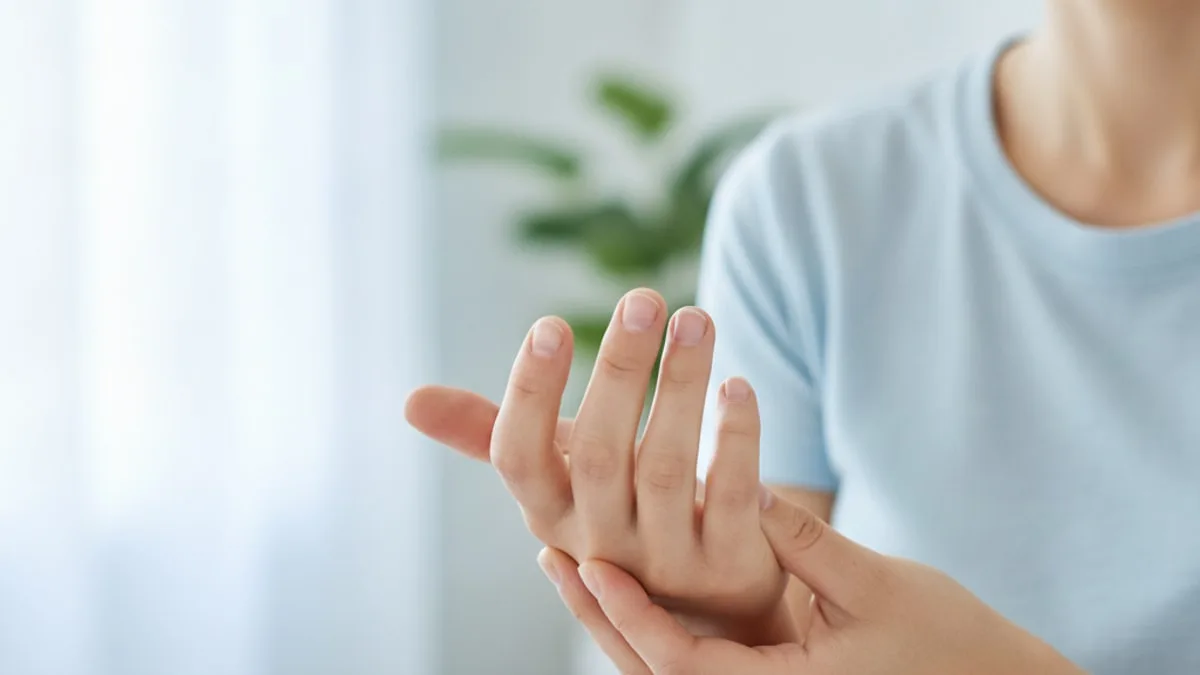
Swollen Finger: Causes and When It Is Urgent
A swollen finger that is hard to straighten, with pain running along the finger, red streaks spreading up the hand, or fever, means call 911 or go to the emergency department.
This page is educational and is not medical advice.
What can make a finger swell?
A finger swells when fluid, blood or inflammatory cells collect inside a space that has almost no room to expand, and the everyday reasons include knocks and sprains, repetitive gripping, heat, salt, alcohol, short sleep, a jump in training load, hormonal shifts across the month, and some medicines (ask your prescriber about anything you take).
Mechanical causes come first because the hand takes constant small hits. A finger jammed while catching a ball, caught in a door, bent backwards in a fall or crushed while lifting can swell within minutes. The swelling itself makes the joint stiff, which makes the finger feel worse than the original knock suggested. A ring worn on that finger can become tight as the tissue expands, and a tight ring can then hold fluid in place and make the swelling harder to settle.
Fluid shifts explain a lot of mild, both-hands puffiness. Heat, a long flight, a long day on your feet, a salty meal, alcohol the night before, a broken night of sleep or a hard training session can all leave the hands feeling full and the rings tighter than yesterday.
Repetitive use is another quiet driver. Grip-heavy work, climbing, long hours with tools, keyboard and phone use, and a sudden increase in pulling or carrying can irritate the tendons that run along the front of the finger and the sheath they slide through. That shows as thickening at the base of the finger, stiffness on waking, and a finger that catches or clicks when you open the hand.
Infection is a separate track, and it starts small. A hangnail pulled off, a bitten nail, a splinter, a scratch from a pet or an aggressive cuticle trim can let bacteria into the nail fold or the fingertip pad. A red, swollen, tender nail fold and a tight, throbbing fingertip pulp are recognized finger infections, and a narrative review describes them as problems assessed in person by a clinician, with drainage forming part of their management 1.
Infection can also reach the sheath that the flexor tendon glides inside, which is a hand emergency. Research suggests that infection inside the flexor tendon sheath presents as a finger held slightly bent, swelling along the whole finger, tenderness over the course of the tendon and pain when the finger is passively straightened 2. A systematic review of acute pyogenic flexor tenosynovitis grouped the ways it is handled, including surgical drainage and washout decided by a surgical team 3.
Inflammatory joint disease produces a different pattern. When a whole finger swells from base to tip rather than one knuckle, clinicians call it dactylitis. Research suggests that dactylitis involves inflammation of the tendon sheath and surrounding soft tissue as well as the joint itself, which is why the digit looks uniformly sausage-shaped 4. Dactylitis is associated with more severe joint disease in psoriatic arthritis, which is one reason a clinician takes a whole-finger swelling seriously and asks about nail pitting, scaly skin patches and heel pain 5.
Crystal inflammation belongs on the list too. Urate crystals can settle in and around joints and tendon sheaths in the hand, producing sudden, intense swelling with redness and heat. Research suggests that gout affecting a finger flexor tendon sheath can look remarkably similar to infection, which is part of why a clinician, not a home judgement, separates the two 6.
Slower, firmer swelling near the end joints of the fingers that builds over years, with bony knobs rather than soft puffiness, points toward wear-related joint change. Other possibilities include fluid that drains poorly after lymph node surgery on that side, color changes in the cold with later puffiness, and skin conditions that thicken the fingertip.
Life stage matters as well. Hands can feel fuller in the days before a period and across pregnancy, and if you are pregnant, ask your OB or midwife about any new hand swelling. For a swollen finger in a child, ask your child's pediatrician. Some medicines also shift fluid balance or urate handling, so ask your prescriber rather than stopping anything on your own.
Many of these causes are not lab findings at all. They are sorted out by history, by what the finger looks like and how it moves, and sometimes by an image. Blood work plays a supporting role around that.
Which blood tests can help explain it?
Blood tests cannot see a finger, so they work as context rather than as an answer, telling a clinician whether an inflammatory process is active, whether urate is running high, and whether something systemic sits behind swelling that involves more than one digit. The markers below are the ones a clinician can reach for when a swollen finger is being assessed.
| Marker | Why it is linked to this symptom | What a result can and cannot tell you |
|---|---|---|
| Uric acid | Urate is the end product of purine breakdown. When it runs high over long periods, crystals can form in and around joints and tendon sheaths, including in the hand. | A value outside the range printed on your lab report is worth discussing with a clinician. It does not confirm or exclude a crystal cause by itself, and a value inside the printed range can sit alongside an inflamed joint. |
| C-reactive protein (CRP) | CRP rises when the body mounts an inflammatory response, whether from infection or from inflamed joints. | It suggests whether an inflammatory process is active somewhere. It cannot say where it is or what started it. |
| Erythrocyte sedimentation rate (ESR) | ESR moves more slowly than CRP and is read alongside it when joint swelling lasts weeks. | A raised value supports an ongoing inflammatory process. Age, sex, anemia and pregnancy all move it, so it is read in context. |
| Complete blood count | White cells, platelets and hemoglobin shift with infection and with sustained inflammation. | It can support a clinician's impression of infection or inflammation. An unremarkable count does not rule out an early or walled-off infection. |
| Rheumatoid factor and anti-CCP antibodies | Labs consider these when swelling involves several finger joints over weeks with morning stiffness. | A positive result raises questions a clinician follows up. A negative result does not close the door on inflamed joints. |
| Thyroid function (TSH) | Thyroid signalling influences fluid balance and soft tissue, and hands can feel puffy and stiff when it is off. | It describes thyroid signalling, nothing about the finger itself. |
| Kidney function (creatinine with eGFR) | The kidneys clear urate and manage fluid balance, so kidney function sits behind both puffiness and urate levels. | It describes filtering capacity. It does not explain a single swollen finger on its own. |
Reference ranges differ between laboratories and by age and sex, so read every value against the range printed on your own lab report. A value outside that range is worth discussing with a clinician, who decides what it reflects for you.
Can a high uric acid result explain a swollen, painful finger?
A high uric acid value can be one possible reason behind a sudden, hot, swollen finger joint, but it is a clue rather than a verdict, because people can carry high urate for years without a joint problem and a joint can flare while the blood value looks unremarkable. Uric acid is what remains after the body breaks down purines, which come both from your own cell turnover and from food. When production outpaces clearance, urate concentrations rise, and over time crystals can form in cooler, slower-flowing tissue such as the small joints of the hand and the tendon sheaths beside them.
That is why a finger flare can be mistaken for an infection. Research suggests that gouty flexor tenosynovitis in the finger can present so similarly to infection that the two are difficult to separate at the bedside 6. The practical consequence is simple. A hot, swollen, exquisitely painful finger is a clinician's call, not a self-assessment, because the paths taken for crystal inflammation and for infection are not the same.
Plenty of things besides crystals move a urate value. Kidney clearance is the largest lever, so anything that changes kidney function changes the number. Alcohol, purine-rich meals, sugary drinks, dehydration, fasting and rapid weight loss can all push it up over short windows. Genetics set much of the baseline, and sex and life stage shift it as well. Some medicines change urate handling, which is one more reason to ask your prescriber rather than guess. Timing matters too, since a value drawn during an acute flare can read differently from one drawn weeks later.
If you want to see where yours sits, the Uric Acid marker page explains what the test measures and why clinicians check it. A single number is a starting point for a conversation, not a label.
What can a normal panel still miss?
A blood panel that comes back unremarkable does not clear a swollen finger, because the structures that cause finger swelling are mostly mechanical and local, and blood work reports on the body as a whole. A fracture in a small bone, a dislocated or sprained joint, a torn or inflamed tendon, a splinter or fragment of glass under the skin, and a crushed fingertip can all exist with a panel that reads normal from top to bottom.
Early infection is the one to respect most. Finger infections around the nail and in the fingertip pulp are judged by how the finger looks and feels in person, and a review describes that assessment and drainage as the centre of their management 1. The signs of flexor sheath infection are examination findings on the finger itself 2, which no blood marker replaces.
Inflammatory finger swelling can also hide from blood work. Studies indicate that ultrasound and magnetic resonance imaging can show tendon sheath and soft tissue inflammation in psoriatic dactylitis that adds to what an examination alone captures 7. Nerve compression at the wrist, poor lymphatic drainage after surgery on that side, cold-triggered circulation changes and skin conditions sit outside the reach of a standard panel as well.
The honest summary is that blood markers narrow the field and flag a systemic process worth following. They do not localize, they do not image, and they do not replace someone looking at your hand.
When should you see a clinician quickly?
Some finger signs need emergency care the same hour, and a separate group needs a clinician appointment within days rather than a watch-and-wait.
Call 911 or go to the emergency department for any of these.
- A finger that is swollen along its whole length, held slightly bent, tender over the tendon line and painful when you try to straighten it 2
- A tight, deeply throbbing fingertip pad, or pus and spreading redness around the nail fold 1
- Red streaks running up the hand or forearm, fever or chills alongside a swollen finger
- An open wound into the finger, an animal or human bite, something driven under the skin, or an injury from a high-pressure tool
- A finger that turns pale, blue, cold or numb, or a ring that cannot be removed while swelling keeps building
- Fainting or passing out, chest pain or pressure, or trouble breathing
Book a clinician visit promptly, within days, for any of these.
- A whole finger swollen from base to tip rather than one knuckle 4
- Swelling across several finger joints with stiffness on waking that has lasted weeks
- Repeating episodes of a hot, swollen joint that settle and then return
- Swelling after a knock that is not easing, with weak grip or a finger that looks out of line
- New hand swelling that began after a change in medicines, which is a question for your prescriber
- Finger swelling alongside nail pitting, nail lifting or scaly skin patches
- Puffy hands with puffiness of the face, new fatigue or changes in weight
- A swollen finger during pregnancy, which is a question for your OB or midwife, or a swollen finger in a child, which is a question for your child's pediatrician
Do not label the cause yourself from a photo, a symptom checker or a single lab value. A clinician examines the finger, checks movement and sensation, decides whether imaging or joint fluid sampling is needed, and interprets any blood work against what the hand is doing.
If you are having thoughts of self-harm, call or text 988 (US) or your local emergency number now.
How can you check these markers?
The FitScript Essential panel measures 40+ biomarkers.
The membership covers 150+ biomarkers tested per year, which means a value can be compared with where it sat last time instead of judged from one snapshot.
Results come back with an explanation from Atlas, FitScript's AI health advisor, in plain language, showing what each marker measures, where your value sits against the range printed on your report, and which results are worth raising at your next appointment. Atlas explains, it does not diagnose.
Testing is one input. A licensed clinician examines the hand, decides what further assessment is needed, and treatment decisions belong to a licensed provider. Discuss your results and any next step with a clinician or licensed provider before acting on a number.
Key takeaways
- A swollen finger that resists straightening, with pain along the tendon line, red streaks or fever, means call 911 or go to the emergency department.
- Everyday causes include knocks and sprains, repetitive gripping, heat, salt, alcohol, short sleep, training load, hormonal shifts and some medicines, and these are not lab findings.
- Blood markers that can add context include uric acid, CRP, ESR, a complete blood count, joint-related antibodies, thyroid function and kidney function.
- A high uric acid value is one possible clue to crystal inflammation, not a verdict, and a finger flare can resemble infection closely enough that a clinician separates them.
- Swelling of a whole finger from base to tip is a pattern worth a prompt clinician visit, especially with nail or skin changes.
- An unremarkable panel does not rule out a fracture, a tendon problem, a foreign body or an early infection, so a worsening finger is examined in person.
- Read every value against the range printed on your own lab report, since ranges vary by laboratory, age and sex.
References
- Management of Finger Felons and Paronychia: A Narrative Review. The Journal of Emergency Medicine, 2025.
- Pyogenic Flexor Tenosynovitis: Evaluation and Management. Hand Clinics, 2020.
- A systematic review of the management of acute pyogenic flexor tenosynovitis. The Journal of Hand Surgery, European Volume, 2015.
- Dactylitis: pathogenesis and clinical considerations. Current Rheumatology Reports, 2006.
- Targeting extra-articular manifestations in PsA: a closer look at enthesitis and dactylitis. Current Opinion in Rheumatology, 2015.
- Gouty finger flexor tenosynovitis with urate milk remarkably similar to infection: a case-based review. Rheumatology International, 2025.
- Ultrasound and magnetic resonance imaging in the evaluation of psoriatic dactylitis: status and perspectives. The Journal of Rheumatology, 2013.
Common questions
finger in pain swelling
A finger that is painful and swollen can follow a knock, repetitive gripping, an infection around the nail, crystal inflammation or an inflamed joint. If the finger is hard to straighten with pain along its length, or there are red streaks or fever, call 911 or go to the emergency department. Otherwise book a clinician visit promptly.
finger pain and swelling
Pain with swelling means something inside a tight space is irritated, from an injury or overuse to infection or joint inflammation. A clinician examines the finger, checks movement, skin and nails, and decides whether imaging or blood work such as uric acid, inflammation markers or a blood count adds anything useful to the picture.
finger swelling and pain
Swelling that arrives before pain points no more clearly to a cause than the reverse, so the order alone does not settle anything. What matters is how fast it started, whether the finger can straighten, and whether there is fever, a wound or spreading redness. A clinician sorts that out in person.
Can a tight ring cause a swollen finger?
A ring that no longer slides off can trap fluid and keep swelling going. If the finger turns pale, blue, cold or numb while a ring is stuck, call 911 or go to the emergency department. If the finger is still warm and moving normally, ask a clinician about safe removal.
Which blood tests might a clinician order for a swollen finger?
Depending on the picture, a clinician can order uric acid, inflammation markers such as CRP and ESR, a complete blood count, antibody tests used when several joints are involved, thyroid function and kidney function. These add context around the exam. No single result names a cause, and the clinician reads them together.
Does a normal blood test rule out a serious finger problem?
No. A fracture, a tendon injury, a splinter under the skin and an early infection can all sit alongside unremarkable blood work. Blood tests also cannot say where inflammation is coming from. If the finger is getting worse, see a clinician rather than waiting on a result.
What does a sausage finger mean?
It is the everyday name for swelling of a whole finger from base to tip, rather than one knuckle. The digit looks uniformly puffy and can be stiff. It is worth a prompt clinician visit, especially alongside nail pitting, nail lifting or scaly skin patches, so the cause can be assessed properly.
Does it matter whether a finger swells in the morning or after exercise?
Timing is useful information for a clinician. Stiff, swollen finger joints on waking that loosen through the day point in a different direction than puffiness after a hot day, heavy gripping or a long session. Track when it happens, how long it lasts and what changes it, then bring that to the visit.