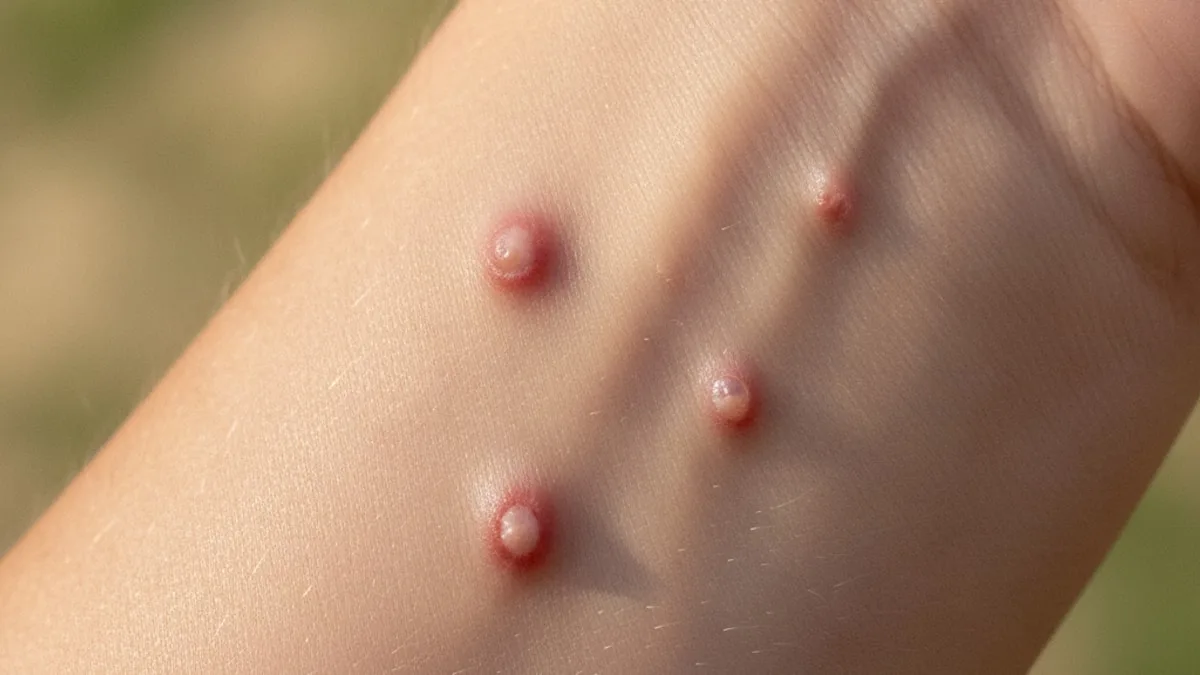
Mosquito Bite Allergy: Skeeter Syndrome Explained
Two situations need emergency care. If a bite area develops fever with spreading redness, or if you have trouble breathing or swelling of the lips, tongue or throat, call 911 or go to the emergency department now.
What usually causes a bite to react so strongly?
A strong bite reaction starts in the skin, where the immune system responds to proteins a mosquito leaves behind while feeding, and everyday factors then decide how loud that response feels. Research suggests that mosquito saliva contains proteins capable of triggering both immediate and delayed skin reactions, and that sensitisation to those proteins underlies the itch and swelling people notice 1. Work on salivary allergens has identified and characterised individual proteins from mosquito saliva 5, 6.
That is the biology. The day-to-day picture is usually simpler, and most of what changes a bite reaction is not a lab finding at all.
- Exposure history. How your skin answers a bite depends on how many bites you have had before. Research suggests that reactions to mosquito bites pass through a changing sequence as a person is bitten repeatedly over years, rather than staying fixed for life 4.
- Number of bites in a short window. Several bites in one evening can merge into one angry, swollen area that looks far more alarming than any single bite would.
- Scratching. Mechanical irritation keeps the welt inflamed, breaks the skin surface and makes the area warmer and redder for longer.
- Heat and sweat. A bite on skin that stays hot and damp, after training or a long day outdoors, tends to feel itchier and look more swollen.
- Skin barrier condition. Dry or already irritated skin reacts more visibly. People who run eczema-prone skin often notice bigger, longer-lasting marks.
- Short sleep and high stress. Both make itch harder to tolerate, which drives more scratching, which keeps the welt going.
- Alcohol. Alcohol widens small blood vessels and can make flushing, warmth and swelling around a fresh bite more noticeable for a few hours.
- Training load. Long sessions outdoors in warm weather mean more exposure and more sweat, and recovery is harder when itching breaks up your sleep.
- Some medicines. A few medicines change how the skin and the immune system respond. Ask your prescriber about anything you take rather than stopping it on your own.
Location on the body matters too. The same reaction looks dramatic on the eyelid, ankle or back of the hand, where loose tissue swells easily, and unremarkable on the forearm.
Which blood tests can help explain it?
No blood test confirms a mosquito bite allergy on its own, but a small set of markers on a routine blood count can add useful context when reactions are repeated, unusually large or hard to tell apart from something else.
| Marker | Why it is linked to this symptom | What a result can and cannot tell you |
|---|---|---|
| Eosinophils (percentage) | Eosinophils are white blood cells that take part in allergic-type inflammation in skin and airways, so the percentage gives a quick read on whether that arm of the immune system is busy. | Can show that allergic-type inflammation is active somewhere in the body. Cannot name mosquito bites, or any other trigger, as the reason, and a normal value does not rule out a strong local bite reaction. |
| Eosinophils Absolute | The absolute count measures eosinophils per unit of blood rather than as a share of all white cells, so it does not move simply because other white cell lines rise or fall. | Can give a steadier number to track over time and across seasons. Cannot separate one allergic trigger from another, and it shifts with infection, time of day and other conditions. |
Compare any number against the range as printed on your lab report, and ask a clinician to read it alongside your history, your skin findings and what happens in different seasons.
Can a high eosinophil count explain itchy welts?
A raised eosinophil percentage can be one sign that allergic-type inflammation is active, but it does not identify what set that inflammation off. Eosinophils circulate in small numbers and are recruited into tissue during allergic responses, which is why clinicians often glance at them when someone describes exaggerated skin reactions.
The immunology of bites is not one single pathway. Studies indicate that reactions to mosquito bites involve both immediate antibody-driven responses and delayed cell-mediated responses, which is why one person gets a wheal within minutes and another gets a firm, itchy lump the next day 2, 3. Research suggests that the skin reaction itself reflects a hypersensitivity response to salivary proteins rather than a toxic effect of the bite 1.
Plenty of other things move this marker, which is the main reason a single value settles nothing. Seasonal nasal allergy, asthma, eczema and parasite exposure can all raise eosinophils. Acute physical stress and some medicines can push the number down. Counts also vary across the day, so two draws a week apart are not always comparable.
If you want to see what the percentage represents and how it sits within a full blood count, the Eosinophils marker page covers it in more detail.
What does an absolute eosinophil count add?
The absolute count tells you how many eosinophils are actually circulating, which is more stable than a percentage when the rest of the white cell picture is shifting. A percentage is a share of a total. If the total white cell count climbs during an unrelated infection, the eosinophil percentage can fall even though the real number of eosinophils has not changed at all.
That makes the absolute value the better number to follow across time. Someone whose bite reactions get larger each summer may want a reading taken in a quiet month and another during peak exposure, so the comparison means something. One reading on its own is a snapshot, and a snapshot of a changing system is easy to over-read.
The same caveats apply. An absolute count can be nudged by other allergic conditions, by parasite exposure, by acute illness and by some medicines, so ask your prescriber before assuming anything you take is or is not involved. Observation comes first, meaning comes second, and the next step is a conversation with a clinician rather than a conclusion drawn at home.
The Eosinophils Absolute page explains what the absolute figure represents and why laboratories report it alongside the percentage.
What can a normal panel still miss?
A completely normal blood count is compatible with reactions that make a whole limb swell, so a clean panel settles less than people expect. Large local reactions are driven in the skin, and the circulating blood picture often looks unremarkable while the welt is at its worst.
Several things sit outside a routine panel entirely.
- Specific sensitisation to mosquito saliva. Studies indicate that specific antibody testing and skin testing using saliva-derived or recombinant salivary allergens have been used to assess sensitisation to mosquitoes 3, 5. None of that is part of a standard blood count, and a clinician decides whether it is worth arranging.
- Allergy versus early skin infection. No marker on a blood count reliably separates a large local reaction from a bite that has become infected. That judgement is clinical and rests on timing, pain, warmth, spread and whether a fever appears.
- Which species and which proteins. Research suggests that different mosquito species produce distinct salivary proteins, and sensitisation patterns differ between people 6.
- The things that wreck your week. Itch intensity, lost sleep, scratching at night and the mark a bite leaves behind are not measurable in blood, and they are usually what prompts someone to look this up in the first place.
When should you see a clinician quickly?
Some signs need emergency care the same hour, with no waiting to see whether they settle. Call 911 or go to the emergency department now for trouble breathing, a tight or closing throat, swelling of the lips or tongue, widespread hives on skin far from the bite, faintness, a racing heartbeat or vomiting that starts soon after being bitten. Do the same if a bite area develops fever with redness that is spreading outward.
Other patterns are worth discussing with a clinician promptly, without being an emergency. A bite that keeps getting larger, warmer or more painful after the first couple of days rather than settling deserves a look. So does one that blisters, weeps, leaves lasting dark or scarred marks, or sits near the eye. Reactions that get noticeably bigger each season, or that interfere with sleep for days at a time, are also reasonable reasons to book an appointment. Bring photographs taken over successive days, because the time course tells a clinician more than any single image.
Do not try to settle this yourself from a photo comparison or a single lab value. A licensed clinician examines the skin, takes the history and decides what, if anything, needs to happen next.
If you are having thoughts of self-harm, call or text 988 (US) or your local emergency number now.
How can you check these markers?
Both eosinophil measurements sit on a standard complete blood count, so they are straightforward to check as part of a broader draw rather than as a one-off test. The FitScript Essential panel includes the eosinophil percentage and the absolute eosinophil count alongside the rest of a full blood count, within a membership that covers 150+ biomarkers tested per year.
Atlas, the AI health advisor, explains what each result represents in plain language and how it sits next to your other markers, so you arrive at an appointment with questions rather than a pile of numbers. Interpretation is not the same as a decision. A licensed clinician reviews the full picture, and treatment decisions belong to a licensed provider.
This article is educational and is not medical advice. Discuss your own results, your symptoms and any next step with a clinician or licensed provider who knows your history.
Key takeaways
- A large, hot, intensely itchy welt that builds over hours and lingers for days is the pattern people describe as skeeter syndrome, and it reflects hypersensitivity to proteins in mosquito saliva rather than a toxin.
- Everyday factors change how loud a reaction feels, including exposure history, number of bites, scratching, heat, skin dryness, short sleep, stress and alcohol. Most of them never show up in blood.
- Eosinophils and the absolute eosinophil count can show that allergic-type inflammation is active, but neither names mosquitoes, or anything else, as the trigger.
- A normal blood count does not rule out a strong local bite reaction, and no routine marker separates an allergic swelling from an early skin infection.
- Trouble breathing, throat or tongue swelling, widespread hives, faintness or fever with spreading redness means call 911 or go to the emergency department.
- Testing adds context. A licensed clinician decides what the context means for you.
Related reading for nearby questions includes the guide to insect sting allergy, which covers reactions to stinging insects rather than biting ones, and the overview of cellulitis symptoms, which is useful when a swollen bite starts looking more like an infection than a reaction.
References
- Update on mosquito bite reaction: Itch and hypersensitivity, pathophysiology, prevention, and treatment. Frontiers in Immunology, 2022.
- Mosquito allergy. Annals of Allergy, Asthma & Immunology, 2013.
- Advances in mosquito allergy. Current Opinion in Allergy and Clinical Immunology, 2007.
- Are we really allergic to mosquito bites?. Annals of Medicine, 1994.
- Mosquito allergy: immune mechanisms and recombinant salivary allergens. International Archives of Allergy and Immunology, 2004.
- Mosquito allergy and mosquito salivary allergens. Protein and Peptide Letters, 2007.
Common questions
What does an allergic reaction to mosquito bites look like?
An allergic reaction to mosquito bites shows up as a welt much larger than a usual bite, hot to the touch, intensely itchy and sometimes blistered or bruised. It builds over hours rather than minutes. Whole-body signs such as hives far from the bite or trouble breathing mean you should call 911 or go to the emergency department.
Can you develop an allergy to mosquito bites as an adult?
Yes. Reactions to mosquito bites can change across a lifetime, and some adults notice bigger, itchier welts after a season of heavy exposure or after moving somewhere with different mosquito species. A clear change in how your bites behave is worth mentioning to a clinician, who decides whether any testing is useful.
What is the difference between skeeter syndrome and a normal bite?
Skeeter syndrome is the informal name for a large local reaction, where a bite swells well beyond the usual small bump, feels hot and tender, and can last days. A normal bite stays small, itches briefly and fades quickly. Size, warmth, pain and how long it lasts are the practical differences a clinician looks at.
How long does a large mosquito bite reaction last?
Large local reactions tend to build over hours and then fade gradually rather than overnight, though the course varies from person to person and by where the bite sits. If a bite keeps getting larger, warmer or more painful after the first couple of days instead of settling, see a clinician promptly.
Is a hot, red, swollen bite an infection or an allergy?
You cannot tell from appearance alone, and a clinician makes that call. Allergic swelling tends to appear within hours and itch more than it hurts. Skin infection tends to appear later, hurt more than it itches, and can bring fever. Fever with spreading redness means call 911 or go to the emergency department.
Does a blood test confirm a mosquito bite allergy?
No. No single blood test confirms that mosquito bites are the reason for a reaction. A blood count including eosinophils can show whether allergic-type inflammation is active, and allergy-specific testing can be arranged by a clinician. Results are read alongside your history and skin findings, never on their own.
What does a raised eosinophil count mean on my results?
It means one type of white blood cell involved in allergic-type inflammation is above the range printed on your lab report. It does not name a cause. Seasonal nasal allergy, asthma, eczema, parasite exposure and some medicines can all move the number, so ask your prescriber and your clinician to interpret it in context.
When is a bite reaction an emergency?
Call 911 or go to the emergency department for trouble breathing, a tight throat, swelling of the lips or tongue, widespread hives away from the bite, faintness or a racing heartbeat. Do the same for fever with redness spreading outward from a bite. Do not wait to see whether it settles.