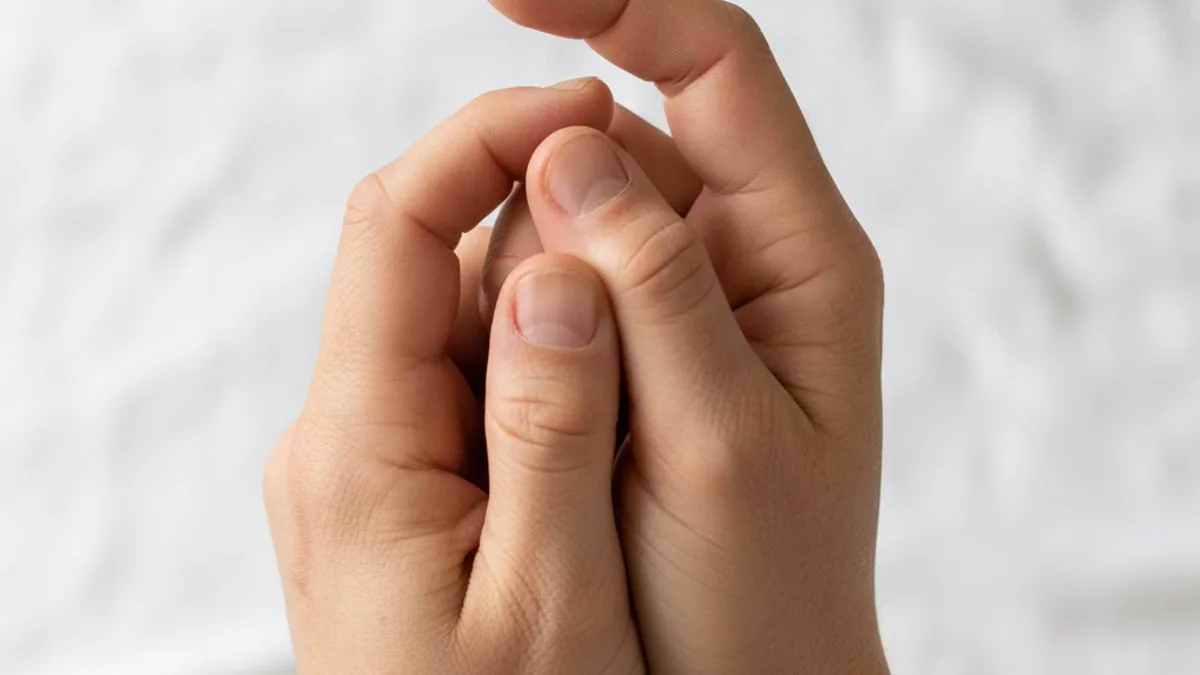
Nail Clubbing: What Rounded Fingertips Can Mean
This page covers what the change looks like, which organ systems it points toward, the simple back to back nail check that clinicians describe, and what blood work can and cannot add to the picture.
What usually causes this?
Clubbing comes from a build up of soft tissue under the nail bed rather than from day to day habits. Short sleep, a stressful month, a heavy training block, a few drinks or a change in diet do not reshape a fingertip. That is what makes the sign useful. When the shape of the finger changes, the explanation sits in the body systems that feed and drain the fingertip rather than in lifestyle.
Research suggests that digital clubbing is reported across a range of long standing conditions involving the lungs, heart, liver and gut rather than belonging to a single disease 1. Clubbing is associated with chronic lung conditions such as bronchiectasis and scarring of lung tissue, with heart conditions present from birth that lower blood oxygen, with infection on a heart valve, with chronic liver conditions, and with inflammatory conditions of the bowel 2.
Lung cancer sits on that same list of conditions a clinician considers when new clubbing appears 2. Whether chest imaging makes sense for a particular person, or whether they fall into a group offered screening, depends on age, smoking history and current symptoms. That is a conversation to have with a clinician rather than something to work out from a nail.
Why the tissue changes at all
The fingertip swelling is driven by signals carried in the bloodstream. Studies suggest that clubbing involves circulating factors that promote the growth of small blood vessels and connective tissue in the nail bed, which normally would be cleared or filtered before they reach the fingers 3. When lung tissue, heart circulation or the liver stops handling those signals in the usual way, the fingertip responds over months.
Causes worth knowing about
The categories a clinician works through include the following.
- Lung and airway conditions. Long standing infection, airway widening, lung scarring and tumours of the chest all appear on the differential 2.
- Heart conditions. Conditions present from birth that mix low oxygen blood into the circulation, and infection seeded on a heart valve, are both described 2.
- Liver conditions. Chronic liver disease is part of the same list 2.
- Gut conditions. Inflammatory bowel conditions and problems with absorbing nutrients are described alongside the others 2.
- Thyroid related changes. Finger and nail changes connected to thyroid disease are listed among the differentials for clubbing 2.
- An inherited form. Some families carry a form that starts in youth rather than following another illness.
- Some medicines. A handful of medicines can change how nails look over time. Ask your prescriber about anything you take, and do not stop a medicine on your own.
The inherited form
A minority of clubbing runs in families and begins without another illness behind it. In this form, the finger changes are associated with variants in genes that regulate how the body handles prostaglandin E2, and they often come with thickened skin and joint changes 4. Research suggests that people with this inherited form can also have involvement of the stomach and bowel, including inflammation and ulceration of the gut lining 6. A chronic gut condition tied to variants in the SLCO2A1 gene has been described in people with the same inherited finger and bone changes 7.
Clubbing has also been described as part of POEMS syndrome, an uncommon disorder involving nerves, hormones and an abnormal blood protein 5.
One more point of detail. Clubbing affecting only one hand or a single finger is considered separately from the two sided form, and local problems with blood vessels or injury are among the reasons described 2. There are also look alikes, where a nail is thickened or curved for reasons that have nothing to do with the tissue under it 2. Telling those apart is an examination task, not a photo task.
Related: Nail Fungus: Causes, Look-Alikes and Testing
How can you tell clubbing from an ordinary nail curve?
The quickest check is the diamond window test, sometimes called the Schamroth sign. Hold your two index fingers out, put the nails back to back so the last joints touch, and look at the space between the two nail beds. In a finger with normal shape, a small diamond shaped window of light appears just below where the nails meet. When the fingertip tissue has thickened, that window narrows or closes completely.
One closed window is not an answer. It is a reason to book an appointment and have someone look at both hands properly.
In the clinic, the assessment goes further than the window. Studies suggest that measured approaches, such as the angle the nail makes with the skin at its base and the ratio of finger thickness at the nail bed compared with the joint behind it, give a more consistent judgement than impression alone 8. A clinician will also press the base of the nail to feel whether it moves in a soft, spongy way, and will ask how long the change has been there.
Clubbing builds over weeks to months, so a photograph of your hands taken a year ago is genuinely useful proof for the person examining you. If older family photos show the same fingertips, the picture is different from fingertips that changed this year.
Which blood tests can help explain it?
No blood test measures clubbing. Blood work earns its place by mapping the organ systems the sign points toward, so that a clinician can decide which imaging or breathing tests to order next.
| Marker | Why it is linked to this symptom | What a result can and cannot tell you |
|---|---|---|
| Hemoglobin | Carries oxygen in red blood cells. Both ends of the scale matter here, because long standing low oxygen pushes red cell production up, while blood loss or poor absorption from an inflamed gut pulls hemoglobin down. | A result outside the range printed on your lab report is worth discussing with a clinician, who decides what it reflects. It cannot identify a lung, heart or gut condition on its own, and a result inside the range does not rule one out. |
| ALT | An enzyme concentrated in liver cells that leaks into the blood when those cells are stressed or injured, which is why it is read whenever chronic liver disease is on the list of considerations. | A raised ALT points at the liver as a system worth examining further. It does not say why the liver is irritated, and it can sit inside the printed range even when the liver has long standing scarring. |
Read every number against the range as printed on your own lab report, because ranges vary by lab, age and sex. These two markers sit alongside the rest of a general panel, and the full picture includes chest imaging, breathing tests or heart imaging rather than blood work alone.
Can hemoglobin explain fingertips that look rounder?
Hemoglobin does not cause clubbing, but it is one of the first numbers a clinician looks at, because it tracks two threads that run through almost every condition clubbing accompanies. Those threads are oxygen delivery and blood loss.
Hemoglobin is the protein inside red blood cells that picks up oxygen in the lungs and releases it in the tissues. When oxygen levels in the blood stay low over long periods, the body responds by making more red cells, so hemoglobin can sit high. That pattern shows up in the chronic lung conditions and the heart conditions present from birth that are associated with clubbing 2. Low hemoglobin tells a different story. Slow blood loss from an inflamed bowel, or poor absorption of iron and other nutrients, both sit on the gut side of the same differential, and research suggests that gut involvement occurs in the inherited form of these finger and bone changes as well 6.
Plenty of ordinary things move Hemoglobin too. Living at altitude, being dehydrated on the morning of the draw, pregnancy, heavy menstrual bleeding, low iron intake, smoking and kidney function all shift the number. That is exactly why a single hemoglobin result is read as one input rather than an answer. Observation, then possible meaning, then a conversation. A value outside the range on your report is worth raising with a clinician, who decides whether it reflects the same process as the change in your fingers or something entirely separate.
Does ALT belong in the same conversation?
ALT is relevant because chronic liver disease sits on the list of conditions in which clubbing is described, and ALT is one of the simplest signals that liver cells are under stress. It is not a clubbing test. It is a liver question asked in blood.
ALT, or alanine aminotransferase, is an enzyme found at high concentration inside liver cells. When those cells are inflamed or injured, ALT leaks into the bloodstream and the measured value rises. A result above the range printed on your report is a reason to look at the liver more carefully with other liver enzymes, imaging and a history, not a statement about what is happening inside it.
The honest limitation is the reverse case. ALT can read inside the printed range in people with long standing liver scarring, because fewer functioning liver cells mean less enzyme to leak. So a normal ALT does not close the liver question when a fingertip has changed shape.
Many things move ALT that have nothing to do with the liver story behind clubbing. Alcohol intake, body weight and fat stored in the liver, a hard training session in the days before the draw, a recent viral infection and some medicines all change it. Ask your prescriber about any medicine you take before assuming a result means something, and keep taking it unless a clinician advises otherwise.
What can a normal panel still miss?
A completely normal blood panel does not rule out the conditions that clubbing points toward, which is the single most important limit to understand on this page. Blood work narrows the field. It does not close it.
Several of the causes show up on pictures rather than in plasma. Imaging can show new bone formation along the shafts of the long bones and joint changes that travel with clubbing in the condition clinicians regard as hypertrophic osteoarthropathy 9. Chest imaging, breathing tests and heart ultrasound answer questions that no blood marker can reach. Where a gut cause is being considered, direct examination of the bowel lining carries the detail.
The inherited form is another gap. In that form, the finger and skin changes come from genetic variants in prostaglandin handling, so a general panel can look unremarkable while the explanation sits in the family history 4.
There is also the matter of time. Clubbing develops slowly, and blood markers describe one morning. If the fingertips have changed over the past year, the trend in your markers across repeat draws tells a clinician more than any single reading, which is why repeat testing is more informative than a one off panel.
When should you see a clinician quickly?
New clubbing always deserves a clinician's eyes, and some symptoms alongside it mean going now rather than booking ahead.
Call 911 or go to the emergency department if any of these appear.
- Severe breathlessness, or breathlessness at rest
- Chest pain or chest pressure
- Lips, tongue or fingertips that turn blue or grey
- Coughing up blood
- Fainting, or new confusion
- A fever with shaking chills and a racing heart
Arrange a prompt appointment with a clinician, rather than waiting for a routine slot, if you notice any of the following.
- Fingertips that have visibly changed shape over recent months
- A cough that has lasted several weeks, or a change in a cough you have had for a long time
- Weight loss you did not intend
- Night sweats, or ongoing low grade fever
- Blood in your stool, persistent diarrhoea or ongoing abdominal pain
- Yellowing of the skin or eyes, or swelling of the abdomen or ankles
- Aching or swelling in the wrists, ankles or knees alongside the finger changes
Do not try to settle this yourself from photographs online, and do not assume an explanation. Describe what changed and when, bring older photos of your hands if you have them, and let the examination and the tests do their work.
If you are having thoughts of self-harm, call or text 988 (US) or your local emergency number now.
How can you check these markers?
Both markers on this page sit inside a standard blood panel, and the FitScript Essential panel measures hemoglobin and ALT along with the rest of its markers. Members have 150+ biomarkers tested per year, which means a result can be read as a trend across draws rather than a single snapshot.
Atlas, FitScript's AI health advisor, explains what each marker measures in plain language and shows how your values have moved over time. Interpretation of a symptom like a change in fingertip shape belongs to a licensed clinician who can examine your hands, take a history and order imaging or breathing tests, and any treatment decision belongs to a licensed provider.
This article is educational and is not medical advice. Discuss your results, your symptoms and any treatment with a clinician or licensed provider before acting on them.
Key takeaways
- Clubbing is a slow structural change in the fingertip, and sleep, stress, training and diet do not produce it.
- The back to back nail check looks for a small diamond shaped window of light. A closed window is a reason to book an appointment, not an answer.
- Clubbing is associated with chronic lung conditions, heart conditions present from birth, infection on a heart valve, chronic liver disease and inflammatory bowel conditions 2.
- Hemoglobin and ALT do not detect clubbing. They map the oxygen, blood loss and liver questions that sit behind it.
- A normal panel does not close the question, because imaging, breathing tests and direct examination of the bowel answer things blood cannot.
- New fingertip changes, especially with a lasting cough, weight loss or joint aching, are worth a prompt appointment with a clinician.
References
- Epidemiology of Digital Clubbing and Hypertrophic Osteoarthropathy: A Systematic Review and Meta-analysis. Journal of Clinical Rheumatology, 2022.
- Clubbing: an update on diagnosis, differential diagnosis, pathophysiology, and clinical relevance. Journal of the American Academy of Dermatology, 2005.
- Clubbing and hypertrophic osteoarthropathy: insights in diagnosis, pathophysiology, and clinical significance. Acta Clinica Belgica, 2016.
- Primary hypertrophic osteoarthropathy: genetics, clinical features and management. Frontiers in Endocrinology, 2023.
- Features of hypertrophic osteoarthropathy in patients with POEMS syndrome: a metaanalysis. The Journal of Rheumatology, 1997.
- Primary hypertrophic osteoarthropathy related gastrointestinal complication has distinctive clinical and pathological characteristics: two cases report and review of the literature. Orphanet Journal of Rare Diseases, 2019.
- Genotype and phenotype characterization of primary hypertrophic osteoarthropathy type 2 and chronic enteropathy associated with SLCO2A1: Report of two cases and literature review. American Journal of Medical Genetics. Part A, 2024.
- The rational clinical examination. Does this patient have clubbing?. JAMA, 2001.
- Hypertrophic Osteoarthropathy: Clinical and Imaging Features. Radiographics, 2017.
Common questions
What is nail clubbing?
Nail clubbing is a gradual change in the shape of the fingertip, where the tissue under the nail thickens, the base of the nail feels soft and springy, and the nail curves downward more steeply than before. It develops over weeks to months and is a reason to arrange an appointment with a clinician.
What does clubbing of fingers look like?
Clubbing of fingers looks like a widened, rounded fingertip with a nail that slopes down over it, so the finger takes on a drumstick shape from the side. The angle where the nail meets the skin flattens out and then reverses, and the nail base feels spongy when pressed gently.
Can fingernail clubbing be inherited?
Yes. A smaller number of people have an inherited form of fingernail clubbing that begins in youth, runs in families, and arrives without another illness behind it. A clinician can sort an inherited pattern from a newly developed one.
How do you do the diamond window test at home?
Hold your two index fingers out and place the nails back to back so the last joints touch. Look at the space just below where the nails meet. A small diamond shaped window of light normally appears there. If that window is narrowed or closed, book an appointment rather than drawing a conclusion.
Which blood tests are checked when fingertips change shape?
Hemoglobin tracks oxygen carrying and blood loss, while ALT reflects stress on liver cells. Neither one detects the finger change itself. They help a clinician decide which imaging or breathing tests to order next.
Does finger clubbing always point to a lung problem?
No. The lungs are one group of causes, and heart, liver and bowel conditions appear on the same list, along with an inherited form. Clubbing limited to one hand or one finger is considered separately. A clinician examines both hands, takes a history and decides which direction to investigate.
Does finger clubbing go away?
It depends entirely on what sits behind it, and that is for a clinician to assess. The fingertip change tends to follow whatever is driving it, so attention goes to identifying and managing the underlying condition rather than to the nails themselves. Expect assessment first, not a prediction about the fingers.
Should I see a doctor if only one finger looks clubbed?
Yes, book an appointment. Changes in a single finger or one hand are assessed differently from changes across both hands, and local blood vessel or injury related reasons are among the possibilities. Describe when you first noticed it and bring older photos of your hands if you have any.