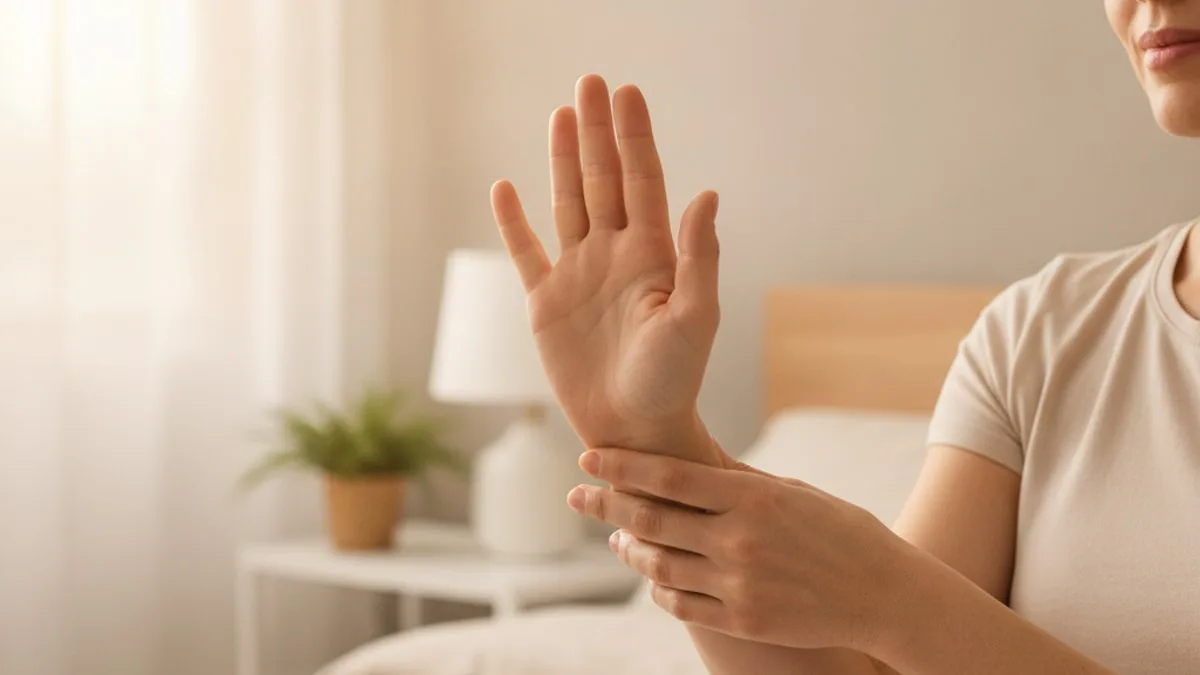
Swollen Hands: Causes and When to Get Checked
Sudden swelling of the hands along with swelling of the lips, tongue or throat, any trouble breathing, chest pain or pressure, fainting, or confusion and vomiting after hours of exercise, means you should call 911 or go to the emergency department.
This page covers swelling across the whole hand rather than one finger swelling on its own. It is educational and not medical advice, so discuss your results and any treatment with a clinician or licensed provider.
What can make both hands swell?
Everyday explanations come before anything a blood test names. Hand swelling can follow heat, hours of walking with the arms hanging down, a salty meal, alcohol, short sleep, a heavy training block, an injury, inflammatory joint conditions, life-stage hormone shifts and some medicines. Ask your prescriber about any medicine you take, since that conversation belongs with the person who prescribed it.
The underlying mechanics are simple. Blood travels through small vessels, and a small amount of fluid moves out into the surrounding tissue and back again all day long. When that exchange shifts, fluid lingers in the tissue and the hand looks puffy. A clinical appraisal of peripheral edema describes increased permeability of small blood vessels as one route by which fluid collects in tissue 4.
Walking and hiking add two things at once. Your arms hang below heart level for a long stretch, and the small vessels in warm hands widen to shed heat. Rings feel tight, fingers feel thick, and the change can show first as puffiness across the back of the hand. Heat alone does something similar on a hot day without any exercise at all.
Long endurance exercise introduces a different possibility. Research suggests that drinking beyond thirst during prolonged endurance exercise is associated with exercise-associated hyponatremia, a fall in blood sodium driven by fluid intake rather than by salt lost in sweat 1. A narrative review of exercise-associated hyponatremia describes how risk relates to factors including sex, race location, ambient temperature, sports discipline and the length of the performance 3. Puffy hands and fingers during a long event sit alongside headache and nausea in that picture, which is why what you drank and for how long matters when a clinician takes the history.
Food, alcohol and sleep shift fluid on a shorter timescale. A salty evening meal, a few drinks, a short night or a high-stress week can all leave hands and fingers feeling tight the next morning, and the pattern settles as the day goes on and the hands move. Long flights, long drives and desk days with the hands low do the same.
Life stage plays a part too. Hormonal shifts across the menstrual cycle and through the menopause transition can change how the body holds fluid from week to week. In pregnancy, swelling in the hands is a topic to raise with your OB or midwife rather than one to read off a chart, because the assessment is different.
Injury, overuse and inflammatory joint conditions cause swelling through tissue damage and inflammation rather than through whole-body fluid balance. Swelling after a fall, a crush injury or hand surgery is handled by a clinician, and a systematic review examined edema management techniques used by hand therapists for subacute hand swelling 6. Morning stiffness in several joints that lasts for weeks is a different pattern again and is worth bringing to a clinician.
Finally, swelling in the hands can be part of fluid building up more widely, where the heart, kidneys or liver are not clearing fluid the way they normally do. That is the situation blood tests help a clinician sort out, and it is the reason three ordinary markers earn their place on the request form.
Which blood tests can help explain it?
Three routine markers do most of the useful work when hand swelling is assessed. Sodium reads on fluid and salt balance, creatinine reads on kidney filtration, and albumin reads on the main blood protein that helps hold fluid inside vessels.
| Marker | Why it is linked to hand swelling | What a result can and cannot tell you |
|---|---|---|
| Sodium | Water follows sodium, so a fall in blood sodium shifts water into cells and tissue, which can show as puffy hands and fingers during or after long exercise. | A result shows where your sodium sat at the moment of the draw. It cannot tell you why on its own, because fluid intake, sweat losses, vomiting, kidney handling of water and some medicines all move it. |
| Creatinine | Creatinine is a waste product the kidneys filter, so it is used as a read on filtration, and kidneys that hold on to salt and water are one possible reason fluid collects in tissue. | A result reflects filtration and muscle turnover together. It cannot separate a kidney issue from high muscle mass, a heavy training block or a recent large meat intake without further assessment. |
| Albumin | Albumin helps keep fluid inside small blood vessels, so a low value is one possible reason fluid settles in the hands and elsewhere. | A result shows the concentration in that sample. It cannot say whether the cause is liver function, protein loss, intake, inflammation or simple concentration from dehydration. |
Values are read against the range printed on your own lab report, and those printed ranges vary by lab, by age and by sex. A value outside that range is worth discussing with a clinician, who decides what it reflects in your situation.
Can low sodium explain hand puffiness during long exercise?
Low blood sodium is one possible reason for puffy hands during very long exercise, and it comes from too much fluid relative to sodium rather than from a single low-salt meal. Sodium is the main electrolyte in the fluid outside your cells, and water distributes itself around sodium. When the balance tips, water moves into cells and tissue, and fingers and hands can be where you notice it first.
Research suggests that exercise-associated hyponatremia develops when fluid intake during prolonged exercise exceeds what the body can clear, and the review describes puffiness along with headache, nausea and, at the more severe end, confusion and vomiting 1. The Wilderness Medical Society published a 2019 update of its clinical practice guidelines for the management of exercise-associated hyponatremia, covering recognition and field management of the condition 2. Confusion, repeated vomiting or a seizure during or after hours of exercise means calling 911 or going to the emergency department.
Plenty of other things move a sodium result, which is why one value is read in context. Fluid intake in the hours before the draw, sweat losses, vomiting and diarrhoea, how the kidneys and hormones are handling water, some medicines, and other medical conditions all shape the number. If you want to read more about what the marker measures and how a clinician uses it, see Sodium.
The practical version for a walker, hiker or endurance athlete is this. Swelling that arrives during a long event, in the heat, alongside heavy drinking from a bottle or bladder, gives a clinician a reason to look at sodium. Swelling that arrives on a quiet week at a desk points somewhere else.
What does creatinine show about the kidneys and fluid?
Creatinine shows how well the kidneys are filtering waste, which matters because kidneys that hold on to sodium and water are one possible reason fluid collects in the hands, ankles and face. Creatinine comes from everyday muscle turnover, circulates in blood, and is filtered out by the kidneys, so the amount left in blood is used as a rough read on filtration.
It is a useful marker and an imperfect one. Muscle mass raises it, so a lifter with a heavy training history can run higher than a smaller sedentary person with identical kidney function. A large meat intake before the draw, hydration state at the time, age, sex and some medicines all nudge it as well. That is why a clinician reads creatinine next to the rest of the panel and the clinical picture rather than alone.
Fluid build-up from the heart is assessed differently again. Research suggests that, in heart failure, fluid build-up in the limbs can be assessed with bioimpedance alongside clinical examination, according to a systematic review of that approach 5. Blood markers and examination work together here, and no single number stands in for the assessment.
If your creatinine sits outside the range printed on your lab report, that is worth discussing with a clinician promptly, who decides whether it reflects your training and build, your hydration on the day, or something that needs follow-up. You can read more about what the marker measures on the Creatinine page.
Can low albumin let fluid settle in the hands?
Albumin is the main protein in blood that helps hold fluid inside small vessels, so a low value is one possible reason fluid settles into tissue including the hands. Think of it as part of the pull that keeps water in circulation. When that pull weakens, or when the vessel walls themselves leak more than they should, fluid spreads into the surrounding tissue. A clinical appraisal of peripheral edema sets out increased vascular permeability as one of the routes to that kind of swelling 4.
A low albumin result has several possible explanations, and the marker does not pick between them. The liver makes albumin, so liver function is one consideration. The kidneys can lose protein into the urine, which is another. Low protein intake, poor absorption and ongoing inflammation can each lower it. Albumin can also look higher simply because a sample was taken while you were dehydrated, and in pregnancy the picture is different again, which is a question for your OB or midwife.
What albumin is good at is pointing a clinician in a direction. A low value with hand and ankle swelling prompts a different set of follow-up tests than a normal value with the same symptom. The result itself does not name a condition, and it should not be read as naming one. More detail on the marker sits on the Albumin page.
What can a normal panel still miss?
A clean sodium, creatinine and albumin result does not rule out a reason for hand swelling, because blood tests cannot see structure, nerves or lymph flow. Several explanations live entirely outside the blood.
Mechanical and positional causes leave no trace in a sample. Hours with the arms hanging low, heat, a tight strap, repetitive gripping, sleeping with the wrists bent, or a long flight all change how fluid sits in the hand without changing a single marker.
Nerve-related problems at the wrist can make a hand feel swollen and tight when the measured size has barely changed, and those are assessed with examination and sometimes nerve conduction tests rather than bloodwork. Lymph drainage matters too, and swelling after lymph node surgery or radiation to the armpit follows a different mechanism that blood does not capture.
Joint conditions in their early stages can show as swelling and stiffness before any inflammatory marker moves, which is why examination and imaging tests have a role. Injury, infection in the skin or deeper tissue, a clot in an arm vein, and allergic swelling all need a clinician looking at the hand rather than at a number. Swelling after injury or surgery is handled clinically, and a systematic review looked at edema management techniques for subacute hand swelling used in hand therapy 6.
There is also the simple limit of timing. A blood test is a snapshot of one morning. Hydration, posture during the draw, a hard session the day before and how long a tourniquet was on can all shift a result at the margins. Retesting, and testing across a year rather than once, gives a clinician a trend instead of a dot.
When should you see a clinician quickly?
Some signs mean emergency care, not an appointment. Call 911 or go to the emergency department for any of the following.
- Sudden hand or arm swelling along with swelling of the lips, tongue or throat
- Any trouble breathing, including new breathlessness when lying flat
- Chest pain or pressure
- Fainting or passing out
- Confusion, repeated vomiting or a seizure during or after hours of exercise
A separate set of signs means arranging a prompt or same-day appointment with a clinician.
- One hand swollen, red, warm and painful, or swelling that spreads up the arm
- Swelling after a fall, crush or other injury, or with loss of movement in the hand
- Swelling along with passing far less urine than normal
- Swelling with weight gain over a few days, or with puffiness around the eyes in the morning
- Stiffness and swelling in several joints lasting weeks
- New swelling after starting a new medicine, which is a conversation for your prescriber
- Swelling that does not change over days, or that keeps coming back without a clear pattern
Bring the pattern with you. When the swelling started, what you were doing, how much you drank, what you ate, how you slept, and whether it is one hand or both all shape what a clinician checks next. Nothing on this page is a diagnosis, and a result outside the printed range on your lab report is a reason to talk to a clinician rather than to draw a conclusion.
If you are having thoughts of self-harm, call or text 988 (US) or your local emergency number now.
How can you check these markers?
Sodium, creatinine and albumin are standard markers included in the FitScript Essential panel, so they can be checked together in one draw rather than one at a time. Members have 150+ biomarkers tested per year, which turns a single snapshot into a trend you and a clinician can read across seasons, training blocks and life changes.
Results come back with an explanation from Atlas, FitScript's AI health advisor, written in plain language rather than lab shorthand, so you can see what each marker measures and what a value outside the printed range might be worth asking about. Interpretation is a starting point for a conversation, not a verdict. A licensed provider reviews your results and decides on any next step, and treatment decisions belong to a licensed provider.
Key takeaways
- Swelling across both hands can follow heat, long walks, salty food, alcohol, short sleep, training load, injury, joint conditions, life-stage hormone shifts and some medicines, and your prescriber is the person to ask about any medicine you take.
- Research suggests that exercise-associated hyponatremia develops when fluid intake during prolonged exercise outpaces what the body can clear, and puffy hands sit alongside headache and nausea in that picture 1.
- Sodium, creatinine and albumin are the markers a clinician can check first, and each is read against the range printed on your own lab report.
- A normal panel does not close the question, because nerve, lymph, joint, vein and mechanical causes leave no mark in blood.
- Sudden swelling with lip, tongue or throat swelling, any trouble breathing, chest pain or pressure, fainting, or confusion and vomiting after long exercise means calling 911 or going to the emergency department.
If your hands also feel numb or tingly rather than simply tight, that pattern points in a different direction, and the page on tingling in hands causes covers it.
References
- Exercise-associated hyponatremia: a review. Emergency Medicine (Fremantle, W.A.), 2001.
- Wilderness Medical Society Clinical Practice Guidelines for the Management of Exercise-Associated Hyponatremia: 2019 Update. Wilderness & Environmental Medicine, 2020.
- Exercise-Associated Hyponatremia in Endurance and Ultra-Endurance Performance-Aspects of Sex, Race Location, Ambient Temperature, Sports Discipline, and Length of Performance: A Narrative Review. Medicina (Kaunas, Lithuania), 2019.
- Peripheral edema due to increased vascular permeability: a clinical appraisal. International Journal of Clinical & Laboratory Research, 1992.
- Bioimpedance for peripheral edema assessment in heart failure and clinical practice: a systematic review. Physiological Measurement, 2025.
- Effectiveness of edema management techniques for subacute hand edema: A systematic review. Journal of Hand Therapy, 2017.
Common questions
What causes swelling in hands?
Swelling in both hands can follow heat, hours of walking with the arms hanging down, a salty meal, alcohol, short sleep, a heavy training block, an injury, joint inflammation, hormonal shifts across life stages, and some medicines. Fluid build-up involving the heart, kidneys or liver is another possibility a clinician assesses with bloodwork and examination.
When is hand swelling worth checking?
Book a prompt appointment if swelling lasts for days, keeps returning without a clear pattern, comes with far less urine than normal, comes with weight gain over a few days, or follows a new medicine. Call 911 or go to the emergency department for swelling with lip, tongue or throat swelling, or any trouble breathing.
Why do my hands swell when I walk?
When you walk, your arms hang below heart level and your hands warm up, so fluid can settle in the tissue of the hand. On very long walks, drinking beyond thirst can also lower blood sodium, which shifts water into tissue. Confusion or vomiting after hours of exercise means calling 911 or going to the emergency department.
Which blood markers does a clinician look at for swollen hands?
Sodium, creatinine and albumin are the three a clinician can start with. Sodium reads on fluid and salt balance, creatinine reads on kidney filtration, and albumin reads on the main blood protein that helps hold fluid inside vessels. Each result is read against the range printed on your own lab report.
Can salty food or alcohol make my hands puffy?
Yes, both can shift how your body holds fluid over a short timescale, and tight rings the morning after a salty meal or a few drinks is a familiar pattern. If the puffiness keeps returning, settles slowly, or comes with swelling elsewhere, bring the pattern to a clinician rather than guessing at the cause.
Does morning hand swelling mean something different from evening swelling?
The timing is useful information rather than an answer on its own. Puffiness on waking can relate to lying flat overnight, fluid intake and salt the night before, or joint stiffness. Swelling that builds through the day can relate to heat, posture and activity. A clinician uses the timing alongside your other markers and findings.
Can a normal blood panel still leave hand swelling unexplained?
Yes. Blood tests cannot see nerve compression at the wrist, lymph drainage problems, early joint inflammation, a vein clot, an injury or simple positional fluid shifts. A normal panel narrows the list rather than closing it, and a clinician may add examination, nerve conduction tests or imaging tests to work out what is going on.
What should I do if only one hand is swollen?
One-sided swelling points away from whole-body fluid balance and towards something local, such as an injury, a joint problem, an infection, a vein issue or lymph drainage. Arrange a prompt appointment, especially if the hand is red, warm and painful or the swelling is spreading up the arm. A clinician examines the hand and decides on next steps.