Patch Test for Allergies: How Contact Allergy Is Found
What is a patch test, and what does it actually find?
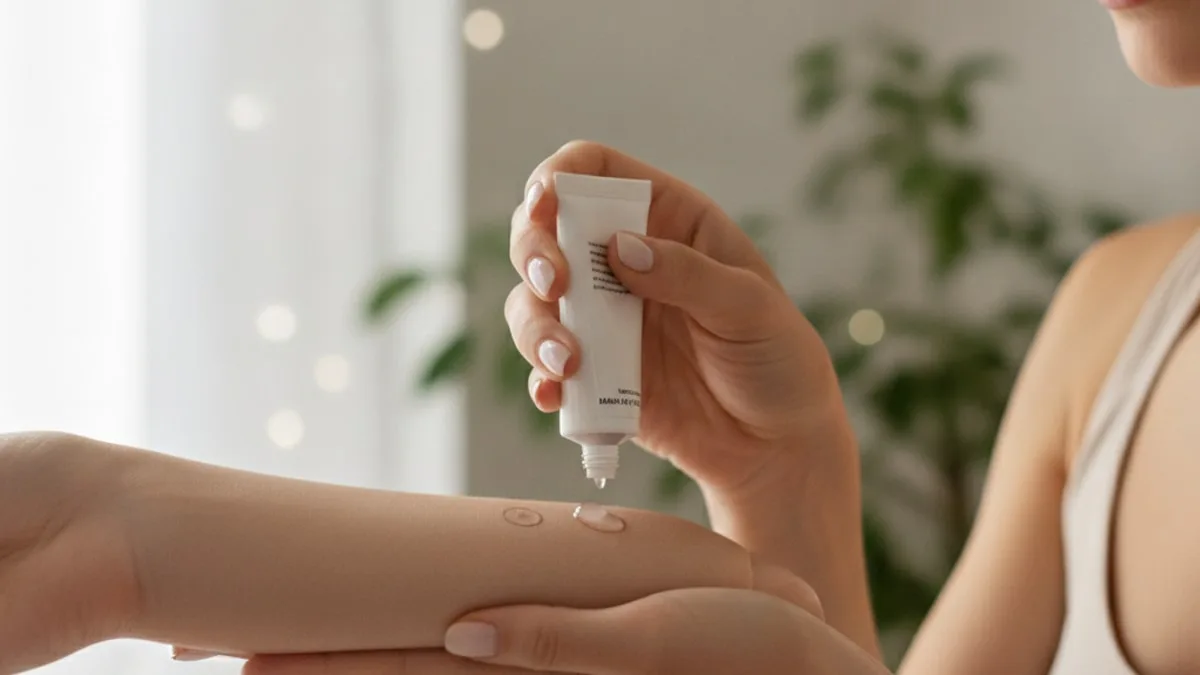
A patch test is a skin test that looks for delayed contact allergy, the kind of reaction that appears as an eczema-like rash hours to days after skin meets a particular substance. Small chambers holding standardized allergens, each at a fixed concentration in a carrier such as petrolatum, are mounted on adhesive strips and taped to clear skin, usually on the upper back.
The slow timing is the whole point. Delayed contact allergy runs through memory T cells that recognise a small chemical once it has bound to proteins in the skin. That cellular response takes roughly a day or more to become visible, which is why nothing much happens in the first few minutes and why the patches stay on long enough for the skin to answer. The European Society of Contact Dermatitis has set out best-practice method for this testing, covering allergen preparation, application, occlusion time and reading schedule 1, with an updated version published in 2026 2.
What the test gives back is a name. A rash on the hands, face or feet that has been put down to sensitive skin may turn out to involve one specific chemical in a product used daily. Once the substance is named, avoidance stops being guesswork about whole product categories and becomes a short list of ingredient terms to read for on a label. A clinician decides which panels to apply and how to interpret the outcome.
How does delayed contact allergy differ from an immediate reaction?
They involve different arms of the immune system, run on different clocks, and need different tests. Immediate allergy, the hives-and-sneezing kind, is driven by IgE antibodies and shows itself within minutes. Delayed contact allergy is cell-mediated, builds over a day or more, and produces itchy, scaly, sometimes blistered skin at the place of contact rather than a sudden whole-body response.
That difference explains a common mix-up. A skin prick test or an IgE blood test can point toward pollen, dust mite, animal dander or certain foods, but neither looks for the chemicals that cause contact dermatitis. Patch testing is the method built for that question 1.
| Patch testing | Skin prick testing | |
|---|---|---|
| Immune pathway | Delayed, cell-mediated | Immediate, IgE-mediated |
| Where it is applied | Chambers taped to clear skin, usually the upper back | Tiny skin pricks, usually the forearm or back |
| When it is read | At patch removal around 48 hours, then again on a later day | At the same visit, within minutes |
| What it looks for | Metals, fragrance ingredients, preservatives, rubber chemicals, hair dye ingredients | Airborne allergens and some foods |
| What a positive looks like | Redness, swelling, small papules or vesicles that persist | A raised wheal with surrounding flare |
| What it cannot show | Immediate food or inhalant allergy | Contact allergy to chemicals |
The two tests answer separate questions, and one does not substitute for the other. A person can have both kinds of allergy, or neither, and a clinician chooses the test that matches the pattern of symptoms described.
Who is usually sent for this test?
Patch testing is usually considered in adults with eczema-like skin disease that keeps returning, follows an unexplained pattern, or does not settle with the care a clinician has already arranged. The guideline on best practice sets out the indications and the standard method used in those situations 1.
Certain patterns raise the question more strongly. A rash shaped like a watch strap, a belt buckle, a jewellery clasp or a pair of earrings suggests something worn against the skin. Hand dermatitis in people whose work involves wet hands, gloves, cleaning agents, hairdressing chemicals, construction materials or machining fluids raises an occupational question. Rashes on the face, eyelids, neck or scalp margin often raise questions about what is applied above them or carried there on the fingers. Dermatitis that flares on holiday and settles at work, or the reverse, is another pattern worth describing to a clinician.
In people with long-standing atopic eczema, a second, contact-driven layer can sit on top of the underlying skin disease, and patch testing is one way clinicians look for it. The test is also used when a rash sits around a wound, an old scar or a site where products have been applied repeatedly over months.
The decision is clinical, not self-serve. A clinician weighs the history, the distribution of the rash, the exposures described at home and at work, and the state of the skin on the back, because testing needs a clear area to work with.
How are the patches applied, and how long do they stay on?
The patches go on clear, untanned, hair-free skin, almost always the upper back, and stay in place under occlusion for 48 hours in the standard method 1. Each chamber carries one allergen, the strips are pressed down firmly so every chamber contacts the skin evenly, and the positions are marked on the skin so the grid can be read accurately later.
The wear period is low-drama but has rules. The back has to stay dry, which means no swimming, no baths that wet the area and showers that keep the back out of the spray. Heavy sweating can loosen the strips, so hard training is usually paused. Sun and tanning lamps on the test area are avoided before and during testing, because ultraviolet exposure changes how the skin responds 2. Loose, older clothing helps, since markings can transfer.
People are told to leave the strips alone but not to ignore them. Intense burning, pain or a sensation far beyond mild itch under one chamber is a reason to contact the testing clinic rather than wait, and some clinics ask that a patch causing severe symptoms be removed early with the position noted so the reaction can still be recorded.
Mild itching under the panels during the wear period can occur, and the back may feel tight under the tape. The appointment structure matters when planning the week, because the test requires returning to the clinic at least twice after application.
What happens at the day 2 reading, and why is a later reading needed?
At around 48 hours the strips come off, the skin is given a short settling period so pressure marks from the chambers fade, and the first reading is taken. A second reading follows on a later day, commonly day 3 or day 4, and the guideline treats that second reading as part of the standard protocol rather than an optional extra 1.
The reason is simple. Allergic reactions are slow to build and tend to persist or strengthen between the two readings, while simple irritation from an occluded chemical tends to be at its peak when the patch comes off and to fade afterwards. Reading twice lets the grader watch the direction of travel, which is one of the main ways allergy and irritation are separated. A test read only once at patch removal can miss reactions that have not yet appeared and can over-call reactions that would have faded.
Some allergens are slower still. Reactions that first appear a week or more after application are recognised, and testing clinics commonly ask people to report any new spot that develops on the test area after the final reading so it can be assessed rather than dismissed 2.
The practical consequence is scheduling. A patch test is not a single appointment. It is an application visit, a removal and reading visit, a later reading visit, and sometimes a phone call about a late change on the back.
How are reactions graded, and what do the grades mean?
Reactions are graded on a standard scale rather than described freehand, so results mean the same thing between clinics and over time. The International Contact Dermatitis Research Group classification is the scale used, and it was clarified and modified in a 2025 update to tighten how borderline and irritant patterns are recorded 3.
| Grading | What the reader sees | How it is interpreted |
|---|---|---|
| Negative | No visible change at the site | No reaction to that allergen at that concentration |
| Doubtful | Faint redness only, no swelling or papules | Not recorded as a positive; may be repeated |
| Weak positive | Redness with swelling, possibly small papules | An allergic pattern |
| Strong positive | Redness, swelling, papules and vesicles | A stronger allergic pattern |
| Extreme positive | Intense reaction with coalescing vesicles or bullae | A very strong allergic pattern |
| Irritant reaction | Sharply bordered, often glazed, scalded or pustular, fading after removal | Skin irritation rather than allergy |
Grading is only half the job. A positive grade says the skin recognises a substance; it does not say that substance explains the rash. Clinicians then assess relevance, matching each positive against what the person actually contacts at home, at work and in hobbies, and deciding whether it is current, past or unclear 1. A positive to a chemical with no realistic exposure may be a historical sensitisation. Bringing a written list of products, workplace materials and hobby supplies to the reading visit makes that step far more productive.
Which substances sit on a standard test series?
A standard or baseline series is a fixed set of allergens chosen because they account for a wide span of contact allergy in the general population, and it is applied first before any extra panels 2. The exact contents differ between countries and clinics, but the categories are recognisable.
Metals appear, with nickel the one most people have heard of, alongside cobalt and chromium compounds that turn up in jewellery, fasteners, tools, leather and cement. Fragrance screening mixes appear, together with a natural resin used as a fragrance marker. Preservatives used in water-containing products are represented, as are rubber accelerator chemicals found in gloves, elastic and footwear, a hair dye ingredient, and plant-derived allergens. Ingredient classes used in products applied to the skin are included as well.
Beyond the baseline, supplementary series exist for particular exposures, such as hairdressing, dentistry, printing, plastics and glues, or for particular body sites. Clinicians may also test a person's own products under controlled conditions when the history points at something specific and a safe way to apply it exists 1.
What the panel does not include matters too. No series covers every chemical in circulation, so a negative result is read in the context of what was tested rather than as a clean sweep of everything the skin has ever touched.
Why do fragrance ingredients get their own attention?
Fragrance is handled carefully because scented material is everywhere and because a single label word can hide many individual ingredients. Research suggests that fragrance ingredients are among the frequent causes of contact allergy and that screening mixes are used as the first-line way to pick this up during testing 4. When a screening mix comes up positive, individual fragrance substances can be tested afterwards to work out which components are involved 4.
The practical problem is identification. Scented ingredients appear in personal care products, cleaning products, laundry products, air fresheners, wipes, candles and even some papers and plastics. A product described as unscented may still contain a masking scent, and a product described as fragrance-free is making a different claim. Labelling conventions vary between regions, which is why clinics hand over the specific ingredient terms a person needs to scan for rather than a vague instruction to avoid perfume.
Transfer is the other complication. Fragranced material moves from hands to face, from a partner's products to a neck, from a scarf or pillowcase to a cheek. A rash in a place where nothing scented is ever applied directly can still involve a scented product used somewhere else, which is one reason clinicians ask about household and workplace products rather than only what the person applies to themselves.
Any change to products or skin care after testing is worked out with the clinician who read the results.
Why do eyelid rashes so often lead to this test?
Eyelid skin is thin, highly exposed and constantly touched, so it reacts to small amounts of material that thicker skin tolerates without visible change. A systematic review with meta-analysis of patch-tested adults with eyelid dermatitis reported that relevant positive reactions were identified in this group, which is why clinicians often raise testing when an eyelid rash keeps returning 5.
Three routes bring material to the eyelids. Direct application covers anything placed on or near the eye. Transfer covers everything carried there on fingertips and nails, including products used on the hair, scalp and hands, which is why a scalp product can show up as an eyelid problem and nowhere else. Airborne exposure covers dusts, sprays, vapours and fumes that settle on an upturned face, including materials encountered at work.
Because of those routes, eyelid testing is as much an exposure interview as a skin procedure. Clinicians usually want a complete inventory, including products used by other people in the household, items used only occasionally, protective eyewear, contact lens care materials, and anything handled at work before the face is touched.
A persistent eyelid rash also deserves an eye examination in its own right, since the eye surface and the lid margin can be involved together. Changes in vision, eye pain, or discharge are reasons to contact a clinician rather than to keep adjusting products at home.
How should you prepare in the weeks and days before testing?
Preparation is mostly about giving the back a fair chance to speak. The test area needs to be free of active rash, untanned and not recently exposed to sun or ultraviolet lamps, because inflamed or UV-exposed skin can distort readings 2. Products applied to the back in the days before application are usually paused, and the skin is left clean and dry on the day.
Some medicines can damp down skin reactions and change what the test shows, which clinics take into account when they plan the timing of testing 1. Nothing on that front is a do-it-yourself decision. The rule is simple: ask your prescriber before changing or stopping anything, and tell the testing clinic everything being taken, including items bought without a prescription.
Practical preparation helps as well. Choose a week with no swimming, no sauna, no heavy sweating and no heavy lifting that rubs the back. Plan for the return visits, since the schedule is fixed by the biology of the reaction and cannot be compressed. Bring a written exposure list covering work, home and hobbies, with ingredient labels photographed where possible, because relevance assessment at the reading visit depends on it.
Finally, mention any history of widespread skin reactions, extensive active dermatitis, or previous problems with adhesive tape, so the clinician can decide whether to postpone, adjust the site or modify the panel selection.
What are the risks and downsides of patch testing?
The main downsides are discomfort, imperfect answers and, occasionally, reactions that outlast the test. Itching at positive sites, redness, small blisters and tenderness are part of how the test works, and a strong positive can be uncomfortable for several days after the patches come off.
Some reactions last well beyond the reading schedule. A literature review describes allergic patch test reactions that persisted for weeks or longer in some people, which is one reason clinics ask to be told about sites that are not settling 6. Pigment change at a reaction site can follow, and existing dermatitis elsewhere can flare during testing. Testing can also, rarely, sensitise someone to a substance they were not previously allergic to, a recognised limitation that influences how panels are selected and how concentrations are standardised 1.
The accuracy limits matter too. False negatives can follow from patches loosening, from a back that was sweated or washed, from a substance that was not on the panel, or from medicines affecting the skin response 2. False positives and irritant patterns can be misread as allergy, which is exactly what the standard grading scale and the second reading exist to reduce 3.
None of that is a reason to skip a test a clinician has recommended. It is a reason to follow the wear instructions closely, attend both readings, and report anything unexpected rather than waiting for the next appointment.
Does skin tone change how a reaction looks?
Yes, and it changes how reactions should be read. Research suggests that in skin of colour the redness used to grade reactions can be harder to see, with reactions appearing violaceous, grey-brown or hyperpigmented instead, so readers rely more on raised texture, papules, vesicles and firmness felt on palpation 7. The same work notes that this contributes to under-recognition of allergic contact dermatitis in these patients 7.
The practical implications run in two directions. For the reader, symptoms are worth reporting out loud at the reading visit. Itch, burning or tenderness at a specific chamber position is information the grader can act on, especially where colour change is subtle. Good lighting, side lighting and touch are part of a careful reading, and asking the clinician to check a site that has felt irritated is reasonable.
For clinicians, grading in richly pigmented skin leans on the non-colour features in the standard scale, which is one reason the classification sets out swelling, papules and vesicles alongside redness. Post-inflammatory pigment change after a strong positive is also more visible in darker skin and can persist after the reaction itself has settled, so it is worth asking what to expect at the site.
Anyone who feels a reaction was missed can raise that directly with the clinician who read the test.
What do the results mean, and what happens next?
A positive patch test means the immune system recognises that substance; the clinician then decides whether it explains the rash. That two-step reading, grade first and relevance second, is the core of how results are used 1. A positive with clear current exposure points at a change worth making. A positive with no plausible exposure may reflect sensitisation from the past and may not be driving today's skin.
A negative result is narrower than it sounds. It says the tested allergens, at the tested concentrations, under the tested conditions, did not produce a reaction. It does not rule out contact allergy to something outside the panel, and technical factors such as loosened patches or a damp back can blunt results 2. Clinicians sometimes repeat testing, extend the panel, or test a person's own products when the history keeps pointing somewhere the baseline series did not cover.
The next step after a relevant positive is usually structured avoidance. That means an ingredient list to recognise on labels, alternative material choices for items worn against the skin, and a plan for occupational exposure where relevant. Skin that has been inflamed for months does not settle the moment a trigger is removed, and the clinician who read the test sets the timeframe for review rather than a general rule.
Any further care, including anything prescribed, is decided by a licensed provider who has assessed the person directly.
When is it worth seeing a clinician promptly?
Some situations need urgent assessment rather than a wait-and-see approach. Swelling of the face, lips or tongue, difficulty breathing or swallowing, faintness, or a rapidly spreading blistering rash with fever are reasons to call 911 or go to the emergency department.
Outside those signs, contact the testing clinic or a clinician promptly for severe burning or pain under a patch during the wear period, for a reaction spreading well beyond the marked test area, for broken skin at a test site with increasing pain, warmth, swelling or discharge, for a fever developing during or after testing, and for a test reaction that is still active weeks after the final reading.
It is also worth booking a review rather than self-managing when a rash keeps returning despite following an avoidance list, when a new rash appears in a new location, when skin disease is interfering with work or sleep, or when the eyes are involved alongside eyelid skin. Treatment decisions belong to a licensed provider, and results should be discussed with the clinician or licensed provider who arranged the test rather than interpreted alone.
This article is educational information and not medical advice. Bringing written notes, product photographs and a timeline of flares to that appointment makes the consultation considerably more useful than describing the rash from memory.
Where do blood markers like eosinophils fit in?
Blood work does not name contact allergens, and no blood marker substitutes for patch testing. Eosinophils are a white blood cell type counted on a routine complete blood count, reported as a percentage and as an absolute number, and labs regard them as part of the broader allergic and inflammatory picture rather than a contact allergy test. FitScript's optimal range for eosinophils is 1 to 4 %, read alongside the lab's own reference interval as printed on your lab report. Optimal ranges are FitScript's optimization targets, not diagnostic cut-offs, and a single value is interpreted in context by a clinician. For what this marker measures, how it is tested and what a result may reflect, see the full Eosinophils guide.
Key takeaways
- A patch test looks for delayed contact allergy, with chambers of standard allergens worn on clear skin for 48 hours.
- Readings happen at patch removal and again on a later day, because allergic reactions build while irritation fades.
- Results are graded on a standard scale, then matched against real exposures to decide whether a positive explains the rash.
- Fragrance ingredients, metals, preservatives, rubber chemicals and hair dye ingredients sit on typical baseline panels.
- Reactions can be harder to see in richly pigmented skin, so reported itch and felt texture matter at the reading visit.
- A negative covers only what was tested, and blood markers such as eosinophils cannot identify a contact allergen.
References
- European Society of Contact Dermatitis guideline for diagnostic patch testing - recommendations on best practice. Contact Dermatitis, 2015.
- European Society of Contact Dermatitis Guideline for Diagnostic Patch Testing-Recommendations on Best Practice (Update 2026). Contact Dermatitis, 2026.
- Clarification and Modification of the International Contact Dermatitis Research Group Classification of Patch Test Reactions on Behalf of the International Contact Dermatitis Research Group. Dermatitis, 2025.
- Fragrance Contact Allergy - A Review Focusing on Patch Testing. Acta Dermato-Venereologica, 2024.
- Eyelid dermatitis in patch-tested adult patients: a systematic review with a meta-analysis. Scientific Reports, 2024.
- Long Lasting Allergic Patch Test Reactions: A Literature Review. Acta Dermatovenerologica Croatica, 2017.
- Allergic Contact Dermatitis and Patch Testing in Skin of Color Patients. Dermatitis, 2023.
Common questions
How long does the whole process take from start to finish?
It runs across several days, not one appointment. Patches are applied at the first visit, removed and read around 48 hours later, and the skin is read again on a later day. Plan for at least three contacts with the clinic, and keep the week free of swimming and heavy sweating.
Does patch testing hurt?
There are no needles and no skin pricks involved; the chambers simply sit under tape on the back. Itching or a tight feeling under the patches can occur during the wear period. Strong burning, pain or a sensation at one spot that feels out of proportion should be reported to the testing clinic rather than endured.
Can I shower or exercise while the patches are on?
The back needs to stay dry and still for the full wear period, so showers are taken carefully with the back out of the spray, and baths and swimming are paused. Heavy sweating can loosen the strips and invalidate the test. Light activity is usually fine, but the clinic's own instructions take precedence.
Can a blood test find a contact allergy instead?
No. Blood work cannot name the chemical causing a contact rash, and no single blood marker substitutes for applying allergens to the skin and reading the response. Blood counts can sit in the background of an allergic picture, but the identification step happens on the skin.
What does a positive result actually tell me?
It tells the clinician that your skin recognises that specific substance. Whether it explains your rash is a separate judgement, made by matching the positive against what you genuinely contact at home, at work and in hobbies. Bringing a written exposure list and product photographs to the reading visit makes that judgement far more accurate.
Does a negative result mean I do not have a contact allergy?
Not necessarily. A negative covers only the substances that were tested, at the concentrations used, under the conditions on the day. Loose patches, a wet back, or a trigger that was not on the panel can all produce a negative. The clinician decides whether to extend the panel or repeat the test.
Should I stop my medicines before the test?
Never change or stop anything on your own. Some medicines can affect how the skin responds, so tell the testing clinic exactly what you take, including items bought without a prescription, and ask your prescriber before altering anything. The clinic will time the test around what you are taking.
What should I do once I have my results?
Go through them with the clinician who ordered the test, and ask for the exact ingredient terms to look for on labels. Ask what to do about work exposures and how long to allow before a review appointment. Any further care, including anything prescribed, is decided by a licensed provider who has assessed you.