Lip Allergy: Swollen or Itchy Lips and Causes
Lip swelling that arrives with tongue or throat swelling, trouble breathing, trouble swallowing, drooling or a tight or changed voice needs emergency care. Call 911 or go to the emergency department.
What usually causes sore, itchy or swollen lips?
Everyday exposures are where a clinician starts, because the lips meet cosmetics, food, dental products, saliva, weather and habits all day long, and few of those causes appear on a blood panel.
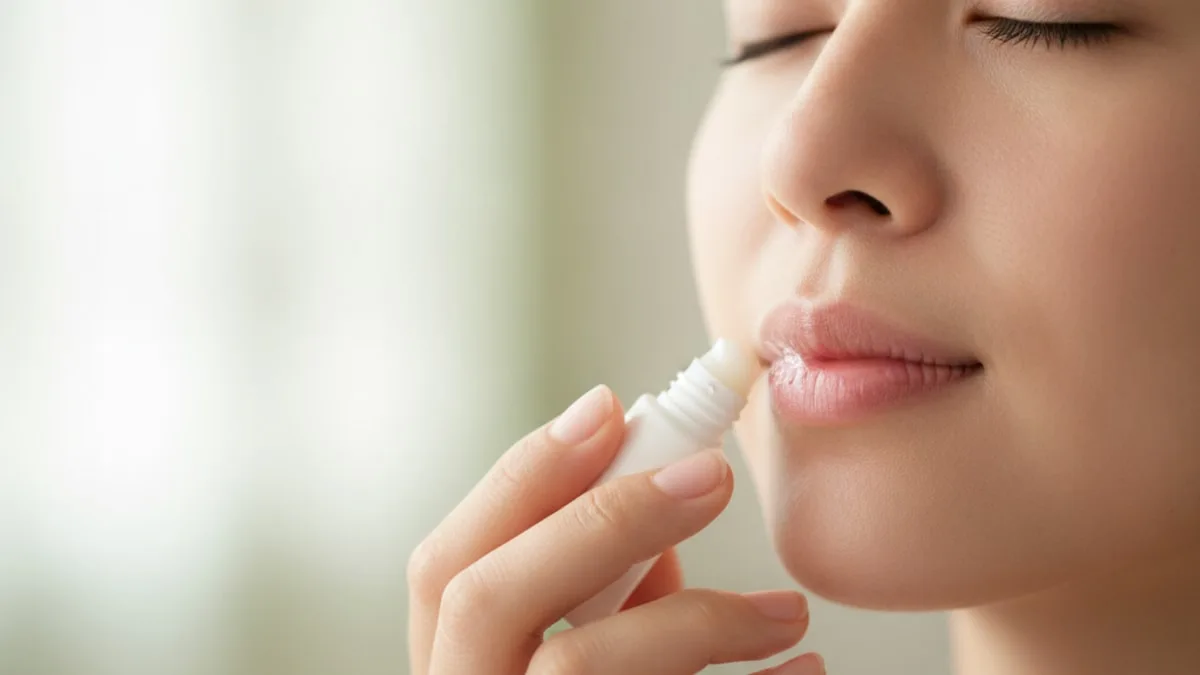
Things the lips touch. Lip balms, lipsticks, lip sunscreens, toothpaste, mouth rinses, flavoured floss and even a musical instrument mouthpiece all rest against thin skin with a fragile barrier. Research suggests that allergic contact reactions to lip cosmetics and dental products are a recognised cause of long-running lip inflammation 1. A clinical review of cheilitis sets out contact reactions, irritant damage and habit-driven dryness among the categories a clinician works through when lips stay sore 2.
Flavouring and fragrance chemicals deserve their own line. Cinnamon, mint and citrus flavours turn up in toothpaste, chewing gum, sweets and mouth rinses, and they stay against the lip and the lip margin for long stretches of the day. A reaction to one of them can look like simple chapping, which is why people often keep reaching for the balm that is feeding the problem.
Related: Latex Allergy Symptoms: Reactions and Cross-Reactive Foods
Foods and the oral allergy pattern. Raw fruit, raw vegetables, nuts and some spices can leave the lips tingling, itching or puffy within minutes in people with pollen allergy, a pattern known as oral allergy syndrome. Cooked versions of the same food often cause nothing at all. That contrast is a useful detail to write down and bring to an appointment.
The corners of the mouth. Cracking, splitting and soreness at the lip corners behave differently from swelling of the lip body. Studies indicate that angular cheilitis has many overlapping contributors, including saliva pooling, mechanical factors, microbial overgrowth and nutritional shortfalls 3. Denture or appliance fit, lip anatomy and a habit of resting the chin on a hand all feed into the same picture.
Weather, habit and hydration. Cold wind, dry indoor air, mouth breathing at night and repeated lip licking strip the lip barrier and leave skin that stings when anything is applied to it. Lip licking is its own loop, because saliva evaporates and leaves the surface drier than before. Long training blocks in heat add to the same problem through sweat loss and mouth breathing.
Sleep, stress, alcohol and life stage. Short nights and sustained stress tend to leave people fidgeting with dry lips more often, and alcohol adds a drying effect of its own. Saliva flow and skin barrier quality also change with age, which alters how the lips cope with the same balm or toothpaste they tolerated for years.
Some medicines. Some medicines change saliva flow, dry the skin or sit behind an episode of lip swelling. If your lips changed after a new prescription started, ask your prescriber rather than stopping anything on your own.
Colour change and swelling that will not settle. Pigmented contact cheilitis is associated with repeated exposure to pigments and other ingredients in lip products 4. Evidence suggests that firm, painless, recurring lip swelling can reflect cheilitis granulomatosa, a condition clinicians separate from allergic swelling by its pattern and by biopsy 5. A published description of the same condition notes swelling that persists between episodes rather than fading away 6. A classification review describes how clinicians sort cheilitis into contact, angular, granulomatous and other groups before deciding which tests are worth doing 7.
Which blood tests can help explain it?
Bloodwork cannot name the substance your lips reacted to, but a complete blood count with differential reports eosinophils, the white cells that rise during allergic and parasitic activity, and that gives a clinician background context for lips that keep flaring.
| Marker | Why it is linked to this symptom | What a result can and cannot tell you |
|---|---|---|
| Eosinophils (percentage of white cells) | Eosinophils are recruited during allergic-type immune responses, so the percentage reflects how much of that activity is running in the background. | A higher percentage can support an allergic picture and prompt a clinician to look harder at exposures. It cannot name a trigger, and a normal percentage does not rule out a contact reaction on the lips. |
| Eosinophils Absolute | The absolute count gives the number of eosinophils per volume of blood, independent of shifts in other white cell lines. | It is the steadier number to follow over repeat draws. It still says nothing about which product, food or material caused a reaction, and single draws are snapshots. |
Compare any value with the range printed on your lab report, because laboratories report differently and ranges vary by lab, age and sex.
Can a raised eosinophil count explain itchy, swollen lips?
A raised eosinophil percentage can support the idea that allergic-type activity is part of the picture, but on its own it never identifies a trigger and never confirms that the lips reacted to anything in particular.
Eosinophils are a type of white blood cell. They spend most of their life in tissue rather than in the bloodstream and are recruited during allergic-type immune responses, which is why the count often sits higher in people with hay fever, asthma or eczema. Because the lips sit at the border between skin and mouth lining, a person whose immune system reacts readily elsewhere may also react readily there. That is context, not a conclusion.
The tests that actually identify a contact trigger are different. Research suggests that patch testing is central to confirming allergic contact cheilitis and to separating it from irritation 1, and a diagnostic review describes patch testing as part of a stepwise approach once a clinician has taken a careful exposure history 2. A blood count sits alongside that work rather than replacing it.
Plenty of other things move the same number. Pollen season, an eczema or asthma flare, a recent viral illness, parasitic infection and the body's own stress hormone rhythm all shift eosinophils, and some medicines raise or lower them, which is a question for your prescriber. Fasting status and the time of day matter less here than they do for some markers, but a single draw is still one frame of a moving picture. You can read more about what the percentage reflects on the Eosinophils page.
The practical reading is simple. If the count is higher than the range printed on your report and your lips have been flaring for weeks, that is worth discussing with a clinician who can match the number against your exposures. If the count is unremarkable, that does not close the case on a lip reaction, because contact allergy frequently runs with an unremarkable blood count.
What does the absolute eosinophil count add?
The absolute count tells you how many eosinophils are present per volume of blood, so it does not move simply because other white cell lines rose or fell, which makes it the more stable of the two numbers to follow over time.
A percentage is a share of a total. If neutrophils surge during an infection, the eosinophil percentage can drop even though the number of eosinophils has not changed at all. The reverse happens too. For a symptom that comes and goes over months, such as lips that swell every few weeks, the absolute figure is the one that makes a trend readable, and a trend is far more informative than a single draw. The Eosinophils Absolute page explains what the measure covers.
What a trend can do is narrow the conversation. A count that climbs through spring and settles in winter points a clinician toward airborne allergy and the food cross-reactions that travel with it. A count that stays flat while lips keep cracking at the corners pushes attention back toward the local factors. Neither outcome is a diagnosis. Both change what gets examined next.
What can a normal panel still miss?
A great deal, because the causes behind most lip reactions are local rather than systemic, and local causes do not register in blood.
Contact allergy is the clearest example. Research suggests that allergic contact cheilitis is confirmed through patch testing rather than through routine bloodwork 1, and a systematic review of pigmented contact cheilitis describes the same reliance on patch testing when lip products are the suspected source 4. A person can have a textbook reaction to a flavouring agent and a completely unremarkable blood count on the same day.
Irritant reactions are invisible to blood too. Wind, lip licking, abrasive scrubs and repeated product layering damage the barrier without any allergic mechanism at all, and a diagnostic review groups irritant and habit-related cheilitis separately from allergic forms for exactly that reason 2. The same goes for mechanical issues at the lip corners, appliance fit, saliva pooling and mouth breathing at night.
Swelling that is not allergic also hides from a routine panel. Evidence suggests that granulomatous lip swelling is recognised on clinical pattern and biopsy rather than on blood markers 5, and a second published account describes persistent, non-itchy swelling as its defining feature 6. A classification review makes the general point well, which is that sorting cheilitis into its categories comes first and testing follows from that sorting 7.
The most useful thing you can bring to an appointment is not a lab printout. It is a short written record of when the lips flare, what touched them in the previous day, what you ate, and how long each episode lasted.
When should you see a clinician quickly?
Some lip swelling is an emergency and some is not, and the difference is whether anything beyond the lips is involved.
These signs need emergency care now. Call 911 or go to the emergency department.
- Lip swelling together with tongue, mouth floor or throat swelling
- Trouble breathing, noisy breathing, a tight or changed voice, or trouble swallowing or handling saliva
- Widespread hives with faintness, a racing heart, vomiting or a sense that something is badly wrong
- Swelling that spreads quickly across the face over minutes
Other patterns are not emergencies but are worth discussing with a clinician promptly. These include lip swelling that lasts more than a day or two, swelling that keeps returning without a clear trigger, one lip that stays enlarged, corners of the mouth that crack and bleed and do not settle, a sore or ulcer on the lip that is not healing, fever or pus, or a change in the lips that began after a new prescription started. In that last case, ask your prescriber before changing anything.
A clinician examines the lips, takes the exposure history, and decides whether patch testing, swabs, bloodwork or a biopsy is the right next step. Nothing on this page replaces that assessment, and no single lab value identifies a cause on its own.
If you are having thoughts of self-harm, call or text 988 (US) or your local emergency number now.
How can you check these markers?
Both eosinophil measures come from a complete blood count with differential, which is standard on most general panels, including FitScript Essential, and membership covers 150+ biomarkers tested per year so a trend can be followed rather than guessed at.
Results arrive with the laboratory's own range printed beside each value. Atlas, FitScript's AI health advisor, explains what each number reflects in plain language and how it sits against your other markers, and a licensed provider reviews the full picture and decides whether anything further is appropriate. Treatment decisions belong to a licensed provider, and patch testing or a biopsy, where relevant, is arranged and interpreted by a clinician.
This article is educational and is not medical advice. Discuss your results, your symptoms and any proposed next step with a clinician or licensed provider who knows your history.
Key takeaways
- Lip swelling with tongue or throat swelling, breathing trouble or a changed voice is an emergency. Call 911 or go to the emergency department.
- Lip products, toothpaste and mouth rinse flavourings, dental materials, raw fruit and vegetables, weather, lip licking and some medicines are all recognised contributors to sore, itchy or swollen lips.
- Eosinophils and the absolute eosinophil count give a clinician background context on allergic-type activity, and the absolute count is the steadier number to track over time.
- No blood value names a trigger. Patch testing, examination and a careful exposure history do that work.
- A normal panel does not rule out a contact or irritant reaction, so keep a written record of flares, products and foods for your appointment.
- Values outside the range printed on your report are worth discussing with a clinician promptly, never ignoring and never self-interpreting.
References
- Allergic contact cheilitis. Contact Dermatitis, 1995.
- Cheilitis: A Diagnostic Algorithm and Review of Underlying Etiologies. Dermatitis, 2024.
- Angular cheilitis-an oral disease with many facets. Wiener Medizinische Wochenschrift, 2024.
- Pigmented contact cheilitis: a systematic review. Medicina Oral, Patologia Oral y Cirugia Bucal, 2024.
- Cheilitis granulomatosa. Journal of the European Academy of Dermatology and Venereology, 2001.
- Cheilitis granulomatosa. Dermatology Online Journal, 2011.
- Differential Diagnosis of Cheilitis - How to Classify Cheilitis?. Acta Clinica Croatica, 2018.
Common questions
What does an allergy on lips usually look like?
An allergy on lips shows up as itching, burning, redness, swelling, dryness, fine scaling or cracking, often strongest where a product sits. It can start hours after contact rather than immediately, which makes the trigger easy to miss. Keep a short diary of products and foods, then take it to a clinician.
Why do allergic lips itch and peel?
Allergic lips itch and peel because the thin lip skin has a weak barrier, so an immune reaction to something in a balm, toothpaste, food or dental material causes swelling, then dryness and flaking as the skin recovers. Patch testing by a clinician is the way to identify a contact trigger.
What causes a puffy lips allergy reaction?
A puffy lips allergy reaction can follow contact with lip products, toothpaste flavourings or dental materials, or eating raw fruit and vegetables in people with pollen allergy. Some medicines are also a possible trigger, so ask your prescriber. Puffy lips with tongue or throat swelling or breathing trouble need emergency care, so call 911.
Can a blood test confirm what my lips reacted to?
No. A blood count can show how much allergic-type activity is running in the background, but it cannot name a product, food or material. Patch testing applied and read by a clinician is the test that identifies a contact trigger.
What is patch testing for the lips?
Patch testing places small amounts of common contact allergens on the skin, usually the back, under adhesive patches that stay in place for a couple of days. A clinician reads the reactions over the following days and matches them against the products you use. It is arranged and interpreted by a clinician, not at home.
How long does lip swelling from an allergy last?
It varies with the trigger and the amount of contact. Swelling from a food contact reaction often settles within hours, while a reaction to a product used daily can keep lips sore for weeks because the exposure never stops. Swelling that lasts more than a day or two is worth a clinician's review.
Can raw fruit make my lips itch without any other symptoms?
Yes. Some people with pollen allergy get tingling, itching or mild puffiness of the lips and mouth within minutes of eating raw fruit, raw vegetables or nuts, while the cooked version causes nothing. Bring that pattern to an allergy-trained clinician, who decides whether further testing is appropriate.
Should I stop my medicine if my lips swelled after starting it?
Do not stop anything on your own. Contact the prescriber who started it and describe what changed and when. If the swelling involves the tongue or throat, or breathing or swallowing is affected, call 911 or go to the emergency department first.