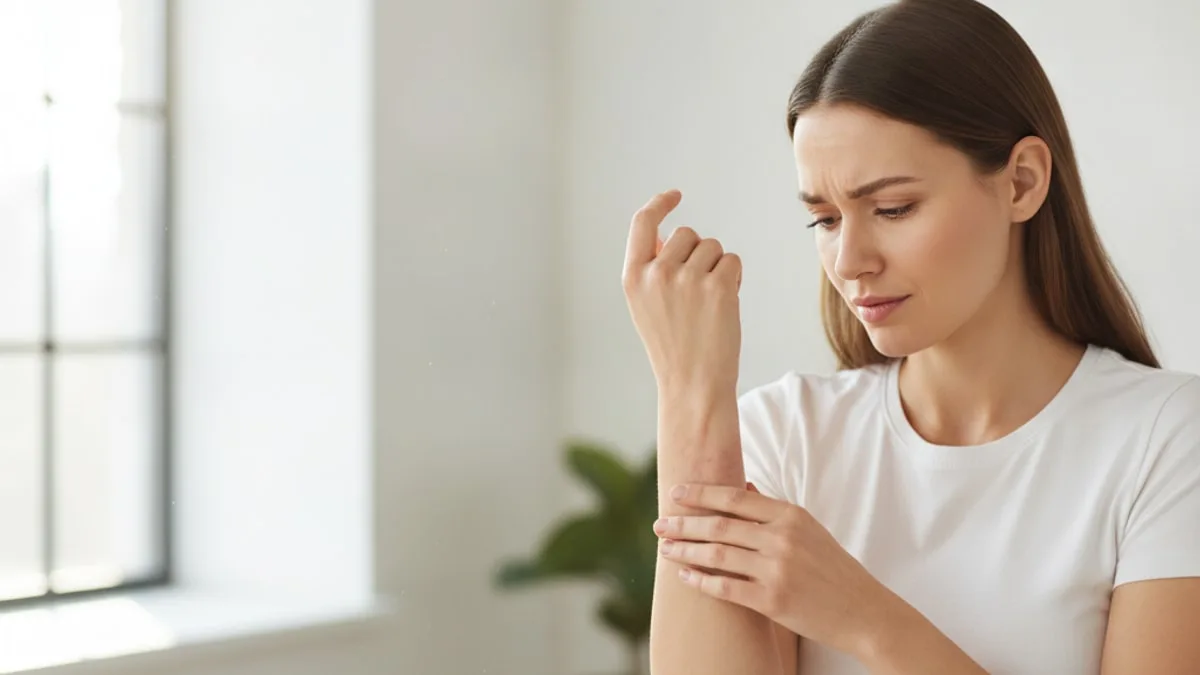
Latex Allergy Symptoms: Reactions and Cross-Reactive Foods
Throat swelling, trouble breathing, noisy breathing, a swollen tongue or lips, faintness or a spreading rash after latex contact need emergency care, so call 911 or go to the emergency department now.
Research suggests that immediate reactions to natural rubber latex are driven by IgE antibodies and can range from localised hives at the point of contact through to whole-body reactions 1. The slower pattern, a dry and fissured rash on the hands that builds over a day or two, behaves differently and is handled differently. Sorting out which pattern is in front of you is the first useful step, and it is a question of history and timing before it is ever a question of bloodwork.
What usually causes this?
A skin or breathing reaction after handling rubber items can arrive by more than one route, and only one of those routes involves the immune system reacting to latex protein itself. Research suggests that reactions associated with rubber gloves fall into three recognised categories, which are simple irritation of the skin, a delayed allergic response to the chemicals used in rubber manufacture, and an immediate response to the natural rubber latex proteins 2. Those three look different on the skin and follow different timelines.
Many everyday things produce red, itchy, cracked hands without any allergy being involved. Frequent handwashing strips the skin barrier. Soaps, detergents and alcohol gels dry the surface further. Sweat trapped under an occlusive glove for hours softens the skin and then leaves it rough. Friction, cold air and low humidity all add to it. Pre-existing dry or eczema-prone skin lowers the threshold for all of the above. None of these show up as a lab finding, and none of them require a blood draw to explain.
Other ordinary factors change how easily the skin flares into hives on any given day. Heat, a hard training session, alcohol, pressure from a tight cuff or strap, broken sleep and stretches of high stress can all make itching and welts more noticeable. Some medicines can bring on hives or itching as well, so ask your prescriber about anything you take before assuming a glove was responsible. Food can play a part too, which matters here more than usual.
Exposure pattern matters. Studies suggest that latex protein can become airborne when it binds to the powder used inside some gloves, which extends exposure beyond skin contact to the air of a room 4, and healthcare work has long been described as a setting where this exposure concentrates 3. Studies indicate that the move to powder-free and lower-protein gloves changed the picture substantially over the following decades 5. Repeated medical or surgical exposure over many years is also described as a factor that shapes who becomes sensitised 6.
Then there are the foods. Research suggests that sensitisation to natural rubber latex is associated with reactions to a group of plant foods including banana, avocado, chestnut and kiwi, a pattern described as latex-fruit syndrome 7. Research suggests that the overlap comes from plant defence proteins that share a hevein-like structural region, so the immune system can recognise a protein in fruit that resembles one in rubber 8. In practice this means mouth itching or lip tingling after certain raw fruits can be part of the same story as a glove reaction, rather than a separate coincidence.
Which blood tests can help explain it?
No blood test can tell you what your skin touched, so bloodwork supports a history rather than replacing it. Research suggests that evaluation rests on the clinical history combined with skin testing and measurement of latex-specific IgE in serum 9. Two markers from a standard complete blood count with differential add background on allergic activity, and both are routinely included in general panels.
| Marker | Why it is linked to this symptom | What a result can and cannot tell you |
|---|---|---|
| Eosinophils (percentage) | Eosinophils are white blood cells that take part in allergic inflammation of the skin and airways, so the percentage gives a snapshot of that activity against the rest of the white cell count. | A raised percentage shows allergic-type inflammation is plausible somewhere in the body. It cannot name the trigger, cannot confirm latex, and can shift simply because other white cell lines rose or fell. |
| Eosinophils Absolute | The absolute count converts the percentage into cells per volume of blood, so it reflects the eosinophil population on its own rather than its share of the total. | It is the more stable of the two for tracking over time. It still names no trigger, and a normal count does not rule out an allergic reaction that has already settled. |
Ranges differ by laboratory, age and sex, so read your own figures against the range as printed on your lab report rather than against a number from an article.
Can eosinophils rise with an allergic reaction?
Sometimes, but not reliably enough to use as a yes or no answer. Eosinophils are granulocytes that accumulate in tissue during allergic inflammation, which is why the count tends to be read alongside symptoms such as rhinitis, wheeze and eczema. Immediate latex reactions, though, run primarily through IgE antibodies and mast cell activation 1, and a single acute event may come and go without moving a blood count that was drawn days later. You can read more about what the test measures on the Eosinophils page.
Plenty of other things move this marker. Parasitic infection, asthma, atopic dermatitis, chronic rhinosinusitis and reactions to some medicines can all raise it, so ask your prescriber about anything you take before reading the result as an allergy signal. The count also has a daily rhythm, running lower in the morning and higher at night, so draw time contributes a little noise. Acute illness or physiological stress can push it down temporarily. A single value sampled during a flu-like week is a poor guide to anything.
Read it as observation, then inference, then next step. The observation is a percentage above or below the range on your report. One possible reason is background allergic inflammation, and another is an unrelated cause from the list above. The next step is to show the result to a clinician alongside a description of your symptoms and their timing, not to draw a conclusion from the number on its own.
What does the absolute eosinophil count add?
It gives a figure that is not distorted by changes in the other white cell lines, which makes it the better number to follow across repeat draws. If the neutrophil count rises during an infection, the eosinophil percentage can fall while the actual number of eosinophils in circulation has not changed at all. The absolute figure, reported in cells per microlitre or as an equivalent SI value, avoids that artefact. The Eosinophils Absolute page covers what the measurement involves.
For someone working through recurrent hives, hand dermatitis or breathing symptoms around rubber exposure, the absolute count is useful mainly as a trend. One figure slightly outside the range on your report is a prompt to look again rather than a finding in itself. A count that stays elevated across more than one draw is worth discussing with a clinician promptly, because persistent elevation has its own list of causes that deserve a proper look, none of which can be settled from an article.
A count sitting comfortably inside the range does not close the question. Immediate latex reactions can occur with an unremarkable differential, and delayed contact reactions have no reason to show there at all. The marker adds context. It does not arbitrate.
What can a normal panel still miss?
A completely normal blood panel is compatible with a real and reproducible latex reaction, which is the honest limit of this kind of testing. Research suggests that the delayed hand rash from rubber manufacturing chemicals is a different immune mechanism from the immediate protein response, identified through patch testing performed by a clinician rather than through blood 2, and reviews of natural rubber latex allergy describe that distinction as central to getting the assessment right 3.
Simple irritant dermatitis is invisible to bloodwork as well. So is a reaction to a fragrance, preservative or adhesive in something else worn on the hands. Timing is another gap, since markers drawn weeks after an event say little about that event. And a food-related mouth reaction to raw fruit, which can sit alongside latex sensitisation 7, is usually pieced together from what happens with specific foods rather than from a count.
There is one more gap worth naming. Research suggests that reactions can occur during surgical, dental and other medical procedures where latex-containing items are in use 10. That risk is handled by telling the care team about any previous reaction well before a procedure, not by a screening blood count. A clear written history in your records does more than any marker here.
When should you see a clinician quickly?
Some signs need emergency care immediately rather than an appointment. Call 911 or go to the emergency department for any of the following.
- Trouble breathing, wheezing or noisy breathing
- Tightness, swelling or a closing sensation in the throat
- Swelling of the tongue, lips or face
- Trouble swallowing, a hoarse voice or trouble speaking
- Faintness, collapse, pale clammy skin or a racing heart
- Widespread hives together with vomiting, cramping or confusion
Do not wait to see whether these settle, and do not drive yourself.
Other situations are not emergencies but deserve a prompt appointment. Recurrent hives at the point of contact with rubber items, hand dermatitis that keeps worsening despite leaving the skin alone, symptoms that appear reliably at work, mouth or throat itching after certain raw fruits, and any reaction that happened during a medical or dental procedure all belong in front of a clinician. Research suggests that proper assessment combines the history with skin testing and latex-specific IgE measurement 9, which is work a clinician does rather than something to self-assess. Bring any result you do not understand to a clinician or licensed provider and discuss it alongside your symptoms, and remember that treatment decisions belong to a licensed provider.
If you are having thoughts of self-harm, call or text 988 (US) or your local emergency number now.
How can you check these markers?
Both markers sit inside a standard complete blood count with differential, which is part of the FitScript Essential panel, so no special ordering is needed to see them. The panel reports the eosinophil percentage and the absolute eosinophil count together, which is the pairing that makes a trend readable rather than a single snapshot.
Results come back with context rather than as a wall of numbers. Atlas, FitScript's AI health advisor, explains what each marker measures and how your figures compare with the range printed on your report, in plain language. Members have 150+ biomarkers tested per year, so allergic-type inflammation can be followed alongside the rest of the picture instead of in isolation. A licensed clinician decides on any next step, including whether allergen-specific testing or a referral makes sense for you.
This article is health education and not medical advice.
Key takeaways
- Reactions after rubber contact split into a delayed rash that builds over hours to days and an immediate response that appears within minutes, and the two are assessed differently.
- Dry, cracked, itchy hands often come from handwashing, soaps, sweat under gloves, friction and cold air rather than from any allergy.
- Banana, avocado, chestnut and kiwi are the foods most often discussed alongside latex sensitisation, because of shared plant proteins.
- Eosinophils and the absolute eosinophil count give background on allergic inflammation. Neither names a trigger, and neither rules a reaction in or out.
- Parasitic infection, asthma, eczema, some medicines and even the time of day can all move the eosinophil count, so read it with a clinician.
- Throat swelling, trouble breathing, faintness or widespread hives with vomiting mean calling 911 or going to the emergency department, with no waiting.
If you want to read further on the testing side, the ige blood test explains what allergen-specific antibody measurement actually shows and where its limits are, and oral allergy syndrome covers why certain raw fruits cause mouth and lip itching in people sensitised to related plant proteins.
References
- Latex allergy. The Journal of Allergy and Clinical Immunology, 2000.
- Latex allergy. American Family Physician, 1998.
- Natural rubber latex allergy. Disease-a-Month, 2016.
- Latex allergy. Clinical and Experimental Allergy, 1995.
- Latex Allergy: Where Are We Now and How Did We Get There?. The Journal of Allergy and Clinical Immunology. In Practice, 2017.
- Latex allergy. The Mount Sinai Journal of Medicine, 2002.
- Latex-fruit syndrome. Current Allergy and Asthma Reports, 2003.
- The latex-fruit syndrome. Biochemical Society Transactions, 2002.
- Latex allergy. The Mount Sinai Journal of Medicine, 2011.
- Perioperative latex allergy. International Journal of Immunopathology and Pharmacology, 2011.
Common questions
What are latex allergy symptoms?
They fall into two patterns. An immediate reaction appears within minutes as itching, hives, redness, a runny nose, sneezing, wheeze or swelling, and in severe cases throat tightness and faintness. A delayed reaction appears hours later as a dry, red, scaly or cracked rash, usually on the hands. Throat or breathing symptoms mean calling 911 immediately.
How common is a latex allergy?
Exact figures depend heavily on who is counted and how the allergy is defined, so no single number describes it well. It does not affect a large share of adults. Clinicians pay closer attention to people with heavy or repeated exposure, such as healthcare work or many past procedures. Your own risk is best assessed from your exposure history.
Which foods can cross-react with latex?
Banana, avocado, chestnut and kiwi are the ones most often discussed, and some people also notice symptoms with fruits such as papaya, fig or passion fruit. The overlap comes from similar plant proteins, not from latex being present in the food. Mouth or lip itching after a raw fruit is worth mentioning to a clinician.
Can a blood test confirm a latex allergy?
A blood test can measure antibodies directed at latex proteins, which is one piece of the assessment. It does not stand alone. A clinician interprets it alongside your symptom history, their timing and any skin testing before reaching any conclusion. A normal result does not automatically close the question, and an abnormal one does not settle it either.
What do eosinophils show on a blood count?
Eosinophils are white blood cells involved in allergic inflammation, and a complete blood count reports both their percentage and their absolute number. A higher count suggests allergic-type activity is plausible somewhere in the body. It never identifies the trigger. Take the figure to a clinician with your symptoms rather than interpreting it on its own.
Why does my hand rash appear a day after wearing gloves?
A rash that builds over hours to days follows a different immune pathway from an immediate reaction, and it is often linked to chemicals used in making rubber rather than to latex protein. Simple irritation from handwashing and sweat under gloves can look identical. A clinician can distinguish them, sometimes using patch testing.
Does a normal eosinophil count rule out a reaction?
No. The count can sit well inside the range on your report while a genuine reaction has occurred, especially if the blood was drawn days or weeks afterwards. Delayed contact rashes have no reason to show on a blood count at all. Symptom history carries more weight than this marker alone.
What should I tell a surgical or dental team before a procedure?
Tell them about any previous reaction to rubber items, any reaction during a past procedure, and any mouth symptoms with banana, avocado, chestnut or kiwi. Say it well in advance rather than on the day, and ask that it is recorded in your notes. The team decides what precautions apply.