Dermatographia: Skin Writing Hives
Clinicians group dermographism with the chronic inducible urticarias, the forms of hives in which a defined physical trigger brings out wheals rather than them appearing out of nowhere 12. That framing matters, because it moves the question away from hunting for a hidden cause in the blood and toward understanding what the skin is reacting to.
What usually causes raised lines after scratching?
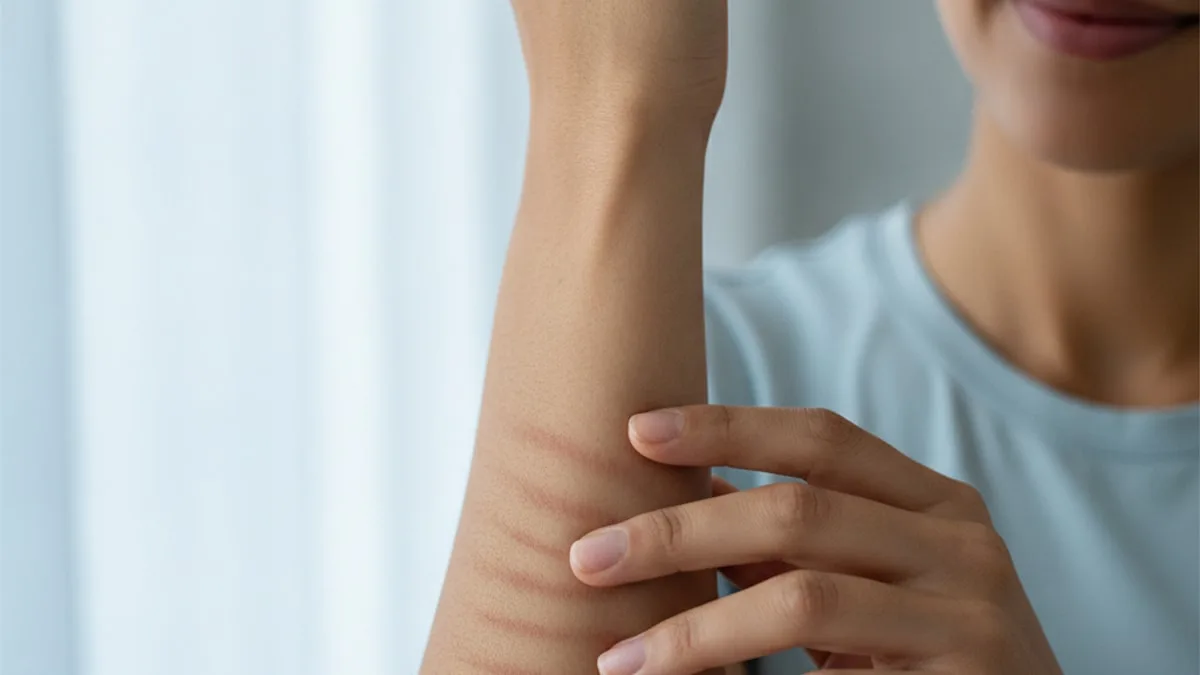
The trigger is mechanical force on the skin, and the things that amplify it sit in daily life rather than in a blood tube. Stroking, scratching, rubbing or steady pressure sets off a local skin response, and the line that rises traces exactly where the force went. That is why the mark can look like handwriting, and why it usually appears within minutes and then fades rather than lasting for days.
Several everyday factors tend to stack up. The ones worth reviewing first are these.
- Friction and pressure through the day. Towel drying after a shower, tight waistbands, bra straps, backpack straps, seat belts, watch bands and sitting against a hard edge all stroke the skin.
- Scratching an existing itch, whether that comes from dry skin, eczema-prone skin, an insect bite or a wool jumper.
- Heat and sweating. Hot showers, saunas, hot rooms and humid weather often coincide with more reactive skin.
- Training load. Exercise combines heat, sweat and friction from kit in a single session, so flares often cluster around workouts.
- Cold, dry air and low humidity, which thin out the skin barrier and raise the urge to scratch.
- Psychological stress and short sleep, both of which tend to increase itch perception and scratching.
- Alcohol, which widens skin blood vessels and can make flushing and welting more noticeable.
- Some medicines can make skin react more readily. Ask your prescriber whether anything on your current list is relevant, and never stop a prescription on your own.
- Life stage. Skin reactivity and dryness shift across adult life, so a pattern that was absent for years can appear later.
Underneath all of that sits the skin's mast cell. A systematic review of chronic inducible urticaria reported histamine release in provoked skin, and research suggests this release is central to the wheal and flare seen in dermographism 3. Published guidance on approaching chronic inducible urticaria places the weight of assessment on the history and on provocation testing in clinic rather than on a broad laboratory workup 4.
None of the everyday factors above show up on a blood panel. They show up in a two week log of flare days, sleep, training sessions, alcohol and clothing.
Which blood tests can help explain it?
Blood tests do not identify skin writing, and guidance for chronic inducible urticaria points toward history and provocation testing rather than a wide panel 4. When a clinician does order blood work alongside an itchy skin pattern, the eosinophil values on a complete blood count differential are among the ones they may look at.
| Marker | Why it is linked to this symptom | What a result can and cannot tell you |
|---|---|---|
| Eosinophils (percentage) | Eosinophils are white blood cells that take part in allergic-type inflammation in skin and airways, so the share they make up of white cells gives a rough read on that pattern | A raised or low percentage flags something worth discussing. It cannot confirm or exclude dermographism, and the percentage moves whenever other white cell lines rise or fall for unrelated reasons |
| Eosinophils Absolute | The actual number of eosinophils per volume of blood, which does not shift simply because another white cell population changed | A steadier value to track across repeat draws. It cannot name a trigger, explain why skin welts under pressure, or predict how skin will behave on a given day |
Compare any number with the range printed on your own lab report, because ranges differ by laboratory, by analyser and by age and sex. A single value is a snapshot of one morning, and a clinician reads it next to the story, the skin examination and anything else on the panel.
Can eosinophils explain skin that welts when it is scratched?
Not on their own. Eosinophils are granulocytes that migrate into tissue during allergic-type inflammation and during the response to certain parasites, and the complete blood count differential reports them as a share of total white cells. A higher share can point toward an allergic pattern somewhere in the body, which is useful context when skin is irritable, but it does not describe what happens when a fingernail is drawn across the forearm.
The immediate wheal of skin writing is a mast cell event in the upper layers of skin. Research suggests histamine release drives that response across the chronic inducible urticarias, dermographism included 3. Reviews of this group of conditions describe subtypes defined by their physical trigger, with symptomatic dermographism among them 5.
Plenty of other things move this number. Hay fever, asthma, eczema, recent infection, parasitic infection and some medicines can all shift it, and the value also varies with the time of day a sample is drawn. That is the observation. The meaning is limited, because a raised share is one possible signal of allergic-type activity and nothing more specific. The next step is to bring the result to a clinician alongside the skin history rather than drawing a conclusion from the number alone. You can read what this value measures in more detail on the Eosinophils page.
What does the absolute eosinophil count add?
It gives a number that stands on its own. The percentage is a ratio, so it rises when other white cell populations fall even if the eosinophil population has not changed at all. The absolute count reports how many eosinophils are actually present per volume of blood, which makes it the more reliable of the two for following a pattern over months.
That matters for an itchy skin complaint, where symptoms wax and wane and a single draw rarely settles anything. A clinician looking at a repeated absolute count is watching for a trend, not a one off reading. A value sitting outside the range printed on the report is worth discussing with a clinician promptly, and it is read together with symptoms rather than treated as a verdict on the skin.
It is also worth being clear about what this marker cannot do. Clinical assessment of chronic inducible urticaria relies on provocation testing and on patient-reported severity scores to follow the condition over time, not on a blood marker 6. A normal absolute count sits comfortably alongside very active skin writing. The detail of what this value measures is on the Eosinophils Absolute page.
What can a normal panel still miss?
A completely normal blood panel does not rule out skin writing, because the finding lives in how skin behaves under pressure rather than in circulating blood. The clinic version of the test is a stroke of the skin with a smooth instrument at a set pressure, followed by watching for a raised line, and that is a physical measurement no analyser performs.
A panel also says nothing about the following.
- The pressure threshold that brings on a wheal, and whether it is shifting over months.
- The mechanical load the skin takes each day from clothing, straps, equipment and towel drying.
- Heat, hot water and sweat exposure, which commonly cluster around flare days.
- Sleep loss and stress, which tend to increase scratching and itch perception.
- Dry skin and barrier quality through the colder months.
- The burden on daily life. Reviews of chronic spontaneous and chronic inducible urticaria describe a considerable impact on sleep and daily functioning, and chronic inducible urticaria is associated with reduced quality of life 7.
- How long the pattern may run. Chronic inducible urticaria can persist over a long period in some people 2.
Management is a separate question from testing, and published reviews describe ongoing challenges in bringing chronic inducible urticaria under control for some people 8. Treatment decisions belong to a licensed provider who has examined the skin and reviewed the full history.
When should you see a clinician quickly?
Get emergency help the moment a skin reaction shows signs of moving beyond the skin. For any of the following, call 911 or go to the emergency department.
- Trouble breathing, wheezing or noisy breathing.
- Swelling of the throat, tongue or lips that makes swallowing or speaking difficult.
- Chest tightness, a racing heart with widespread hives, or feeling faint and about to collapse.
- Widespread hives together with vomiting, stomach cramps or a sudden drop in alertness.
These signs mean call 911 or go to the emergency department. Do not wait at home to see whether they settle.
Other patterns are not emergencies but are worth discussing with a clinician promptly. Welts that come with fever and joint pain fall into this group, and a case series described urticarial rash and dermographism in people with adult-onset Still's disease 9. So do individual welts that stay in one spot for more than a day, welts that leave bruising or a brown mark as they fade, deep swelling of the lips or eyelids without any breathing trouble, unexplained weight loss or night sweats, and itch that is breaking sleep several nights a week. A clinician can perform provocation testing, check what else is going on, and decide whether any blood work is useful 4.
If you are having thoughts of self-harm, call or text 988 (US) or your local emergency number now.
How can you check these markers?
Both eosinophil values sit on the complete blood count differential, which is part of the FitScript Essential panel, so a standard blood draw covers them without a special request. Membership includes 150+ biomarkers tested per year, which means a value can be followed across repeat draws instead of being judged from one morning in isolation.
Atlas, the AI health advisor, explains what each value measures, where it sits against the range printed on the report, and what it does and does not say about an itchy skin pattern. A licensed clinician decides on any next step, including whether further testing or any treatment is appropriate.
This page is educational and is not medical advice. Discuss your results, your symptoms and any treatment with a clinician or licensed provider who knows your history.
Key takeaways
- Skin writing is a raised itchy line that rises where the skin has been stroked, scratched or pressed, and clinicians group it with the chronic inducible urticarias 1.
- The everyday drivers to review first are friction, heat, sweat, training, dry skin, alcohol, stress and short sleep, plus any medicines your prescriber can comment on.
- Assessment rests on the history and on provocation testing in clinic rather than on a broad laboratory panel 4.
- Eosinophils and the absolute eosinophil count give context about allergic-type inflammation. Neither confirms nor excludes skin writing.
- The absolute count is the steadier of the two to follow over time, because the percentage moves when other white cells move.
- A normal panel misses the pressure threshold, the daily mechanical load, and the effect on sleep and daily life.
- Breathing trouble, throat or tongue swelling, or feeling faint with hives means call 911 or go to the emergency department.
For a wider look at why welts appear in the first place, including triggers that have nothing to do with pressure, see hives causes.
References
- Shedding light on dermographism: a narrative review. International Journal of Dermatology, 2024.
- Chronic Inducible Urticaria. Immunology and Allergy Clinics of North America, 2024.
- Evidence for histamine release in chronic inducible urticaria - A systematic review. Frontiers in Immunology, 2022.
- How to Approach Chronic Inducible Urticaria. The Journal of Allergy and Clinical Immunology. In Practice, 2018.
- New insights into chronic inducible urticaria. Current Allergy and Asthma Reports, 2024.
- Clinical Evaluation and Outcome Measures of Chronic Spontaneous Urticaria and Chronic Inducible Urticaria. The Journal of Allergy and Clinical Immunology. In Practice, 2025.
- Chronic spontaneous urticaria and chronic inducible urticaria. The Journal of Allergy and Clinical Immunology, 2025.
- Advancements and challenges in the management of chronic inducible urticaria. Frontiers in Immunology, 2026.
- Urticaria and dermographism in patients with adult-onset Still's disease. Rheumatology International, 2012.
Common questions
What is dermatographia?
Dermatographia, also called skin writing, is a raised itchy line that appears where the skin has been scratched, rubbed or pressed, then settles on its own. It belongs to the group of hives that a physical trigger brings on. A clinician identifies it by watching how the skin responds, not from a single blood value.
Is dermatographism the same as dermatographia?
Yes. Dermatographism and dermatographia are two spellings of the same thing, and skin writing is the everyday name for it. Some clinicians add the word symptomatic when the lines itch rather than simply appearing. The wording on a clinic note does not change what the skin is doing or how it is assessed.
Which dermatographia causes should you look at first?
Start with mechanical force on the skin. Towel drying, tight waistbands, straps, seat belts and scratching an existing itch all stroke the skin enough to raise a line. Heat, sweat, exercise, dry air, alcohol, stress and short sleep can make skin react more readily. Some medicines can too, so ask your prescriber.
Does dermatographia need blood tests?
Not always. The pattern is identified on the skin, and a clinician decides whether blood work adds anything useful. When tests are ordered, eosinophils and the absolute eosinophil count are two values that may be included. Any result is read next to the history and the skin examination, never on its own.
What do eosinophils show on a blood test?
Eosinophils are white blood cells involved in allergic-type inflammation and in the response to certain parasites. A complete blood count reports them both as a percentage of white cells and as an absolute number per volume of blood. A value outside the range on your report is a flag to discuss with a clinician, not an answer.
Why is the absolute eosinophil count better for tracking than the percentage?
The percentage is a ratio, so it rises or falls when other white cell populations change even if eosinophils have not moved at all. The absolute count measures the eosinophils themselves. That makes it the steadier number to follow across repeat draws when a clinician wants to see a trend over months.
Can stress and poor sleep make skin writing worse?
Many people notice more itch and more reactive skin during stressful stretches and after short nights. Scratching also increases when sleep is broken, which raises more lines. Logging sleep, stress, training sessions and flare days for a few weeks gives a clinician something concrete to work from at the appointment.
When is skin writing an emergency?
When the reaction moves beyond the skin. Trouble breathing, noisy breathing, swelling of the throat, lips or tongue, difficulty swallowing, chest tightness or feeling faint all mean call 911 or go to the emergency department. Itchy raised lines without those signs are not an emergency, though they are still worth a clinic visit.