Nickel Allergy: Jewelry Rash and Patch Testing
This page is educational and not medical advice. It explains where the exposure usually comes from, what a blood panel can and cannot add, and what patch tests actually involve.
What usually causes a reaction like this?
Most reactions start with ordinary, repeated skin contact with metal rather than with anything visible in bloodwork. Research suggests that nickel is among the most frequently identified contact allergens in people assessed for contact dermatitis 1.
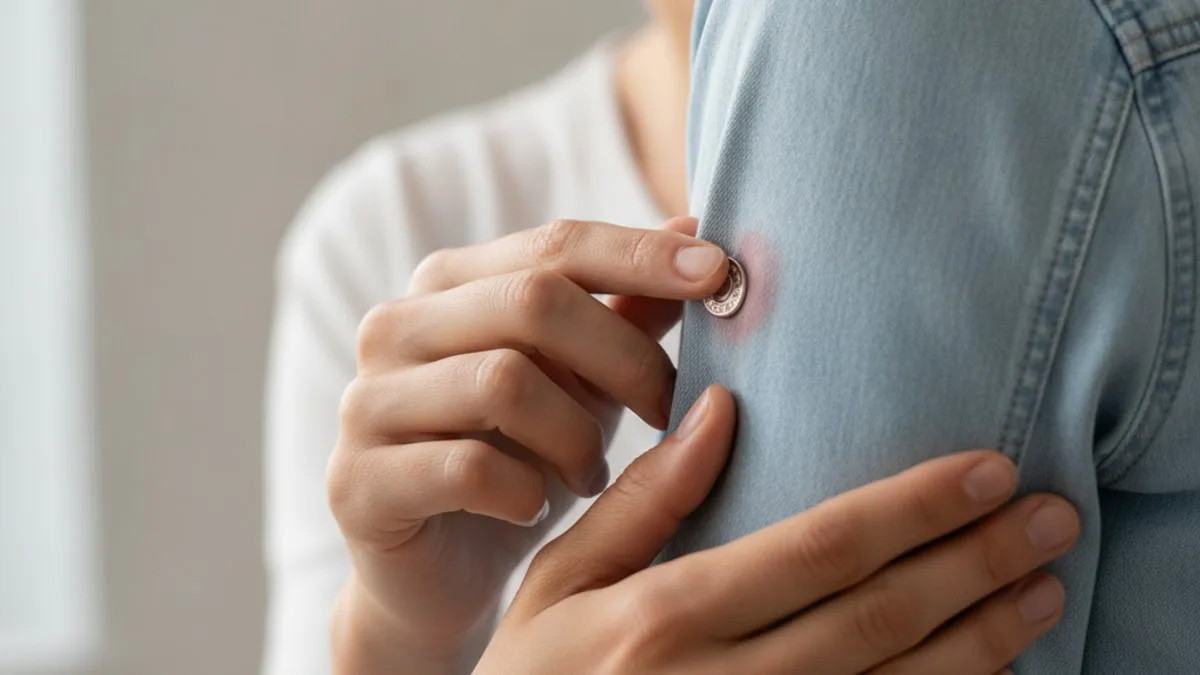
The usual suspects are household objects. Earring posts and backs, necklace clasps, rings, watch cases and straps, belt buckles, the metal stud inside the waistband of jeans, bra hooks, zippers, keys, coins, eyeglass frames, hair clips, scissors and tool handles all turn up in exposure histories 1. A rash that traces the outline of an object is the clue most people notice first.
Several everyday factors change how likely contact is to become a visible rash. Sweat and heat increase how much metal ion reaches skin, so heavy training weeks, humid weather and sleeping in jewelry all lengthen contact time. Friction under a strap or waistband matters. So does a damaged skin barrier from frequent handwashing, harsh soaps, wet work or dry winter air.
Short sleep and high stress do not sensitize anyone to metal, but they change how much a person scratches and how much itch registers, which is why a flare can seem to appear during a rough fortnight. Skin also becomes drier with age, and drier skin tolerates friction less well. Alcohol and diet come up constantly in questions about skin flares, and neither identifies a metal trigger. Dietary nickel is debated, and research suggests that systemic reactions to ingested nickel are described in some sensitized people without settled agreement on how much diet contributes 1.
Some medicines can cause rashes that look similar, so ask your prescriber before assuming metal is the cause.
A few exposure routes deserve a mention because they come up so often. Research suggests that ear and body piercing is associated with nickel sensitization 2. Research suggests that nickel sensitivity is reported more often in women than in men 3, a pattern that has been described for decades. Studies suggest that rules limiting how much nickel items in prolonged skin contact may release are associated with lower sensitization rates in younger age groups in Europe 4, and research suggests that sensitization is common enough in the general population for wider prevention measures to have been called for 5.
Dental and orthodontic hardware is another source. Research suggests that orthodontic appliances are a recognised route of nickel exposure in the mouth 6, and research suggests that nickel hypersensitivity can be identified in a share of orthodontic patients when they are tested 7.
Which blood tests can help explain it?
No blood test identifies nickel sensitization, but a small set of markers can help a clinician see whether an allergic or other inflammatory process is running in the background. The markers below are the ones commonly checked when an itchy, recurring rash is being worked up, and they are read alongside the history and the skin examination rather than instead of them.
| Marker | Why it is looked at when a metal rash is assessed | What a result can and cannot tell you |
|---|---|---|
| Eosinophils | Eosinophils are white blood cells that rise in some allergic, parasitic and inflammatory states, so the percentage gives a quick read on whether that kind of activity is present. | Can show that allergic-type inflammation may be active somewhere. Cannot name the substance, cannot confirm a metal trigger, and a normal value does not rule contact allergy out. |
| Eosinophils Absolute | The absolute count expresses eosinophils as a number per volume of blood rather than a share of total white cells, so it is steadier when other white cell lines shift. | Can show whether a raised percentage reflects a real increase in eosinophils. Cannot identify which allergen, which tissue or which condition is involved. |
Reference ranges differ between laboratories, by age and by sex, so read your own numbers as printed on your lab report and let a clinician interpret them in context.
Can a raised eosinophil count explain an itchy metal rash?
Not on its own, and often it does not change at all in this situation. Research suggests that the skin reaction to nickel is a delayed hypersensitivity driven by T cells, building over hours to days after contact rather than within minutes 8, which is a different arm of the immune system from the one that reliably drives blood eosinophils upward.
That is worth sitting with, because it explains a common disappointment. A person with a clear, reproducible rash under a watch strap can have a completely unremarkable eosinophil percentage, and that result says nothing against the metal being the trigger.
Where the marker earns its place is in widening the picture. Eosinophils can rise in people with asthma, hay fever or atopic dermatitis, in parasitic infection, in some skin conditions, as part of a reaction to some medicines, and uncommonly in blood disorders. Counts can also sit low during acute physical stress. A clinician looking at an Eosinophils result is usually asking whether something broader is going on alongside the rash, not whether metal is the culprit.
Read the result in three steps. The observation is a number above or below the range printed on your report. The possible meaning is allergic-type or other inflammatory activity somewhere in the body, or nothing clinically relevant at all. The next step is to bring the result, the rash pattern and the exposure history to a clinician together, because any one of those alone is thin.
What does the absolute eosinophil count add?
It converts the percentage into an actual count per volume of blood, which makes it harder to misread. If total white cells fall for an unrelated reason, the eosinophil percentage can drift upward while the number of eosinophils has not moved. The reverse happens too. The absolute figure removes that distortion.
In practice, a clinician reviewing an Eosinophils Absolute value is checking whether a flagged percentage is real, whether a raised count persists across repeat testing, and how large the shift is. A single out-of-range value in a person who feels well is a reason to repeat the test rather than to reach a conclusion. A count that stays outside the range on more than one draw is worth discussing with a clinician, who decides whether anything further is needed.
What it still cannot do is point at a metal. The absolute count has no way of distinguishing nickel from cobalt, chromium, a fragrance, a preservative in a hand cream or a parasite. It measures a cell population, not a cause.
What can a normal panel still miss?
A clean blood panel misses the one thing that matters most here, which is which substance the skin is reacting to. That question is answered on the skin, not in a tube.
Patch tests are the usual route. Small amounts of standardised allergens are held against the skin of the upper back under adhesive patches, left in place for a set period, then the patches come off and the skin is examined. It is read again a day or more later, because a delayed reaction needs time to declare itself. A reaction appears as a localised patch of redness, swelling or small bumps confined to one test site. The interpretation is the clinical part, since a positive result shows sensitization and still has to be matched against real exposures before anyone decides it explains the current rash.
A blood panel also misses irritant reactions, which look similar and come from soap, solvents, friction or moisture rather than from immune recognition of a metal. It misses co-sensitization, where more than one metal or chemical is involved at once. It misses contact that happens through a thin layer of clothing or sweat, and it misses the simple fact that the same item worn for years can start causing trouble after a barrier break.
Implanted hardware is a separate grey area where bloodwork does not settle much either. Research suggests that nickel hypersensitivity has been reported in people with implanted endovascular devices while its clinical significance remains uncertain 9, and studies suggest that symptoms attributed to nickel in implanted septal devices are reported less consistently than the level of concern about them would imply 10. Questions of that kind belong to the clinician who placed or follows the device.
Finally, avoidance strategy, barrier measures and any medical care for the skin sit outside what a lab panel can tell you. Treatment decisions belong to a licensed provider who has examined the skin.
When should you see a clinician quickly?
Some signs need emergency care rather than an appointment. Call 911 or go to the emergency department if there is trouble breathing, tightness in the throat, or swelling of the lips, tongue or face. Call 911 or go to the emergency department for widespread blistering or peeling skin, especially with sores in the mouth or eyes, or for a spreading, hot, painful red area with fever, chills or red streaks running from a wound. Call 911 or go to the emergency department for chest pain, fainting or sudden breathlessness in a person with an implanted device.
Other situations deserve a clinician appointment soon rather than months of experimenting. A rash that keeps returning in the same place, one that is spreading beyond the point of contact, broken or weeping skin, a reaction around a new piercing that is not settling, a rash that disturbs sleep, or skin changes that appear alongside unexplained weight loss, night sweats or persistent fever all warrant professional assessment. The same applies to an eosinophil result outside the range printed on your report, which is worth discussing with a clinician promptly rather than ignoring.
No one should work out a skin condition from a single number or a web page. Bring the pattern, the timeline and the lab report to someone qualified to read all three.
If you are having thoughts of self-harm, call or text 988 (US) or your local emergency number now.
How can you check these markers?
Both eosinophil measures sit inside a standard complete blood count, which is included in the FitScript Essential panel. The panel is drawn in one visit and reported with the laboratory's own ranges beside each result as printed on your lab report.
Results are explained in plain language by Atlas, FitScript's AI health advisor, which walks through what each marker measures, what a value sits above or below, and which findings are worth raising with a clinician. Members retest across the year, with 150+ biomarkers tested per year, so a one-off reading can be checked against a trend instead of being treated as a verdict.
A lab panel is a starting point for a conversation. Discuss your results, and any care for your skin, with a clinician or licensed provider, who decides what, if anything, happens next.
Key takeaways
- Nickel reactions come from repeated skin contact with ordinary metal objects such as earrings, buckles, watch backs, frames and zippers.
- Sweat, friction, long wear time and a damaged skin barrier all make a visible reaction more likely.
- No blood test identifies the metal. Patch tests applied and read by a clinician are how a contact trigger is pinned down.
- Eosinophils and the absolute eosinophil count describe allergic-type and inflammatory activity in general, not a specific allergen.
- A normal eosinophil result does not rule out a contact reaction, and a raised one does not confirm the cause.
- Emergency signs such as breathing difficulty, facial swelling, widespread blistering or spreading infection mean calling 911 or going to the emergency department.
- A persistent or spreading rash, or a result outside the range on your report, is worth discussing with a clinician promptly.
References
- Nickel allergy and allergic contact dermatitis: A clinical review of immunology, epidemiology, exposure, and treatment. Contact Dermatitis, 2019.
- Nickel Allergy and Piercings: A Systematic Review and Meta-Analysis. Contact Dermatitis, 2025.
- Contact dermatitis. 8. The significance of nickel sensitivity in women. The British Journal of Dermatology, 1971.
- Prevalence of nickel allergy in Europe following the EU Nickel Directive - a review. Contact Dermatitis, 2017.
- Nickel hypersensitivity: a clinical review and call to action. International Journal of Dermatology, 2010.
- Nickel hypersensitivity and orthodontic treatment: a systematic review and meta-analysis. Contact Dermatitis, 2015.
- Prevalence of nickel hypersensitivity in orthodontic patients: a meta-analysis. American Journal of Orthodontics and Dentofacial Orthopedics, 2008.
- Nickel Allergy: Epidemiology, Pathomechanism, Clinical Patterns, Treatment and Prevention Programs. Endocrine, Metabolic & Immune Disorders Drug Targets, 2020.
- Nickel hypersensitivity and endovascular devices: a systematic review and meta-analysis. Heart, 2022.
- Nickel Hypersensitivity to Atrial Septal Occluders: Smoke Without Fire?. Clinical Reviews in Allergy & Immunology, 2022.
Common questions
What is a metal nickel allergy?
It is a delayed immune reaction of the skin to nickel released from metal that stays in contact with it. The rash usually appears hours to days later, in the exact shape of the object, and it tends to return whenever that item is worn again. A clinician confirms the trigger with patch tests.
Can a blood test show whether nickel is the problem?
No. Blood work cannot name a contact allergen. Markers such as eosinophils describe whether allergic-type inflammation is active in general, which is useful background but never identifies a specific metal. Patch tests applied to the skin and read by a clinician are how the trigger is confirmed.
What happens during patch testing?
Small amounts of standardised allergens are held against the skin of the upper back under adhesive patches. The patches stay on for a set period, the skin is examined when they come off, then read again a day or more later. A clinician decides which positive results actually explain your rash.
Which everyday items most often contain nickel?
Earring posts and backs, necklace clasps, rings, watch cases and straps, belt buckles, the metal stud inside jeans, bra hooks, zippers, keys, coins, eyeglass frames, hair clips, scissors and tool handles. A rash shaped like the object touching your skin is the clue worth bringing to a clinician.
Do high eosinophils mean the rash is from metal?
Not by themselves. A raised eosinophil result points toward allergic-type or other inflammatory activity somewhere, and it has no way of distinguishing a metal from a fragrance, a skin condition or an unrelated cause. A normal count also does not rule out a contact reaction. A clinician interprets it alongside your history.
Does stainless steel contain nickel?
Many stainless steel alloys contain nickel, but how much nickel actually reaches the skin varies a great deal between items and finishes. That is why some people tolerate one steel item and react to another that looks identical. A clinician can advise on safer choices once a trigger is confirmed.
Can a reaction start after years of wearing the same earrings?
Yes. Sensitization can develop at any point after repeated exposure, and an item worn comfortably for years can start causing a rash later. Sweat, friction, a piercing that has been irritated, or a break in the skin barrier can all change how much metal reaches the immune system.
Should diet change because of nickel?
Dietary nickel is debated and is not a decision to make alone. For most people, the reaction is a local skin response to objects rather than to food. If you are wondering whether diet plays a role in your case, raise it with a clinician, who decides whether that line is worth pursuing.