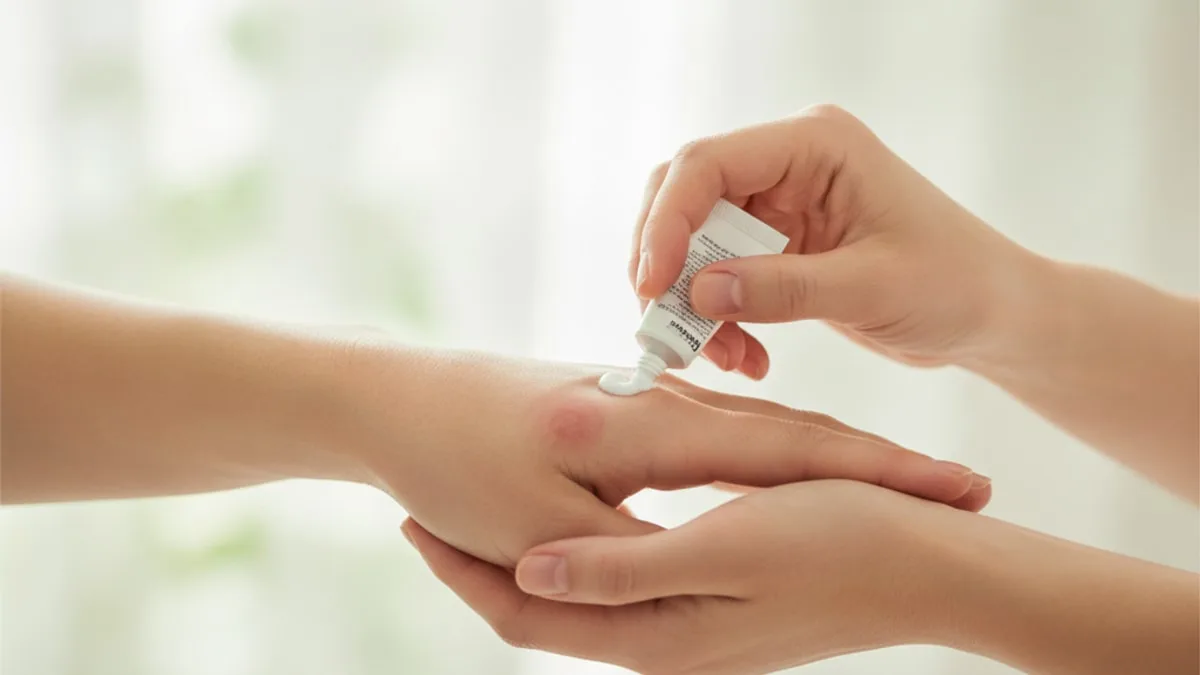
Allergic Skin Rash: Contact Dermatitis vs Hives
The rest of this page separates the two patterns, walks through the everyday exposures worth noticing first, and explains what a blood panel can and cannot add when the problem is skin.
What usually causes this?
Start with the ordinary explanations, because skin reacts to daily life long before it reacts to anything rare. Contact with a substance is one of the first things a clinician asks about, and contact dermatitis covers both allergic reactions and plain irritation of the skin barrier 1.
Everyday contributors worth writing down before any lab appointment include the following.
- Water, soap and repeated hand cleaning. Research suggests that wet work and frequent washing are among the occupational exposures behind irritant contact dermatitis 2.
- Preservatives in cosmetics and household products. Studies suggest that one widely used family of cosmetic and household preservatives produced a marked rise in allergic contact reactions 3.
- Lip products. A systematic review of lip care cosmetics identified fragrances, flavourings and other ingredients among the reported contact allergens 4.
- Thin eyelid skin. Allergic contact dermatitis of the eyelids is associated with products applied to the hair, scalp, face and hands that are then transferred by the fingers 5.
- Materials used in religious observance. A review of the literature describes allergic contact reactions to dyes, oils, plant materials and metals used in religious practice 6.
- Metal in jewellery, watch straps, belt buckles, tools and phone cases, where the rash can outline the object itself.
- Heat, sweat, friction and occlusive kit during heavy training blocks. Skin that is rubbed and damp for hours reddens and itches without any allergy being involved.
- Short sleep, high stress and alcohol. None of these create an allergy, though itch can feel louder when you are run down and sleeping badly.
- New foods, new drinks and large changes in diet, which more often come up in the story behind hives than behind a contact rash.
- Some medicines can set off a rash. Ask your prescriber about anything you started recently, and do not stop a prescription on your own.
- Life stage matters too. Skin becomes drier and more easily irritated with age, and dry skin itches at a lower threshold.
Almost nothing on that list is a lab finding. That is the point. A careful timeline of what touched the skin, what was new that week and how fast the rash appeared usually does more work than a blood draw, which is why clinicians build the story first and order testing second.
What tells a delayed contact rash apart from hives?
Timing separates the two patterns more reliably than appearance does. A delayed contact reaction needs hours to days to surface after the skin meets the substance, while hives rise quickly and individual welts settle quickly. Both itch, and both can look alarming in the mirror, so the pattern over the clock is the more useful clue.
| What to notice | Delayed contact rash | Hives |
|---|---|---|
| When it shows up | Hours to days after contact, sometimes after months or years of using the same product without trouble 1 | Minutes to about an hour after a trigger |
| How long one patch lasts | Days to weeks while the skin barrier repairs | Short lived, one welt can fade within a day while a new one appears somewhere else |
| How it looks and feels | Red, scaly, sometimes blistered or thickened, intensely itchy, and it can take the shape of whatever touched the area | Raised welts with clear edges that come and go, with normal looking skin once they settle |
| Where it appears | On the skin that met the substance, although eyelids, lips and face can react to something carried there by the hands 5 | Anywhere on the body, and the location moves from hour to hour |
| How it is worked up | Patch tests applied to the back and read across several days under a standardised protocol 8 | History and examination first, with blood work used for context rather than identification |
Hives have their own list of possible triggers, including foods, infections, physical triggers such as pressure, heat or cold, and some medicines, and a single trigger is not always identified. Not every red patch belongs to either group either. A practical review of the differential diagnosis of contact dermatitis notes that several other skin conditions can imitate it closely at first look 7.
Which blood tests can help explain it?
No blood test names the substance behind a contact rash, but a complete blood count with differential gives useful background, and the two parts clinicians look at in this situation are the eosinophil percentage and the absolute eosinophil count.
| Marker | Why it is linked to this symptom | What a result can and cannot tell you |
|---|---|---|
| Eosinophils | A white cell type that takes part in allergic type inflammation and in the response to certain parasites, reported as a percentage of total white cells | A raised percentage is a prompt to look further at allergic, parasitic and inflammatory explanations. It cannot name an allergen, and a result inside the printed range does not rule a skin allergy in or out |
| Eosinophils Absolute | The same cells counted per volume of blood rather than as a share of the differential, which keeps the figure steady when other white cell lines move | Gives a firmer number to track over time and to compare between draws. It still points at a category of explanation rather than at a cause, and it says nothing about which product or metal is involved |
Reference ranges vary by lab, by age and by sex, so compare any result with the range as printed on your lab report, and read the two eosinophil figures together rather than in isolation.
Can a high eosinophil result explain an itchy rash?
Not by itself. Eosinophils are a white blood cell type involved in allergic type inflammation and in the body's response to certain parasites, so the Eosinophils percentage on a differential is one of the figures a clinician scans when an itchy rash is being worked up. A result above the printed range is an observation, not an answer.
The honest reading of a raised eosinophil percentage goes in three steps. The observation is that a larger share of your white cells are eosinophils on the day of the draw. The possible meanings include allergic type inflammation, an airway or nasal allergy running in the background, a parasitic exposure, or a reaction to something you have started recently. The next step is a conversation with a clinician who can match the number to your skin, your breathing, your travel history and your medicine list.
Plenty of things move this marker that have nothing to do with your rash. Recent infections, allergic airway symptoms, parasitic exposures and some medicines all shift it, and the percentage also moves when other white cell lines rise or fall, which is why the absolute count is read alongside it. The reverse is just as important. A normal eosinophil percentage cannot exclude a contact allergy, because contact allergens are identified by patch tests applied to the skin rather than by anything measured in blood.
What does the absolute eosinophil count add?
It converts the percentage into a count of cells per volume of blood, which makes it the steadier of the two figures. If your total white cell count shifts after an infection or a hard training week, the percentage can move while the actual number of eosinophils barely changes. The Eosinophils Absolute value is the one clinicians tend to track across repeat draws for that reason.
Read it the same careful way. The observation is the number of eosinophils circulating on the morning of the draw. The possible meanings run from an allergic pattern of inflammation, to a parasitic exposure, to a response to something recently introduced. What follows is a clinical conversation, not a conclusion. A single out of range value is a reason to retest and to look at the wider picture, never a reason to name a condition.
Context still decides everything. If your rash follows the outline of a watch strap, appeared two days after you changed a face cream and clears when that product is paused, then the eosinophil figures matter far less than the timeline does. A structured approach of removing suspects, observing the skin, detecting the likely source and deducing the culprit is how allergic contact dermatitis is actually pinned down 9.
What can a normal panel still miss?
A clean blood panel can sit alongside a very real skin allergy, because the identification step happens on the skin, not in a tube. Patch testing under a standardised protocol is the method used to confirm which substance a person reacts to, and the readings are taken over several days rather than in one visit 8.
Several common causes leave no blood signature at all.
- Irritant reactions from wet work, detergents, solvents and friction damage the skin barrier directly, and research suggests these workplace exposures account for a large part of occupational irritant contact dermatitis 2.
- Products used far from the rash. Eyelid reactions can trace back to hair and nail products carried to the eye area by the hands 5, and lip reactions can trace back to ingredients in lip care cosmetics 4.
- Look alike conditions. Other skin diseases share the appearance of contact dermatitis closely enough that the differential needs a practised eye 7.
- Reactions to substances used in cultural or religious practice, which rarely come up unless the clinician asks 6.
So a panel that comes back unremarkable is useful information. It narrows the field and it rules out some background explanations. It does not close the case on a rash, and it is never a reason to ignore skin that keeps flaring.
When should you see a clinician quickly?
Some skin reactions are emergencies and need an emergency response rather than a lab appointment. Call 911 or go to the emergency department straight away for any of these signs.
- Difficulty breathing, wheezing, a tight throat or a change in your voice alongside a rash.
- Swelling of the lips, tongue, throat or face that is spreading.
- Feeling faint, collapsing, or a racing heartbeat together with hives or widespread redness.
- Widespread blistering, skin peeling or sheets of skin coming away.
- A rash with fever, severe pain, confusion, or sores in the mouth, eyes or genitals.
Other situations are not emergencies but are worth discussing with a clinician promptly. A rash that keeps returning in the same place, one that is spreading week after week, one that weeps or crusts, one that follows every shift at work, or one that appears after starting a new medicine all deserve review. For anything you have recently been prescribed, contact your prescriber rather than changing the medicine yourself. Please do not try to name the condition yourself from an internet list or from one lab value, and do not ignore a result that falls outside the range printed on your report.
If you are having thoughts of self-harm, call or text 988 (US) or your local emergency number now.
How can you check these markers?
Both figures sit on a standard complete blood count with differential, and the FitScript Essential panel measures them alongside the rest of your baseline blood work. FitScript membership covers 150+ biomarkers tested per year, Atlas explains each result in plain language next to the range printed on your report, and a licensed clinician decides whether anything further is appropriate.
A sensible sequence looks like this. Bring a written timeline of the rash, a photograph of it at its worst, a list of every product that touches the affected skin and a list of anything you have started recently. Pair that with current blood work so the markers are read against a real story. If a contact allergy stays on the table after that conversation, patch testing is the step that identifies the substance, and a clinician arranges it.
This page is educational and is not medical advice. Discuss your results, your rash and any treatment with a clinician or licensed provider who can examine your skin.
Key takeaways
- Timing is the clearest divider. A delayed contact rash builds over hours to days and lingers, while hives rise fast and individual welts settle fast.
- Everyday exposures come first. Soap and water, preservatives, fragrances, metals, friction and heat explain far more rashes than anything rare does.
- Blood work gives context, not identification. The eosinophil percentage and the absolute eosinophil count point at a category of explanation and never at a specific product.
- A result inside the printed range does not clear a skin allergy, because contact allergens are confirmed by patch testing on the skin.
- Breathing difficulty, spreading facial or throat swelling, faintness, widespread blistering or a rash with fever mean calling 911 or going to the emergency department.
- One out of range value is a prompt for a conversation, not a conclusion, and a licensed provider decides on any next step.
Related reading on the fast pattern is available in the guide to hives causes.
References
- Diagnosis and management of contact dermatitis. American Family Physician, 2010.
- Causes of irritant contact dermatitis after occupational skin exposure: a systematic review. International Archives of Occupational and Environmental Health, 2022.
- Isothiazolinone derivatives and allergic contact dermatitis: a review and update. Journal of the European Academy of Dermatology and Venereology, 2019.
- Allergic contact dermatitis to lip care cosmetic products - a systematic review. Cutaneous and Ocular Toxicology, 2024.
- Allergic contact dermatitis of the eyelids: An interdisciplinary review. The Ocular Surface, 2023.
- Allergic Contact Dermatitis Associated With Religious Practices: Review of the Literature. Dermatitis, 2023.
- Differential diagnosis of contact dermatitis: A practical-approach review by the EADV Task Force on contact dermatitis. Journal of the European Academy of Dermatology and Venereology, 2024.
- European Society of Contact Dermatitis guideline for diagnostic patch testing - recommendations on best practice. Contact Dermatitis, 2015.
- Diagnosing Allergic Contact Dermatitis Through Elimination, Perception, Detection and Deduction. American Journal of Clinical Dermatology, 2017.
Common questions
What does an allergic reaction on skin usually look like?
An allergic reaction on skin can show as redness, itching, small bumps or dry scaly patches, and it can follow the exact shape of whatever touched the area. A delayed reaction builds over hours to days. Hives look different, raised and clearly edged, and they move around the body. A clinician can tell these patterns apart.
What can cause an allergic rash on the face?
An allergic rash on the face can come from anything applied to the face, hair or hands, since products carried on the fingers reach the eyelids and lips easily. Cosmetics, cleansers, fragrances and preservatives are worth writing down. Irritation from cold, wind or frequent washing can look similar, so a clinician should sort out which pattern fits.
How long after contact does a delayed rash appear?
A delayed contact rash typically surfaces hours to days after the skin met the substance, which is why people often blame the wrong thing. It can also appear after months or years of using a product with no trouble at all. Keeping a dated note of new products helps your clinician reconstruct the timeline.
Can a blood test tell me what I am allergic to?
No. Blood work gives background on the type of inflammation present, not the identity of a substance touching your skin. Contact allergens are identified by patch testing applied to the skin and read over several days, which a clinician arranges after reviewing your history.
What is patch testing and how does it differ from a skin prick test?
Patch testing places small amounts of suspected substances on the back under adhesive discs, which stay in place and are read over several days to look for delayed reactions. A prick test checks for fast reactions on the forearm or back within minutes. A clinician decides which route fits your pattern.
Can eosinophils be raised without a skin allergy?
Yes. Eosinophils rise in several situations, including airway and nasal allergies, parasitic exposures, some infections and reactions to things recently started. The figure is a prompt to look further, never a label. Read it alongside your absolute count and discuss it with a clinician.
Should I stop using a product I think caused the rash?
Note down every product that touches the affected skin, with dates, and bring that list to your appointment. For anything prescribed, speak to your prescriber before changing it rather than stopping on your own. A clinician decides what to pause and in what order so the trigger stays identifiable.
When is a rash an emergency?
Call 911 or go to the emergency department for difficulty breathing, a tight throat, spreading swelling of the lips, tongue or face, faintness, widespread blistering or peeling skin, or a rash with fever and sores in the mouth or eyes. Those signs need immediate care, not a scheduled visit.